Lewis Hamilton has done more than give Ferrari a timely win in Barcelona. He’s also shifted the internal optics at Maranello in a way that’s hard to ignore when contracts, status and long-term planning are all sitting on the same table.
On paper, Ferrari’s driver situation looked neatly boxed off a fortnight ago when Charles Leclerc signed a new deal that’s been reported to run beyond 2030. Hamilton, brought in last season to lead the reset, is tied in until 2027. That sort of staggered commitment usually reads as sensible succession planning — until the “shorter” contract holder is the one dragging the operation forward on Sundays.
Right now Hamilton is 40 points clear of Leclerc in the standings. More pointedly, he’s contributed 61% of Ferrari’s points this season and four of the team’s six podiums. That’s not a marginal advantage; it’s the kind of split that quietly changes who gets listened to most in debriefs, whose preferences carry the final vote on set-up direction, and which side of the garage the development momentum naturally follows.
Jacques Villeneuve, never one to let an awkward truth pass unpoked, suggested the situation is ripe for friction — not because Leclerc has suddenly become a problem, but because Ferrari has handed him what Villeneuve called a “lifetime contract” at the exact moment Hamilton is doing the heavy lifting.
“Internally at Ferrari, they just re-signed Leclerc two races ago for what, the best contract ever? Lifetime contract,” Villeneuve said on Sky Sports F1. “But who’s actually getting the points? Who’s going to the front? Lewis. So that will create a little bit of issues internally as well.”
The word “issues” can mean a lot in Formula 1. It doesn’t have to be a blow-up, a public sulk, or a briefed story war. Often it’s subtler: the pressure of expectation hardening into noise, the driver with the bigger future contract feeling the need to justify it immediately, or the team’s leadership having to manage two different timelines at once — Hamilton’s push for results now, Leclerc’s obligation to be Ferrari’s long-term standard-bearer.
Leclerc’s dip has made the contrast starker. As recently as the Canadian Grand Prix he was third in the championship; since then he’s taken back-to-back scoreless races and dropped to fourth, now 31 points behind George Russell. That’s a swing that tends to invite questions even when the underlying pace isn’t catastrophic — and this weekend wasn’t just about pace.
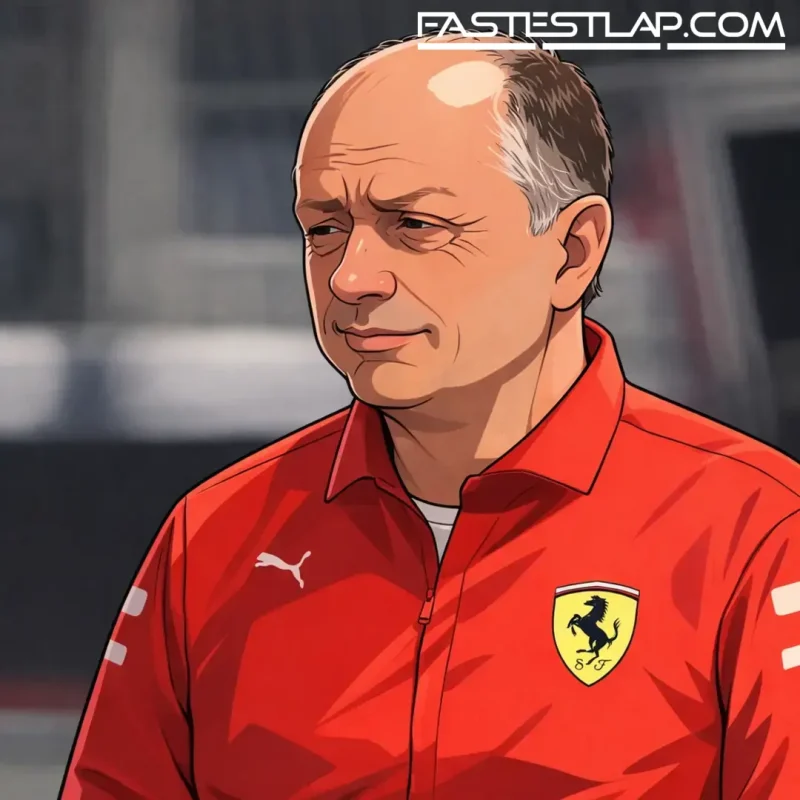
Ferrari team principal Fred Vasseur said he felt more encouraged by Leclerc’s position than he did two weeks ago, even if the team still hadn’t pinned down the root cause of a brake-by-wire issue.
“I’m more positive with Charles than two weeks ago,” Vasseur said. “He had a good feeling with the car, he was in confidence, he was able to fight for the good position yesterday.
“Then the fact that he was starting P10 and we changed his strategy in the middle of the race, it was difficult for him, that he pitted once again one lap before the safety car like it is, but I think the approach and the feeling is much better for Charles today than it was two or three weeks.”
That comment, and the way Vasseur framed it, mattered. It was less about defending the result and more about stabilising the narrative around Leclerc: the feeling is coming back, the approach is improving, the weekend was messy. It’s management language — the kind you use when you know the next question is going to be why one Ferrari looks so sharp and the other looks trapped in its own weekend.
Leclerc, for his part, didn’t attempt to dress it up. He praised Hamilton’s win and the team’s upgrades, then openly admitted he isn’t matching that level.
“I mean, it’s great for the team, it’s great for Lewis,” Leclerc said. “The team has been pushing massively to bring upgrades, and it seems to be working fine, so now I’ve got to be with him up there, which hasn’t been the case in Canada.”
He also made a point of crediting Vasseur and the factory effort behind the scenes, before landing on the emotion that tends to sting the most for a driver: not anger, but disappointment.
“Fred deserves it as much as the whole team has been working massively hard. I’m very happy for them, but surely the main feeling I’ll have getting home is disappointment, because it’s been a very difficult weekend.”
That’s the interesting tension for Ferrari now. The external story is easy: Hamilton is delivering, Leclerc is wobbling, and a big long-term contract has arrived at a delicate moment. The internal reality will be more complex — because Ferrari doesn’t have the luxury of choosing one and sidelining the other. Not with the points on the board, not with the contracts signed, and not with a season still alive enough that momentum can flip again quickly.
But make no mistake: when one driver is scoring nearly two-thirds of the team’s points, the hierarchy starts forming whether the team wants it to or not. Ferrari can insist it’s a two-car operation — it always does — yet the sport has a way of turning “equal status” into “equal on paper” the moment results demand decisions.
For Leclerc, the task is less about proving he deserves the contract — Ferrari already decided that. It’s about stopping the situation from becoming self-fulfilling: Hamilton’s side of the garage becoming the reference, the upgrades being judged through his lens, and Leclerc spending week after week chasing a moving target while the points gap grows. For Hamilton, it’s a different kind of pressure: keep delivering at a rate that makes a 2027 end date feel like an administrative detail rather than an endpoint.
Barcelona gave Ferrari a win. It also sharpened the questions that come with it.