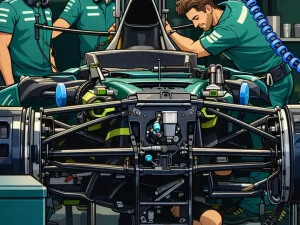
Esteban Ocon didn’t bother dressing it up after Austria. Two laps down, nowhere near the points and wrestling a car that simply wouldn’t stay underneath him as the stint went on, the Haas driver reached for a comparison that landed with a thud in the paddock: it “felt like driving a road car”.
For a team that began 2026 talking up a reset and a clearer direction, Spielberg was another bruising reminder of how far the reality is lagging behind the rhetoric. Haas left the Red Bull Ring empty-handed for the third time this season, and Ocon’s own tally remains stuck at three points — a stark figure when his rookie team-mate Oliver Bearman has already built a 15-point cushion over him.
Ocon’s race had a brief flicker of momentum. Starting 15th, he picked off a few places on the opening lap to run 12th, but that was as good as it got. From there the familiar pattern returned: early promise evaporating into a long, slow bleed of lap time as tyre life disappeared and the car’s balance slid away. The timing of a Virtual Safety Car didn’t help, but it sounded more like an inconvenience layered on top of a deeper issue rather than the decisive turning point.
By the flag, Ocon was 16th and blunt about the scale of the struggle.
“Towards the end of the race,” he said, “I was struggling to keep the car on track.”
The detail he offered was more worrying than the headline-grabbing “road car” line. Haas, he explained, is still chasing rear-end load — and failing to find it. To compensate, the car is being run in a compromised window, effectively forced into trimming the front to prop up a weak rear, which then punishes the tyres. Ocon’s description of the knock-on effect was damning: overheated rear tyres, a stint that feels “fun for nine laps” after each stop, and then a drop-off so severe he ends up needing an extra stop compared to those around him.
In other words, it’s not just that the Haas is slow; it’s slow in a way that wrecks its own race. Even when the team tries to lean into what the car can do, it seems to collapse into the same limitations once the tyres and track evolution move on.
Ocon also pointed out this isn’t a one-off trait emerging in Austria’s heat. He referenced Monaco and Barcelona as weekends that played out in much the same way — suggesting Haas isn’t fighting a circuit-specific weakness, but a fundamental characteristic it hasn’t been able to engineer out of the package.
And then there’s the other headache: whether the car can even get to the end in decent shape. Ocon framed it as two separate problems — performance and “getting my car healthy” — and that distinction tells its own story about how messy his season has been. He went as far as to say that simply finishing would feel like progress, which is a grim bar for any driver with his experience.
Bearman’s debrief was quieter, but it didn’t contradict anything. He called it an “anonymous weekend” and insisted he’d extracted what was there. The subtext was familiar: there’s only so much a driver can do when the car isn’t in the fight. When a rookie is already talking like a veteran about “maximising everything” just to end up buried in the order, it’s usually a sign the team’s problems are deeper than set-up nuance.
Silverstone is next, and Ocon says Haas will “keep pushing hard” there. But Austria had the feel of a weekend where optimism is starting to run out, replaced by something more brittle: the sense that everyone at the track can see the symptoms, yet the cure remains elusive.
For Ocon, the frustration is compounded by the intra-team picture. Being outscored by Bearman by 15 points this early doesn’t automatically tell you who’s driving better — it often reflects who’s had the cleaner Saturdays, the tidier races, the fewer mechanical gremlins. But it does add pressure, and in a midfield where perception can harden quickly, a season that keeps producing “road car” weekends is exactly the sort of narrative a driver wants to kill before it takes on a life of its own.