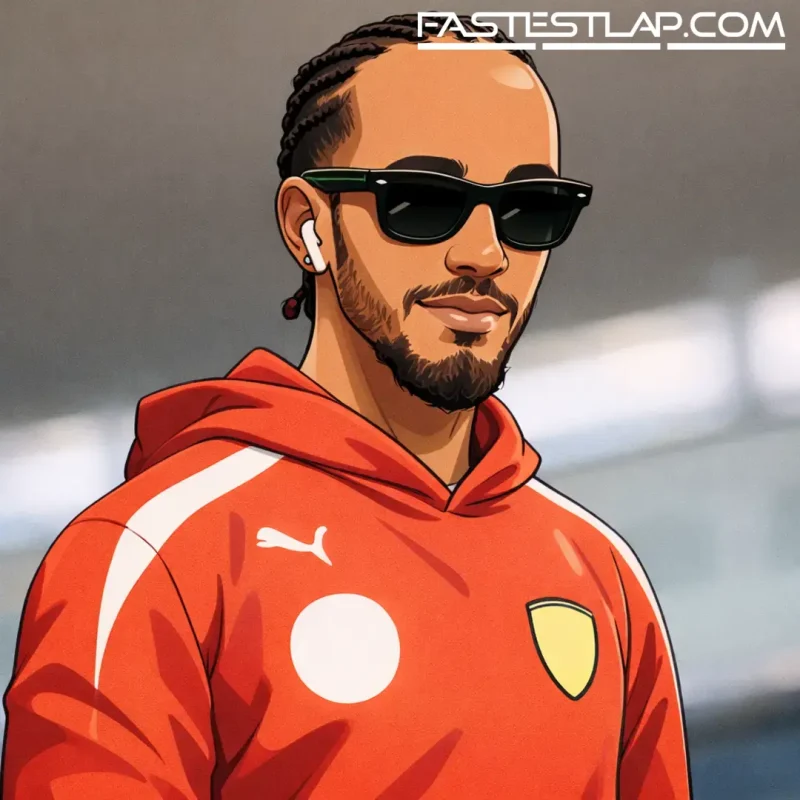
Eddie Irvine isn’t buying the “Lewis Hamilton is back” storyline just yet — and, in fairness, he’s got a pretty straightforward reason for pumping the brakes: Shanghai is Hamilton territory.
Hamilton’s first Ferrari podium came at the 2026 Chinese Grand Prix, a track where he’s a record six-time winner. In a season that’s begun with Mercedes taking all three victories, Ferrari’s early consistency has been the more interesting detail: the Scuderia has been present on every podium so far, with Charles Leclerc third in Australia and Japan before Hamilton joined him on the rostrum in China.
But Irvine, never one to hand out gold stars for sentiment, sees a danger in over-reading one result — particularly when it arrives on a circuit that has long suited Hamilton’s eye and rhythm.
“I wouldn’t take that for granted,” Irvine said when asked whether Hamilton has rediscovered his best form. “In China, he finished on the podium for the first time with Ferrari, but that’s his circuit.
“In Japan, however, he was outclassed by Charles Leclerc throughout the weekend.”
It’s a pointed choice of wording. “Outclassed” doesn’t leave much room for interpretation, and it speaks to the central tension inside Ferrari’s season so far: the team is clearly closer to the front than it was, but the internal pecking order still looks more Leclerc-shaped than Hamilton-shaped across a broader sample.
That matters because Hamilton’s 2026 has been framed — not least by Hamilton himself — as a reset year in mindset and approach after a difficult first campaign in red. The China podium gave that narrative a clean, celebratory moment, and you could sense the relief around him: not just a good Sunday, but something tangible to point at when the noise starts.
Irvine’s argument is that one clean Sunday isn’t proof of a trend. If you’re looking for a more reliable yardstick, Suzuka is a tougher one to dismiss than Shanghai. Japan’s weekend exposed the gap between Ferrari’s two drivers, and it fed the idea that Leclerc still has a more natural handle on what this Ferrari wants from the driver — especially in the messy early phase of a new rules era, when the fastest teams are often the ones who understand their own compromises quickest.
At the same time, the picture isn’t quite as simple as “Hamilton good at China, Leclerc good everywhere else”. Melbourne, for instance, offered a different kind of evidence: Hamilton pressuring Leclerc all the way to the flag, looking far more plugged-in than you’d expect from someone still being judged through the lens of last year’s bruises. It wasn’t a highlight-reel moment, but it was the sort of performance that tends to show you where a driver actually is — present, accurate, irritatingly hard to shake off.
What Irvine is really challenging is the temptation to treat a podium as a verdict. It isn’t. Not in this field, not in a season that already feels like it’ll be decided by development cadence and operational sharpness as much as outright pace. Ferrari’s on every podium, Mercedes has all the wins, and we’re still close enough to the start that one upgrade cycle can redraw the order.
Irvine was also asked whether Ferrari can mount a serious title push this year, and his answer carried a familiar sting: the team’s life outside the UK-based “heart of the F1 world” remains a practical disadvantage, even in an era where remote operations and rapid iteration are supposedly easier than ever.
“It’s always very difficult for the Scuderia,” Irvine said. “The problem is the distance from the heart of the F1 world, which is the UK.
“Compared to last year, though, I think they can secure at least one victory.”
That’s a smaller prediction than Ferrari fans will want, but it’s grounded in the reality of where the team sits right now: close enough to matter, not yet positioned like the one setting the pace. And with Mercedes bankrolling the points haul at the top, “close enough” quickly becomes “running out of weekends” unless you start turning podiums into wins.
For Hamilton, the question isn’t whether he can still produce a weekend like China. He clearly can — and he’s argued as much, saying the Shanghai result showed he can still fight at the front. The harder question is whether Ferrari can give him a car that lets him do that often enough to make the conversation boring. One podium can be a spark; a run of them is proof. And in 2026, the sport has a habit of punishing anyone who confuses the two.
In other words: time will tell. Irvine’s just making sure nobody declares the verdict after the first encouraging chapter.