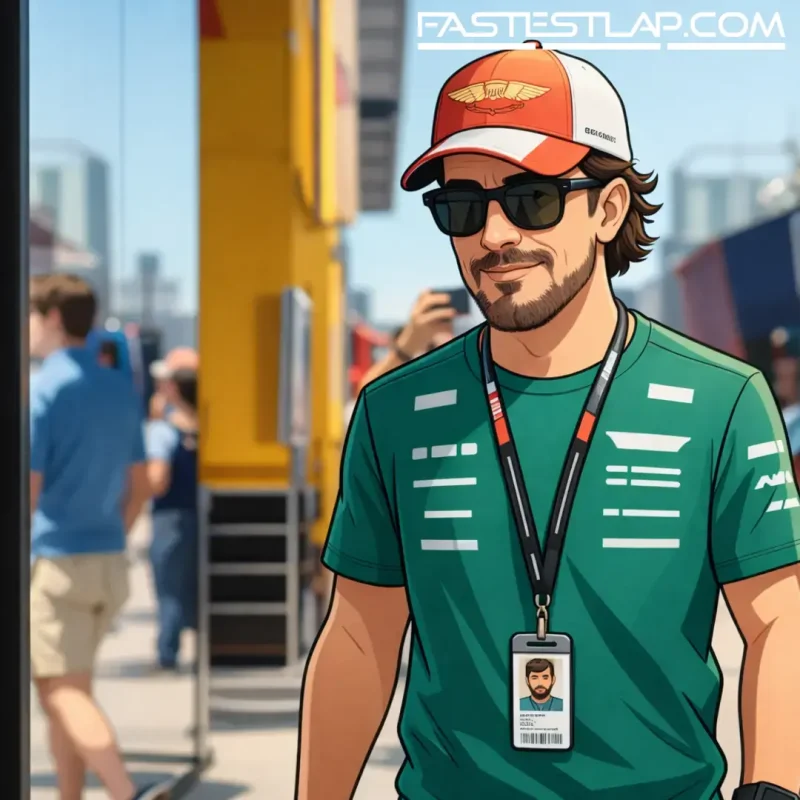
Fernando Alonso has never been shy about revisiting old chapters, but the latest paddock noise suggests he might be considering something even by his standards: another return to Enstone.
With his Aston Martin deal expiring at the end of 2026, the 44-year-old is weighing up what comes next — and, increasingly since Miami, the talk in the garages has pointed back towards Alpine, the team with which he won both of his world titles and a hefty chunk of his grand prix victories.
On the face of it, it’s the sort of rumour that should die quickly in a serious news cycle. Alonso has been down this road before, Alpine has been down this road before, and both parties know exactly how complicated “the romantic option” tends to become the moment it hits the contract clause stage. Yet this one isn’t going away, largely because the circumstances around Alpine have shifted.
The biggest change is political, not lap-time. Flavio Briatore is back around the operation as a consultant on behalf of the Renault Group board — and, crucially, he’s still Alonso’s manager. In F1, alignment matters. When the person with the sharpest elbows in the room is also the conduit to the driver, conversations that might otherwise be hypothetical can move quickly.
Briatore’s influence is also understood to have been central in Gucci’s planned arrival as Alpine’s title sponsor for 2027. That kind of commercial momentum doesn’t just make a team look healthier on paper; it creates the sense of a project moving forward, of a narrative that sells. If Alpine is repositioning itself for the next cycle, then the idea of Alonso returning as the headline act for what would almost certainly be his final contract suddenly becomes more than nostalgic gossip — it becomes a marketable strategy.
Alpine’s on-track trajectory helps, too. Since switching from its own power unit to a Mercedes customer supply, there’s been an uptick in performance, and it’s been visible enough for the rest of the grid to take it seriously. Pierre Gasly’s third place in Monaco underlined it: Alpine’s first podium since the surprise two-three at the 2024 São Paulo Grand Prix.
In a year where the midfield is constantly being re-shuffled by form swings and development hits, Alpine has started to look like a team with an upward slope rather than a flat line. That matters when you’re selling a seat to a driver who has always been brutally honest about what motivates him: competitiveness, not sentimentality.
It’s why Alonso’s name isn’t the only one being floated. With seats and contracts across the grid tightening and loosening in pockets, Alpine has been linked with other out-of-contract options such as Alex Albon and even George Russell. But Alonso is the name that sticks, because unlike the others his move has a ready-made internal advocate — and because it would complete a circle that F1, for all its cynicism, still enjoys drawing.
The question, of course, is who makes room.
Gasly signed a new Alpine deal last September that runs through to the end of 2028, so the speculation naturally lands on Franco Colapinto. The 23-year-old Argentinian is on a one-year contract and, while he had a rough stretch late last season, he’s been notably better recently and has already scored points three times in 2026. That’s the inconvenient detail in all of this: Colapinto is starting to give Alpine reasons not to treat him like a placeholder.
If Alonso becomes a genuine option, Alpine would have to decide what it wants its short-term identity to be. Do you back a younger driver who is trending upwards and could still be moulded into a long-term asset, or do you seize a one- or two-year window with one of the most complete racers of the modern era — a driver who brings not just pace but an entire ecosystem of attention, pressure and expectation?
It’s also not a straight “Alpine good, Aston bad” call. Alonso may be outperforming Lance Stroll again, but Aston Martin’s current form has them stuck towards the back, and that inevitably colours any conversation about his future. Alpine, right now, would look like an immediate performance upgrade.
Yet there’s a strategic trade-off in the background. Leaving Aston Martin would mean walking away from a factory-style works identity in favour of a customer set-up, while Aston Martin’s future is tied to its Honda power unit agreement. For a driver making what could be his final move, the question isn’t simply where the car is today, but which project gives him the best chance of being relevant when the next performance order settles.
Alonso has always framed his retirement logic in simple terms: he’ll stop when he no longer feels competitive. He turns 45 next year, he’s already the oldest driver on the grid, and he’s the most experienced in the championship’s history. There’s no appetite from him to hang around as a ceremonial figure, and no reason to think he will.
That’s why an Alpine return is such an intriguing proposition. It would be his fourth stint with the Enstone team — Renault in 2003-06, back again in 2008-09, then Alpine in 2021 before departing for Aston Martin in 2023 — and it would place him back with the organisation that delivered the 2005 and 2006 titles and 17 of his 32 wins.
But the appeal isn’t just the scrapbook. It’s the possibility that Alpine is finally turning into something coherent again, at the same moment Alonso has the leverage of an expiring contract and a manager with real influence inside the team’s orbit.
None of this makes it a done deal. It does, however, explain why the rumour has teeth. In modern F1, the moves that happen aren’t always the neatest on a spreadsheet — they’re the ones where timing, politics and ambition line up for long enough to get a contract over the line. Alonso to Alpine, again, is starting to look like one of those moments where the impossible becomes discussable.