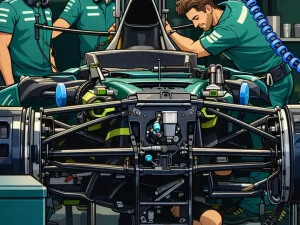
Fernando Alonso didn’t need to look at lap time sheets in Austria to know where Aston Martin stands right now. All he had to do was open the FIA’s Friday update document — and watch the list of new parts balloon again.
In a season where the 2026 regulation reset has turned development into a weekly arms race, Aston Martin has chosen a notably different rhythm. The AMR26 is the first Aston designed under Adrian Newey’s leadership, but rather than drip-feeding small revisions, the team has been working towards a larger, more comprehensive package. Meanwhile, rivals keep arriving with fresh bodywork, floors and aero trims as if the cost cap were a rumour.
Austria underlined the contrast. Red Bull turned up with a sizeable seven-part package, and Cadillac — one of Aston Martin’s most direct targets in the midfield fight — rolled out a hefty 10 updates, all pitched as performance-related. It’s the kind of churn that makes a team sticking to a “big bang” upgrade plan look either disciplined… or dangerously static.
Alonso, never one to let a narrative pass unchallenged, bristled at the suggestion that he’d simply nodded along with Aston Martin stepping away from the upgrade skirmish.
“I didn’t agree, but apparently there is no money to bring upgrades, unlimited upgrades, like the other teams do,” he said in Austria. “It’s surprising to see the FIA page on Friday every race.
“Maybe they have the money machine in the minus one [floor] in the factory.”
It was classic Alonso: a joke with teeth, aimed less at any one team than at the sheer volume of declared changes appearing every weekend. Yes, spending is governed by a cost cap across all 11 teams, but Alonso’s point was obvious. In a year where everyone is learning fast and making mistakes in public, the teams able to iterate most quickly look like they’re playing a different game.
Still, he was careful not to turn the sarcasm into an internal critique. Asked directly whether he doubted Aston Martin’s approach — particularly with the team spending most Sundays in the wrong half of the field — Alonso insisted he hadn’t questioned the decision.
“No, I didn’t question it,” he said. “Because obviously we don’t know exactly the cost cap limitations and how much is going to change in the car, and the time that was needed to understand the problems.
“It’s not that you can trial and error with some of the upgrades, so I think we took the first three or four races to really understand our weaknesses and our limitations, to start testing on the wind tunnel solutions, to see also the other cars what kind of solutions they implement, and which ones are working.”
That explanation gets to the heart of Aston Martin’s gamble. Under a new ruleset, the temptation is to chase every tenth as soon as it appears. But if the car’s baseline concept is flawed — or simply poorly understood — piling on incremental parts can become expensive noise. Aston Martin’s argument, as framed by Alonso, is that it needed early-season races to diagnose the AMR26 properly before committing resources to the “right” development direction.
He referenced the uncomfortable start to the year: missing the Barcelona upgrade window, a troubled opening test in Bahrain, and a stark realisation in Australia about how marginal the situation was. By the time the team had absorbed that reality, the decision had effectively been made: stop trying to patch small gains onto a package that wasn’t delivering, and focus on something more transformative.
“The decision was made, and I think it’s the right decision,” Alonso said.
There’s also a cold competitive logic in what he added next — the part that sounded less like a driver defending his team and more like someone who understands resource allocation under the cap.
“For us, it doesn’t change to bring three or four tenths in a couple of grand prix, and still be fighting at the back. We need something bigger than that.”
It’s an admission that Aston Martin’s current trajectory isn’t being solved by a new winglet here or a minor floor tweak there. If the AMR26’s ceiling is too low, marginal gains just rearrange the order of the same problems. The bigger update, whenever it lands, has to shift the car into a different performance bracket altogether — otherwise it’s simply catching up to where others already are.
For now, the results are thin. Alonso has scored Aston Martin’s only point of the season so far, a P10 in Monaco, and he’s also pushed back publicly on what he described as “borderline abuse” in the way Aston Martin’s struggles have been discussed. That context matters: when you’re having a rough start under a brand-new technical regime, it doesn’t take much for a team’s credibility to become a paddock punchline.
Alonso’s message in Austria was essentially a plea for patience — but not a soft one. He’s not pretending the car is fine, and he’s not hiding behind vague optimism. He’s pointing to a deliberate strategy, insisting the factory is “working flat-out”, and warning against writing Aston Martin off before Newey’s first full swing at the problem has even arrived.
“We don’t know yet the results, and we don’t see the result yet,” Alonso said, “but we cannot underestimate Aston Martin as much as has been done in the last few weeks.”
If the big package delivers, Aston Martin can sell this as discipline in the face of a development frenzy. If it doesn’t, Alonso’s “money machine” line will age into something sharper: a reminder that in modern F1, waiting for the perfect upgrade can look a lot like falling behind.