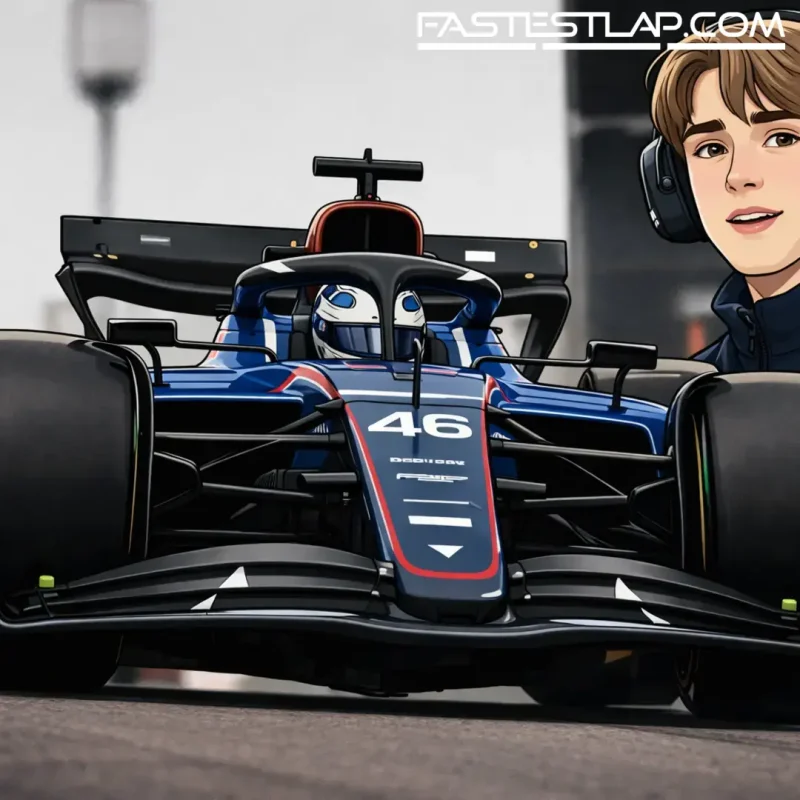
Williams will hand Luke Browning the keys to Alex Albon’s car for FP1 at this weekend’s Spanish Grand Prix, giving the team’s reserve driver his first taste of the new-generation 2026 machinery in a live grand prix environment.
It’s a neat bit of timing. With the regulations reset still fresh — and with everyone, including the full-time race drivers, only a handful of race weekends into understanding where the lap time really lives — Williams’ rookie outing in Barcelona isn’t just a box-ticking exercise. It’s one of those sessions where the normal pecking order of “experienced race driver versus Friday stand-in” is slightly blurred, because the grid is still learning the same things.
Browning’s Spain run is also the first half of a two-part plan: Williams has confirmed he’ll take another FP1 next month in Austria, that time stepping into Carlos Sainz’s seat. Under the current rules, each team must run a rookie in four FP1 sessions across the season, with each race driver sitting out twice. Williams hasn’t said yet whether Browning will complete the set or whether it will rotate other names later in the year.
For Browning personally, this is less about novelty than it looks on paper. The 24-year-old has already logged four FP1 sessions with Williams across previous seasons and has done the end-of-year young driver tests in both 2024 and 2025. What changes in Barcelona is the car: Spain will be his first proper mileage in the 2026-spec machine, a different technical world to the one he’s previously sampled.
His recent racing CV is strong enough to make these Fridays feel like more than a courtesy. Browning finished fourth in last year’s Formula 2 championship and has kept himself sharp in Japan’s Super Formula this season with Kondo. It’s a smart bridge category for anyone eyeing F1: fast enough to demand proper commitment, technical enough to force a driver to work with engineers rather than simply drive around problems, and physical enough to keep the neck honest.
Browning isn’t pretending these sessions don’t matter, either. Asked whether he’s treating them as an audition, he was candid: the lap time isn’t the only currency on a Friday, but he wants to show he’s ready if a seat ever opens up.
“There’s no pressure necessarily on lap times, but it’s just showing that I’m ready to get in a seat if I’m needed,” he said. “That’s not necessarily pressure from above, that’s just what I apply about myself.”
That last line is the tell. Williams’ driver line-up is currently locked in with Albon and Sainz, but in Formula 1 “locked in” is rarely as absolute as it sounds once performance swings, market pressure, and opportunity elsewhere start tugging at contracts. Browning knows he’s not just gathering experience; he’s trying to position himself as the obvious internal answer if Williams needs one.
What makes Spain particularly interesting is Browning’s point that the 2026 reset gives rookies a more realistic shot at looking credible quickly. Last year’s FP1 outings, he argued, came in the mature phase of a set of regulations — teams had spent seasons polishing details, building reference libraries, and developing established driving habits. Dropping in for an hour meant chasing a moving target with years of momentum behind it.
Now, it’s closer to a blank canvas.
“The really exciting part for me is that it’s a clean slate,” Browning said. “Okay, they’ve had the preseason testing in Barcelona, but the opportunity for rookies now getting in is quite exciting, because we’re not having to unlearn anything, unlearn braking points.”
He even reached for a gamer’s analogy — “a new skill tree” — which, in its own way, captures the mood around the paddock when a new formula lands. Everyone is still deciding what the ‘right’ way to drive these things even looks like.
Of course, “clean slate” cuts both ways. Browning is stepping into a car that the race drivers are still mapping out, while also navigating the operational reality of FP1: experimental run plans, aero rakes and correlation tests, and the subtle pressure of not being the person who interrupts the weekend before it starts. The brief is to be useful to the team first, impressive second — and, ideally, both at once.
He doesn’t sound overawed by the complexity, though. Browning pointed to the tools now available to rookies — namely the simulator — and suggested that while the new driving dynamics have created plenty of chatter, the concepts are manageable if you’ve been properly brought up to speed.
“There’s probably talk about it being difficult or being very complicated but the way it’s been explained to me, it’s quite simple, to be honest,” he said. “I feel like I’m on top of it all in the simulator.”
His broader preparation has been deliberately varied. Alongside Super Formula, Browning’s been running Williams’ testing of previous cars programme in older machinery, including recent outings in a 2025-spec car at Budapest and Monza. He’s under no illusion that it’s a straight translation — different tyres, different generation, different behaviours — but he sees value in the sheer volume of driving, and in the mental adaptability required to jump between platforms.
“I’m a busy boy,” he laughed. And it’s hard to argue. Super Formula one week, older F1 cars the next, then an FP1 in the current car with all the 2026 energy management work layered on top — it’s a schedule designed to build a driver who can be dropped into almost anything and find his feet quickly.
Barcelona will still be just one session, and one where the stopwatch isn’t the only measure of success. But in a season where everyone is still deciphering the new rules, the rookies who look calm, coherent and immediately helpful can move the perception needle faster than usual.
For Browning, that’s the whole point. The opportunity may not be his to choose — but being ready absolutely is.