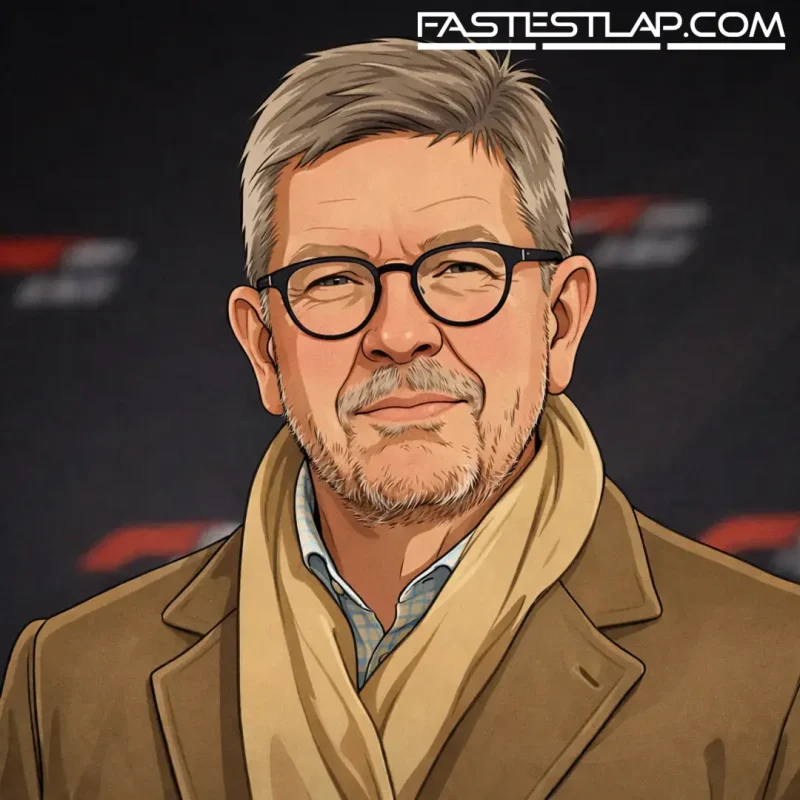
Ross Brawn isn’t the type to come back to the paddock with a fanfare. He’s also not, as it turns out, the type to stay away from racing for long. Four years after stepping away from his Formula One Management role at the end of 2022, the 71-year-old has taken on a fresh brief — joining the board of directors at MotoGP outfit Pramac Racing.
It’s a move that makes sense in the wider drift of the sport. Since Liberty Media completed its takeover of MotoGP last year, the gravitational pull between its two flagship properties has only strengthened, and Brawn is precisely the sort of operator Liberty has always valued: a political heavyweight who speaks fluent “performance”, understands governance, and can translate big-picture change into something teams can live with. Pramac, meanwhile, gains a rare commodity in modern racing — calm institutional knowledge — at a time when top-level series are increasingly run as much in meeting rooms as they are on track.
Back in Formula 1, the Canadian Grand Prix left plenty to chew on, not least because it offered the clearest look yet at how Lewis Hamilton is shaping his Ferrari era — not just driving it. Data from Montreal suggests Hamilton’s pass on Max Verstappen was effectively drawn up a lap in advance, with a deliberate tweak in energy harvesting on the start-finish straight and a subtle reprofile of his approach to the final chicane before he emptied the electrical deployment into Turn 1. It was classic Hamilton: patient, forensic, and executed with the kind of timing that makes an overtake look inevitable after the fact.
Canada also delivered Hamilton his best result since moving from Mercedes to Ferrari at the start of 2025 — a second place that carried a little extra bite given who he went around. These are the sorts of moments that do more than fill a highlight reel; they set an internal benchmark. Ferrari didn’t bring Hamilton in to be a name on the timing screen. They brought him in to impose standards, and Montreal looked like a weekend where that influence became hard to ignore.
Charles Leclerc certainly didn’t hide from it. He called Canada “probably the most difficult weekend of my Formula 1 career” after being convincingly outperformed by his team-mate and finishing a distant fourth, more than 30 seconds back. That’s a savage margin between two drivers in the same car, on a circuit where Hamilton has always been a reference point. And it matters because it’s not just one bad Sunday — it’s a psychological hit in the middle of a season where momentum and belief are increasingly valuable commodities.
The numbers sharpen the picture: Leclerc and Hamilton are now level on two podiums apiece in 2026. On paper, that looks balanced. In reality, Montreal didn’t feel like a draw inside Ferrari. It felt like a weekend where one side of the garage had a plan and the other spent the race chasing clarity.
If Ferrari left Canada with mixed emotions, McLaren left it with an unmissable bruise. Their call to start Lando Norris and Oscar Piastri on intermediates — third and fourth on the grid respectively — was a gamble shaped by rain in the area. The problem was that the rain never really turned up in the way they needed, and the experiment was abandoned quickly once it became clear the track wasn’t going to reward it.
Verstappen, never one to pass up a well-timed needle, described it as a “great call” — the kind of dry compliment that lands because everyone knows what he actually means. The consequence was bigger than a few lost places: it handed Red Bull-Ford an opening to snatch its first podium of the partnership. In a season where Red Bull is fighting for any kind of foothold, you don’t need many gifts like that — but you’ll take them all the same.
And then there’s the championship picture, which is starting to harden into something that looks uncomfortably straightforward. George Russell’s first retirement of the year, triggered by a battery issue on his Mercedes W17, wasn’t just a personal gut punch — it was a title swing. Kimi Antonelli capitalised with a fourth consecutive win and now holds a 43-point advantage.
Russell didn’t try to dress it up afterwards, admitting the 2026 title is now Antonelli’s “to lose”. It’s a striking thing for a driver to say in public, and it speaks to the shape of the season as much as any points table does. Russell knows how quickly a narrative can flip in Formula 1 — but he also knows what kind of run you have to be on to make rivals start talking in those terms by June.
The wider theme from Canada, though, wasn’t just who won and who blundered. It was how quickly the competitive landscape is being defined by decision-making: Hamilton’s premeditated pass, McLaren’s weather bet that didn’t land, Mercedes’ reliability wobble at the worst possible time. In 2026, it’s starting to feel like the margins aren’t living only in lap time — they’re living in judgement. And right now, Antonelli’s the one making everyone else pay for theirs.