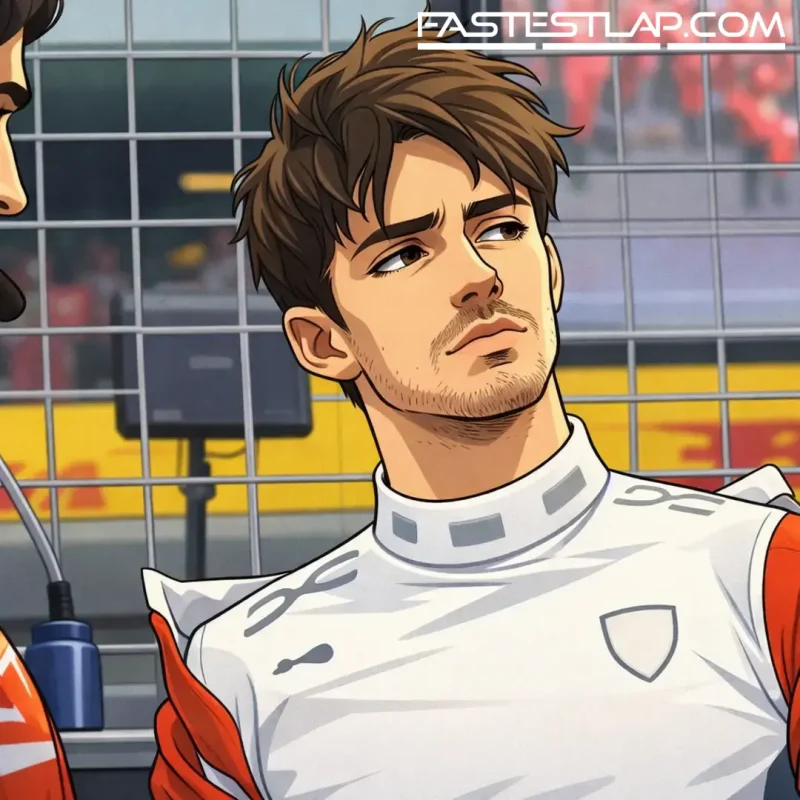
Charles Leclerc’s been around Formula 1 long enough now to know where the real noise lives. It isn’t always in the cockpit at 300km/h. Sometimes it’s the 20 minutes when the car’s stationary, the visor’s up, and the grid is a moving crowd scene that has to be navigated with the same precision as Turn 1.
Speaking on the BSMT podcast, the Ferrari driver described the pre-race grid as “one of the most difficult things” to handle in the sport — not because the steps are complicated, but because the environment is designed to be anything but calm.
“To enter the grid, I think that’s one of the most difficult things in our sport,” Leclerc said. “We do two or three laps to go to the grid, then we stop on the grid, we get out of the car. We have, I think, about 20 minutes more or less to get out of the car, talk to the engineers, do the last brief, and then get back in the car.
“In those minutes on the grid, there are thousands of people, obviously there are sponsors, sometimes there are some fans that ask you for photos and to talk. But in that moment, for me, it’s full of all the information I need to have for the whole race. So it’s fundamental for me to stay in my own bubble, and that’s the hardest thing.”
Anyone who’s spent time in a paddock will recognise the truth in it: the grid is where Formula 1’s competing identities collide. It’s a high-performance workplace, a television set, and a hospitality corridor all at once. The mechanics are trying to make sure the car is exactly where it needs to be. Engineers are firing off last-minute reminders. Broadcasters want a quote that will survive the first lap. VIPs want their moment. Sponsors want their shot. And the driver has to process all of it while holding onto the mental thread of tyre behaviour, brake temperatures, clutch bite, start procedure, and the opening stint plan.
It’s not that Leclerc is complaining about attention. It’s that he’s explaining the cost of it — the concentration tax you pay right before the one moment in the day where a tiny lapse can undo a weekend.
Leclerc, now in his ninth season in F1 and an eight-time race winner, said the grid environment was a shock when he stepped up from Formula 2, where a driver can largely slip through the build-up unnoticed.
“I had to change my approach from Formula 2 to Formula 1,” he said. “In Formula 2 nobody knows you. You did your whole career quietly, you got into the car and that was it.
“Then you arrive in Formula 1 and there are hundreds of thousands of people around. That was very difficult to manage in the first races, then you adapt to everything, but this is something particularly difficult.”
It’s the kind of detail that’s easy to underestimate from the outside, because fans see drivers as performers who must be permanently “on”. But the modern grid is less a pre-race tunnel and more an open-plan office where every desk is surrounded by cameras. For the top drivers — and especially those at Ferrari — there’s nowhere to hide, and the pressure to be presentable never quite stops.
That’s why routines matter, and Leclerc admitted he leans on one heavily. Not for superstition’s sake, but because it gives him something stable when everything around him is moving.
“I’d say about 30 minutes before getting into the car to do the two or three laps that take you to the grid. I have a routine that I practically always do, more or less the same, with a cold shower, physical warm-up, etc,” he explained. “By always doing the same things, it helps me to reset and get back to the same mental state I need to get in.”
It’s a telling glimpse into how drivers manage the parts of racing that aren’t “driving”. We talk endlessly about set-up directions, strategy calls and tyre models, but the sport’s biggest stars are also trying to control a very human thing: attention. They need enough openness to function inside a team sport, enough accessibility to survive the commercial reality of F1, and enough isolation to execute a job that demands brutal focus.
The irony is that the grid looks like the glamorous bit — the place where the sport sells itself. For the driver, it can be the most vulnerable moment of the entire weekend. The car isn’t moving, so the mind has space to race ahead. The crowd is close. The schedule is tight. And once the helmet goes back on, there’s no resetting anything.
Leclerc’s point, really, is that the work starts long before the lights. The hardest part isn’t always the lap you see. Sometimes it’s building the bubble before you need it most.