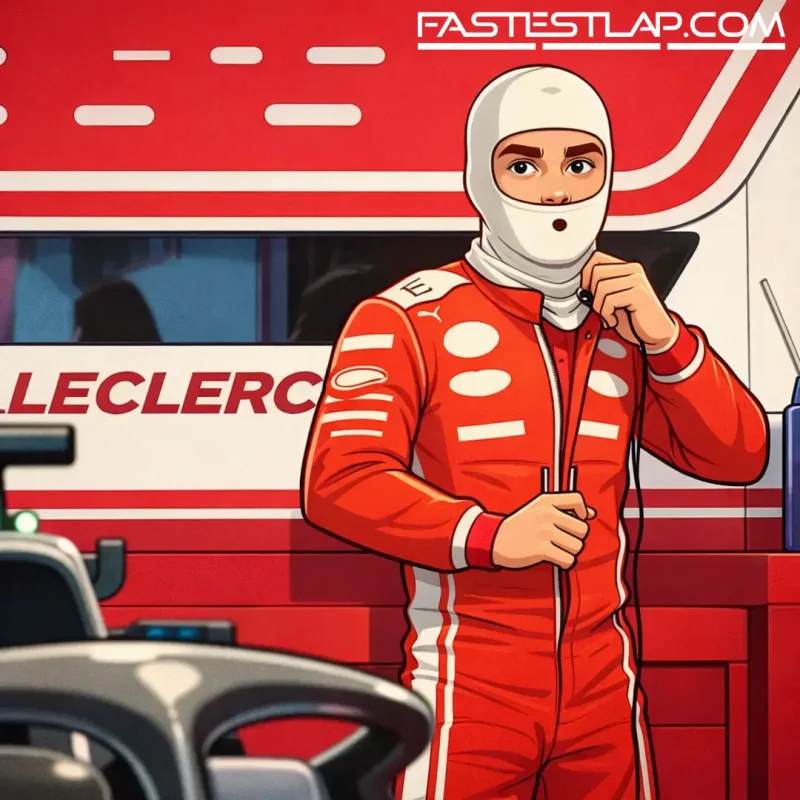
Charles Leclerc has heard the Monaco hype before. Usually it arrives wrapped in certainty — the assumption that a driver who’s grown up threading a road car through the Principality’s alleyways must be the default pole favourite the moment the calendar turns to Monte Carlo.
This week, the noise has returned with added volume because it’s not just fans doing the talking. Both Lando Norris and Kimi Antonelli have been happy to point the finger at Ferrari as the one to beat around the barriers, with Norris even suggesting the red cars will simply stick it on pole.
Leclerc’s reaction, when that was put to him, was telling: a laugh, then a quick reminder that “I don’t know if you can bet.” It was more than a throwaway line. In a season where Ferrari has yet to start a Grand Prix or a Sprint from P1 — and hasn’t won either format — there’s a fine line between optimism and wishful thinking. Leclerc, perhaps more than anyone, knows Monaco punishes the latter.
For all the talk about his “Monaco curse”, the scars are real and specific. There was 2021, pole at home and then a brutal post-qualifying discovery that he wouldn’t even start because Ferrari found gearbox damage traced back to his late Q3 crash. In 2022 he did everything required on Saturday again, only for Ferrari’s strategy to unravel in full public view on Sunday: called in, then told to stay out after he’d already committed, then stacked behind Carlos Sainz. Leclerc called it a “freaking disaster” at the time — and it’s hard to argue.
Even his long-awaited Monaco victory in 2024 came in conditions that turned the race into an exercise in control rather than combat. The early red flag reshuffled the normal rhythm of the Grand Prix, everyone effectively took their tyre change under stoppage, and the afternoon became a slow-burn procession. Leclerc managed it perfectly, winning in 2h23m15, but it wasn’t the kind of Sunday that rewrites the laws of probability for the future.
So when rivals frame Monaco 2026 as Ferrari’s weekend, Leclerc is pushing back — not because he doesn’t think Ferrari can be quick there, but because the championship has taught him to respect what’s been consistently in front of them.
“We need to be careful,” he said, and his reasoning wasn’t complicated. Mercedes, in his view, is the complete package with the W17: strong through corners, strong on the straights, and — crucially for Monaco — robust enough across the lap that you don’t need the perfect set of circumstances to unlock the time.
That’s the subtext behind Leclerc’s caution. Monaco isn’t only about slow-speed mechanical grip and bravery anymore; it’s about arriving with a car that’s predictable on the limit, that switches its tyres on without drama, and that gives the driver confidence to live millimetres from the walls for an entire qualifying session. If Mercedes has been “very, very, very strong” and “all-rounded”, as Leclerc put it, that matters even in a venue that’s supposed to scramble the usual hierarchy.
Still, Leclerc didn’t hide from the obvious: if Ferrari is going to grab a pole this season, Monaco looks like the most plausible shot. “If there’s one race this year where I feel we could have more of a shot at pole, [it] will be Monaco,” he said. That’s not the same as accepting the “team to beat” label — it’s simply acknowledging that the calendar does, occasionally, offer you a lifeline.
The broader context isn’t flattering for Ferrari. Six rounds in, the numbers are stark: no pole positions in any qualifying format, and no wins. Mercedes has swept the big Saturday moments apart from Miami’s Sprint, where Norris started first. In the constructors’ table, Ferrari is still hanging on to second, but 147 points leaves them 72 adrift of Mercedes, with McLaren third on 106.
In other words, this isn’t a Ferrari that turns up to Monaco with swagger. It’s a Ferrari turning up to Monaco with need — for a statement weekend, for a clean execution, and for one of those Saturdays where Leclerc’s feel for the place actually converts into something tangible before the racing even begins.
And that’s why Leclerc’s tone matters. He’s not trying to dampen expectations for the sake of it; he’s trying to protect the weekend from the kind of narrative that tends to grow legs in Monaco. One brush with a barrier, one mistimed call, one small operational misstep — and the whole thing collapses, as he’s learned the hard way.
If Norris and Antonelli want to back Ferrari as the favourite, that’s their prerogative. Leclerc’s been around long enough to know Monaco doesn’t hand out results based on reputation, even local ones. It asks you to earn everything twice — once on Saturday, then again through the slow, unforgiving hours on Sunday when there’s nowhere to hide from your own decisions.