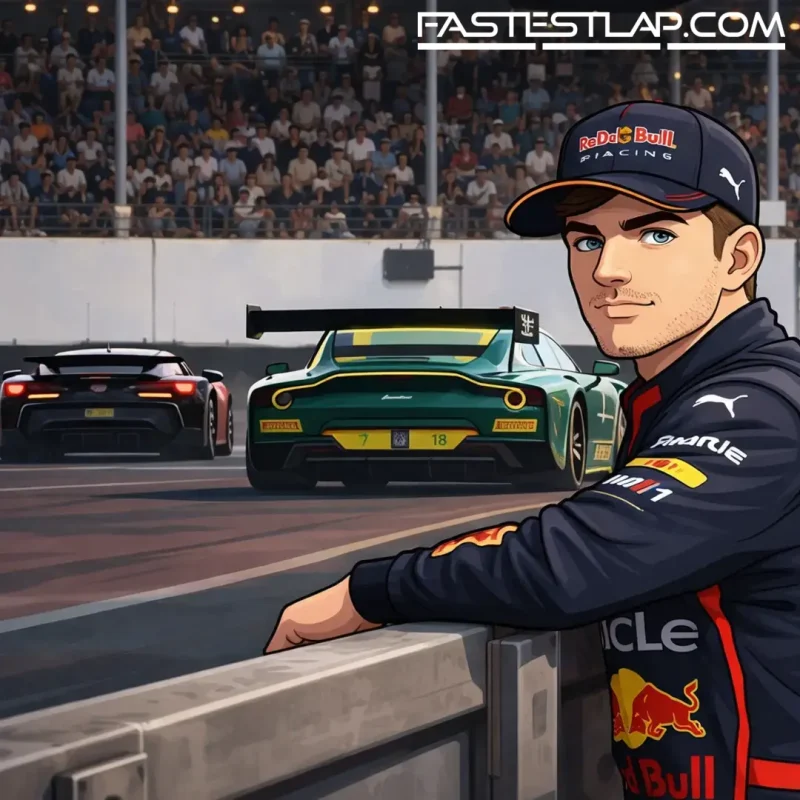
April has offered Formula 1 an unusual sight: two current drivers spending what should’ve been prime season prep time climbing into GT3 cars instead.
Lance Stroll quietly slipped into a six-hour GT World Challenge outing at Paul Ricard with Comtoyou Racing, while Max Verstappen has also been sampling GT machinery during this unplanned mid-season pause. And with two race weekends wiped off the calendar, the paddock’s favourite hypothetical has suddenly become a real-world prompt: if there’s daylight in the schedule, should more F1 drivers be allowed to go racing elsewhere?
Stroll’s weekend is a neat snapshot of both the appeal and the pitfalls. By most accounts he was competitive in his stint, but Comtoyou’s race unravelled under penalties that dumped the crew out of the victory conversation. That, in itself, is part of the point. GT racing doesn’t hand anything out because you’ve got an F1 superlicence. Different procedures, different traffic management, different expectations in a multi-driver format — and a different kind of scrutiny when things go wrong because the margins are often governed by regulations rather than raw lap time.
Verstappen’s interest, meanwhile, is hardly a secret to anyone who’s watched him over the last few years. The fascination with driving “anything with four wheels” isn’t PR; it’s the kind of compulsion that tends to define the very top end of the sport. And when the calendar unexpectedly loosens its grip, it’s no shock that the most restless characters are the first to start looking for a steering wheel elsewhere.
The romantic version of this story is simple: motorsport’s best should race more, in more places, against more specialists — and prove it. That’s the line F1 itself has always flirted with, even as it’s become increasingly protective of its own ecosystem.
History backs up the romance. F1 drivers once treated the season as just one pillar of their year, hopping between disciplines because the schedule allowed it and the culture encouraged it. But the modern reality is a different animal. The calendar has swollen, the commercial obligations have multiplied, and the physical and mental load is heavier than most fans see. Even if a driver has a free weekend on paper, teams know it rarely functions like one.
And that’s before you get to the two things team principals care about most: risk and control.
Risk is obvious. A current F1 driver getting hurt in a non-championship event is the nightmare scenario that sits behind every “maybe” conversation. It’s the same logic that makes certain forms of training and leisure activities quietly frowned upon. Control is subtler but just as real. An F1 driver today is part athlete, part brand asset, part technical feedback loop. Teams spend fortunes optimising their year — physically, logistically, psychologically — and an external racing commitment is, by definition, an element they don’t fully own.
That’s why Fernando Alonso’s 2017 Indianapolis 500 cameo still stands out as the last properly high-profile example of a current driver stepping outside the bubble with their F1 team’s blessing. Even then, it came with a huge asterisk: McLaren’s F1 campaign that year wasn’t exactly pulling Alonso towards Sunday afternoons with title stakes. Had it been a front-running situation, you suspect the “permission” conversation looks very different, regardless of what anyone says publicly.
Stroll’s own résumé shows the more manageable route: races like the 24 Hours of Daytona, which take place in January and don’t collide with the F1 schedule. That kind of outing is easier for teams to tolerate because it sits in a part of the year already earmarked for conditioning, seat time and sponsor-facing activity. In-season appearances are what make executives twitchy — not because they hate racing, but because they hate uncertainty.
Still, this April gap has exposed a truth F1 doesn’t always like admitting: drivers are racers first, and the best of them often need to race to feel sharp. GT3 machinery isn’t an F1 car, obviously, but it offers something the simulator can’t replicate — the messy, compromised business of sharing track with a mixed field and fighting for position without the certainty of perfect information. In a world where F1 weekends can feel choreographed down to the minute, there’s value in dropping a driver back into an environment that demands improvisation.
There’s also a fan-facing upside F1 could do with embracing. The sport sells its grid as an assembly of the best drivers on the planet. Letting them occasionally measure themselves in other arenas — especially ones packed with specialists who’ve built entire careers in a single category — would be a compelling, organic way to reinforce that claim. It’s not about “proving” F1 is superior; it’s about celebrating how adaptable elite drivers can be when they’re taken out of their comfort zone.
But the counterargument remains stubbornly practical: time. Modern F1 isn’t only the races. It’s the travel, the debriefs, the marketing, the fitness work, the engineering briefings, the constant technical evolution. A driver can be “free” for a weekend and still be behind on the kind of preparation that quietly wins tenths. Add in the reality that some teams will be developing hard through 2026 while others are juggling long-term priorities, and the tolerance for distractions will vary wildly.
So should more current F1 drivers follow Stroll and Verstappen’s lead when the calendar unexpectedly opens up?
If you’re a purist, it’s hard not to like the idea. It makes drivers happier, keeps them race-hardened, and gives the wider motorsport world moments that cut through the usual F1 noise. If you’re running a team, you probably want strict guardrails: the right events, the right cars, the right insurance, and the right timing — with a veto ready to deploy the moment a championship fight tightens.
This April has reminded everyone that the appetite is there. The real question is whether F1’s modern machinery — commercial, political and logistical — can ever allow that appetite to become something more than a rare anomaly.