Miami’s never needed much encouragement to turn a Grand Prix weekend into a weather story, but 2026 has pushed the FIA into spelling out — in unusually explicit terms — how it intends to keep the show on the road if lightning starts popping around Hard Rock Stadium.
With thunderstorms forecast to arrive at the worst possible time, officials have already made the most meaningful move available: shifting Sunday’s race start from 4pm to 1pm local time, a decision taken jointly by the FIA and Formula One Management to get ahead of the heaviest cells predicted later in the afternoon. It’s a pragmatic play, and it tells you plenty about how seriously the organisers are treating the local constraints.
Those constraints are the real headline. Miami operates under regulations that require a “shelter in place” response if a lightning strike occurs within six miles of the circuit. In F1 terms, that isn’t a vague recommendation or a polite request to be careful — it’s a hard trigger that forces the event to stop. The FIA’s position is straightforward: if that threshold is met, the race will be red-flagged. Everything else flows from there.
In practice, the established approach is that personnel must remain sheltered for 30 minutes after the last strike. The FIA hasn’t needed to lean on those procedures often in recent years, but Miami’s geography and spring climate make this one of the few venues where a lightning plan isn’t just a box-ticking exercise. It’s why the governing body has issued a detailed framework for both pre-race and in-race disruptions, aimed as much at operational clarity as it is at avoiding confusion when the sky goes dark and everyone’s radio lights up at once.
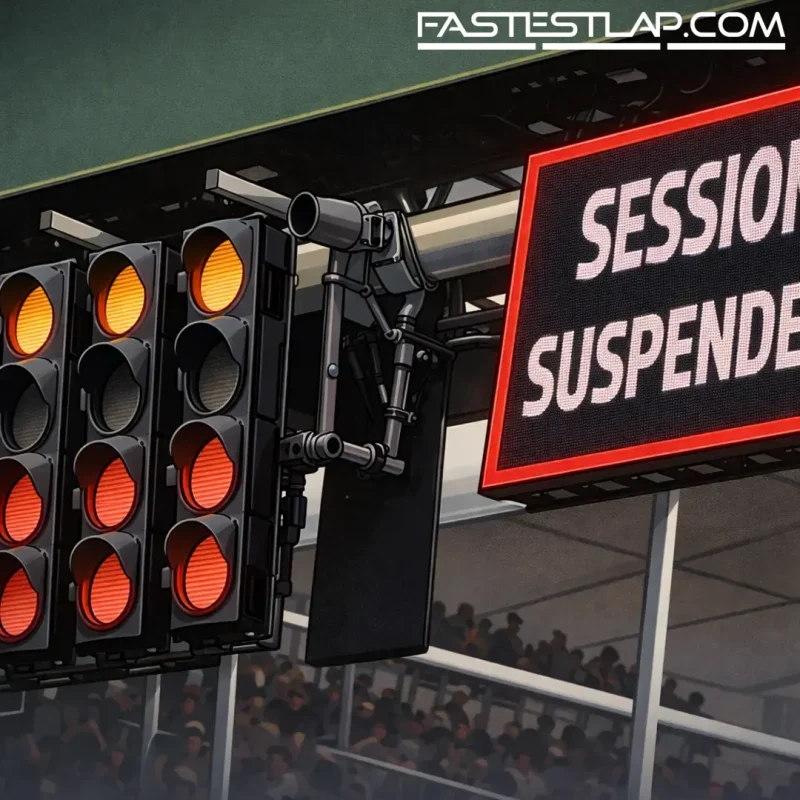
If lightning hits before the start, the process is blunt and functional: cars already on the grid or sitting in the pit lane will be pushed back into their garages. Teams are instructed to keep the garage doors open, a detail that’s less about theatre than about visibility and oversight while the session is paused. Once race director Rui Marques is satisfied conditions have improved, the cars will be returned either to the grid or pit lane, and the start procedure will pick up again from the 10-minute signal — not from scratch, and not on a whim. It’s designed to get the sport back to a familiar rhythm quickly once the weather gives the all-clear.
If lightning arrives once the race is underway, the FIA’s plan is similarly prescriptive. The race would be suspended and the cars stopped in the pit lane, then pushed back into the garages, again with doors remaining open unless Race Control instructs otherwise. This is the key sporting wrinkle: during a suspension, teams *can* work on the cars, but only within a tightly defined box. Accident damage repairs are allowed. Tyre changes are allowed. Changes to radiator and ducting are allowed — an important concession in South Florida humidity where cooling margins can vanish quickly. What teams can’t do is start treating the stoppage like a free extended parc fermé break: no set-up changes.
That limitation matters because it shapes who benefits if the worst happens. A red flag can be a gift if you’re nursing damage, overheating, or sitting on the wrong tyre. But in Miami, the FIA is trying to prevent it becoming an open invitation to re-optimise the car and reset the competitive order. You can fix what’s broken, manage temperatures, and bolt on fresh rubber — you can’t suddenly reinvent your balance because the storm rolled in.
When the circuit is ready to go again, Race Control will provide teams with at least 20 minutes’ warning. During that window, teams must re-establish the running order by pushing their cars out into the pit lane. It’s another operational choice that prioritises control and sequence over scramble: everyone knows the clock, everyone knows the order, and the restart can be managed without guesswork.
And if Miami does what Miami does — and the weather simply doesn’t let up — the FIA has also clarified how classification will be handled. Should the race prove impossible to resume, the result will be taken from the end of the penultimate lap before suspension. The points caveat is equally clear: no points will be awarded unless at least two complete and consecutive racing laps have been completed without a Safety Car or Virtual Safety Car.
It all adds up to an approach that’s more procedural than dramatic, but that’s the point. Lightning rules aren’t negotiable, and the FIA knows the optics of a half-managed stoppage in a high-profile US race are dreadful. Bringing the start forward to 1pm is the first attempt at staying out of trouble; the rest is the governing body making sure that, if trouble arrives anyway, nobody can pretend they didn’t know how it was going to work.
Miami’s been sold as a spectacle since day one. On Sunday, the FIA’s priority is simpler: make it a Grand Prix that can actually be finished — and do it without leaving teams, drivers, or the paying public guessing what happens the moment the first strike lands within that six-mile bubble.