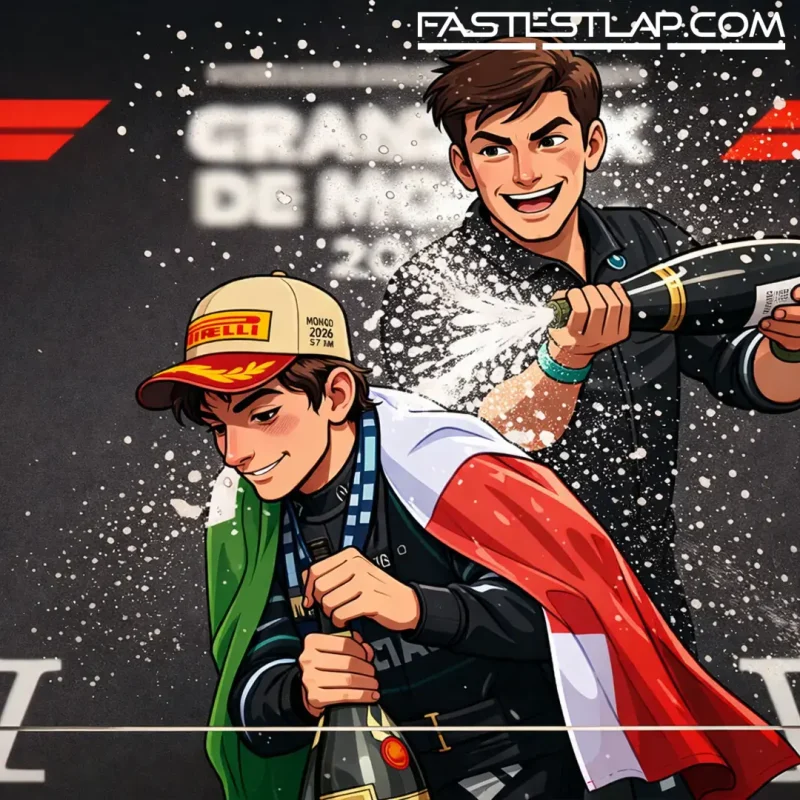
George Russell can frame it however he likes, but Kimi Antonelli isn’t taking the bait.
After Monaco — where the 19-year-old made it five wins on the bounce — Russell suggested the championship is now Antonelli’s to lose. It’s the sort of line that can read two ways in the paddock: a weary admission of being on the back foot, or a neat attempt to shove the weight of expectation onto the kid in the other car. Either way, Antonelli’s response was pure cold-blooded focus.
“It’s not the first time we’ve seen mind games,” Antonelli said. “People always try to shift the pressure onto their opponent, whether it’s an external rival or a teammate – it doesn’t make much difference. Fortunately, those things don’t really affect me.”
That’s the thing with Antonelli right now: he’s racing like someone who doesn’t yet feel the burden everyone else is trying to place on his shoulders. Japan turned him into the youngest driver ever to lead the world championship — 19 years and 216 days, flipping a four-point deficit to Russell into a nine-point advantage — and Miami underlined the streak with a genuinely eyebrow-raising stat: the first driver in F1 history to convert his first three pole positions into Grand Prix wins. That run has since stretched to five.
If there’s been a soft spot, it’s been the starts. Antonelli had a habit earlier in the season of making life harder than it needed to be within the first 200 metres. Monaco, of all places, was where he finally made that story go away. He launched cleanly, owned the run to Turn 1, then did it again when a red flag — triggered by Charles Leclerc’s crashed Ferrari — forced a standing restart and another moment where nerves can spike and mistakes arrive. Antonelli didn’t blink.
The most telling Monaco detail, though, wasn’t the start. It was Mercedes trying to slow him down.
Toto Wolff revealed there were points in the race where both he and Antonelli’s race engineer Peter Bonnington were essentially waving the calm-down flag — not because Antonelli was skating on the edge, but because the pace was so fierce it didn’t look sensible for a race being controlled from the front.
“Bono told him first, then I repeated it,” Wolff said. “I added to Bono, ‘You have to tell him he’s half a minute ahead.’ Peter repeated the message, but Kimi kept doing those times, so we thought maybe that was his pace.”
That line lands with a thud for the rest of the grid: Monaco is normally the place where you manage gaps, manage risk, and manage your own impatience. Antonelli, instead, was lapping so quickly he ended up putting a lap on everyone except the Ferraris in second and third. Wolff’s description of it was as much about temperament as speed.
“What Kimi can do is special,” he said. “He has full control of the car and his emotions. He doesn’t lose his cool if the person behind is only a second and a half behind, because he’s capable of changing pace and increasing the gap. It’s truly incredible.”
This is where Russell’s “to lose” comment becomes interesting. There’s a version of 2026 where Antonelli’s raw pace is obvious but the season turns on the usual young-driver traps: overdriving under pressure, chasing perfection, getting dragged into intra-team politics, believing the noise. Antonelli’s message is that none of that is on the table — and that, crucially, he’s not even going to pretend it is.
“We’re still only in the first third of the season, and I think it’s definitely too early to start talking about a title showdown. I’m working race by race,” he said. “Of course, at the end of each weekend I take a look at the standings, but immediately afterwards my focus is already on the next race.
“When I lower the visor and head out on track, I’m not thinking about the championship. I race to do the best job possible. And, as I’ve already said, since I haven’t won anything yet, I have nothing to lose.”
That last sentence is doing a lot of work. Because he has everything to lose, really — a 66-point championship lead over Lewis Hamilton, with Russell a further two points back in third, doesn’t exist by accident. But the psychology of it matters. Drivers who start defending a title before they’ve won it tend to tighten up; drivers who treat it like an extended qualifying session tend to keep finding laptime.
Mercedes, for their part, will be thrilled and mildly terrified in equal measure. Thrilled because this is the sort of control you can build a championship campaign around. Mildly terrified because when a driver is that comfortable at a pace that looks uncomfortable to everyone else, you have to decide when to let them run and when to pull them back — and you have to do it without puncturing the very confidence that makes them so quick.
Monaco also carried a quieter significance for the team: it was their first victory in the Principality since Hamilton’s win in 2019. Wolff admitted it’s long been a track that’s “a bit of a challenge” for Mercedes, which only makes Antonelli’s dominance there more of a statement.
Russell can keep talking. Former drivers can keep interpreting it. None of it appears to be reaching the cockpit. Antonelli’s not arguing with his teammate, he’s just lapping the field — and, right now, that’s a far more persuasive form of conversation.