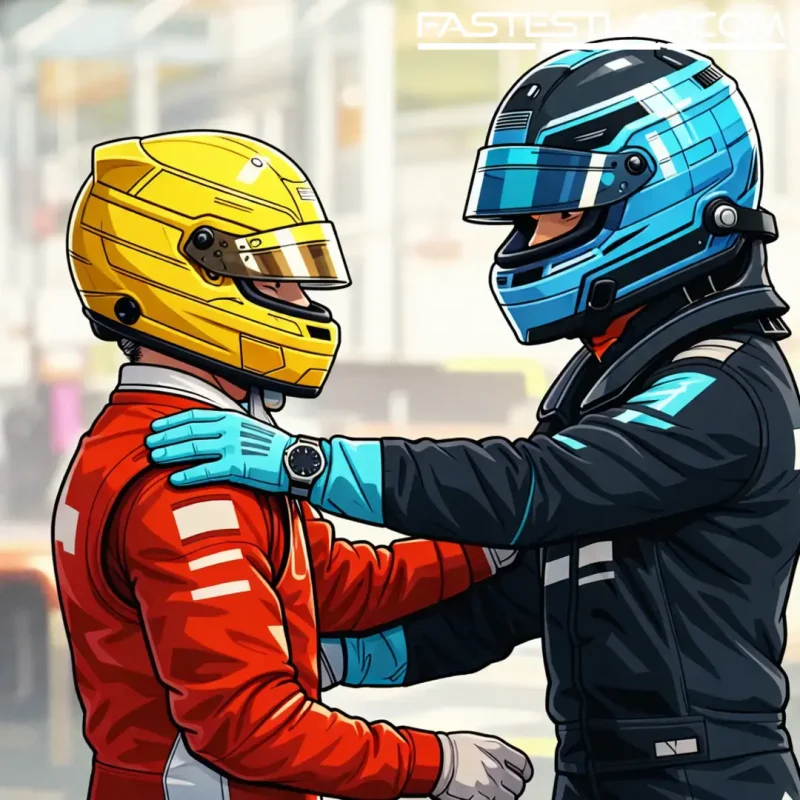
George Russell didn’t hide behind platitudes after Barcelona. Mercedes, he admitted, let Ferrari dictate the rhythm of the race the moment Lewis Hamilton peeled into the pits early — and once that first reactionary move was made, the rest of their afternoon was essentially spent trying to live with the consequences.
Hamilton’s breakthrough first win as a Ferrari driver came on a day when the red car looked prepared to do something different from the off. Ferrari committed Hamilton to a three-stop plan, dragging him in on lap 12 of 66. Mercedes blinked a lap later with Russell, unwilling to concede track position to the undercut and wary of being caught napping by an aggressive call.
It was, in Russell’s telling, the sort of decision that makes perfect sense in the moment and becomes far less comfortable when you’re replaying the race in your head afterwards.
“I felt solid at the start, and just slowly eking out the gap to Lewis,” Russell said afterwards. “He obviously committed quite early to the three-stop, and then we covered, but stuck on the two-stop.
“From that point onwards it was quite challenging, and just didn’t have the pace, and I wasn’t feeling too happy with the hard tyre.”
That’s the key detail. The early stop wasn’t simply a response to Ferrari; it pushed Mercedes into tyre phases it didn’t particularly want, at a time it couldn’t fully control. Russell was blunt about the fact that, in a vacuum, he would have ignored Ferrari’s early move.
“If I was in the race on my own and there were no other drivers, and I was in a two-stop, I would not have pitted on lap 13,” he said. “Now, you’re never in the race on your own, you’re reacting to your competitors, and they put us in a very challenging position to pit this early.”
Ferrari’s second stop only tightened the screws. Once Hamilton had cycled through again, his pace allowed him to close back onto the Mercedes cars quickly enough that it effectively boxed the Silver Arrows into their original thinking. To switch to a three-stopper at that stage, Mercedes would have risked gifting track position away — and, at Barcelona, being behind the wrong car at the wrong time can be a strategic death sentence.
There was also the internal wrinkle Russell openly acknowledged: Kimi Antonelli. With Mercedes committed to a two-stop and Hamilton moving onto fresher tyres for the final phase, Russell could see an alternative, but it came with collateral.
“The truth is, my pace wasn’t quite strong enough today, but I do think I could have just mirrored his strategy on the three-stop, but that would have maybe left me exposed to Kimi on the two-stop,” Russell said. “Maybe I wouldn’t have been happy about that in the end. So, I need to go through it with my team.”
It was the sort of comment that tells you plenty without spelling it out. Mercedes’ strategic room to manoeuvre wasn’t just about beating Ferrari; it was about not creating a different problem at home. Protecting Russell from Hamilton’s undercut threat was one thing. Opening the door to Antonelli — who had enough late-race bite to take the fight to Russell — was another.
Antonelli did get ahead in the closing stages, only for a power unit issue to stop him five laps from the flag, wiping away what would have been a significant result in the team’s intra-garage story. It also, indirectly, spared Mercedes the uncomfortable optics of a late shuffle while Hamilton headed to the win.
A mid-race Virtual Safety Car helped Hamilton pit and retain track position, but Russell’s view was that Ferrari’s man was likely coming through regardless. The pace advantage, particularly once Hamilton was armed with fresher rubber, was hard to miss — and Mercedes never quite looked in love with the tyre it needed to make its chosen plan work.
The broader significance, though, is that Barcelona finally produced a proper full-distance interruption to Mercedes’ early-season stranglehold. This was the first non-Mercedes victory of the 2026 season over a full race distance, and it arrived with a message: Ferrari can force strategic errors, not just capitalise on them.
In the standings, Russell now sits 50 points off the top, with Hamilton positioned between him and Antonelli. Hamilton’s win also nudged him nine points clear of Russell — a small but pointed swing in a season where momentum has tended to come in chunks rather than drips.
For Mercedes, the uncomfortable postscript is that the pivotal moment wasn’t a botched pit stop or an unlucky safety car. It was a choice: the instinct to cover Ferrari early, and the inability to find a clean exit once that cover turned into a commitment. In a field as sharp as this, that’s often all it takes.