Mercedes arrived in Montreal with the sort of straightforward brief it tends to like: a quick car, a track that rewards efficiency, and two drivers capable of turning that into a haul of points. It left Canada with something else entirely — a very public reminder that, in 2026, its biggest opponent might be sitting in the other cockpit.
The Russell–Antonelli dynamic has been simmering for weeks, but Canada pushed it into the open. Not because either driver did something wildly abnormal by modern F1 standards, but because Mercedes had to start policing the tone of the fight in real time.
It began in the sprint, where George Russell twice made it extremely clear he wasn’t interested in giving Kimi Antonelli a clean run at him. Antonelli didn’t hide his feelings afterwards, branding Russell’s defence “unfair” and pushing the idea it warranted a penalty. That sort of complaint is common enough; what wasn’t was Toto Wolff’s patience running out over the radio.
“It’s the fourth time to talk about this,” Wolff cut in. “We shall talk about this internally and not on team radio.”
Russell went on to win the sprint, Antonelli took third, and the expectation was that the main event might cool it down. Instead, the grand prix turned into something more revealing: two Mercedes drivers running at the front, trading tiny errors, and driving like neither quite trusts the other to blink first.
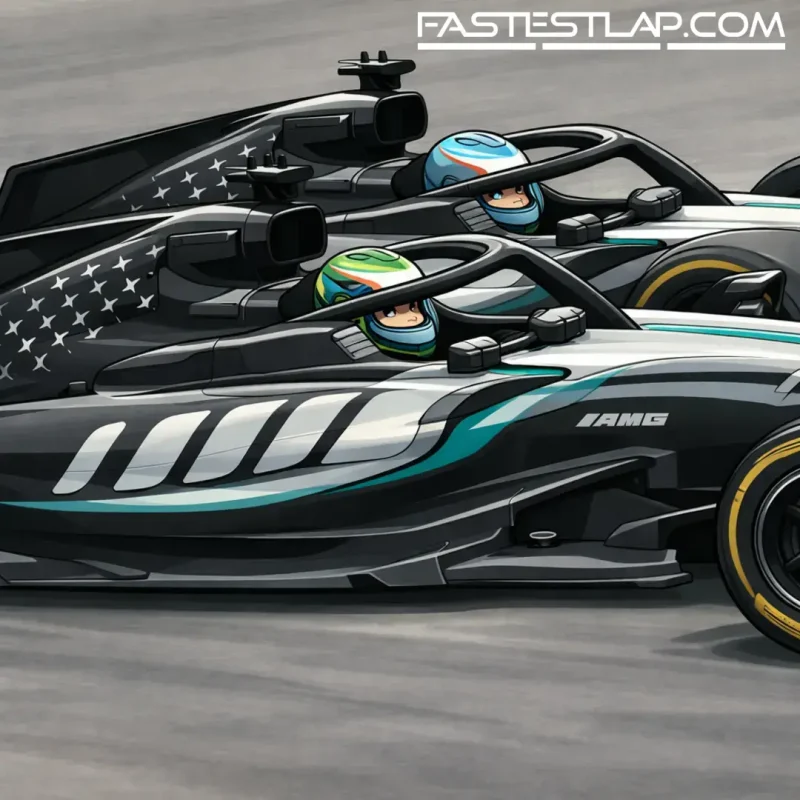
Their duel for the win was tight and messy in the way only intra-team battles can be — not reckless, but constantly on the edge of becoming a problem. Both made mistakes at the hairpin that swung momentum back and forth, and for long spells they circulated within half a second of each other. That closeness, plus the constant energy-management chess, made it volatile.
At one point Russell, aware Antonelli had the tools to attack, asked whether his team-mate had overtake mode available. His engineer, Marcus Dudley, confirmed it — and Russell immediately wanted space to reset his own systems.
“He needs to back up a bit,” Russell argued as he tried to recharge.
Then came a moment that captured the entire afternoon: Antonelli emerged ahead into the final chicane, both cars running off the track in the process. Dudley told Russell the position would be handed back.
“Kimi will give you position,” he said.
“Convenient just [before] Turn 3,” Russell snapped back.
Dudley tried to calm it down — “head down” — but the tension was audible. Wolff’s voice then arrived on the channel with a clipped “George…” before Dudley reminded him there were plenty of laps left.
Mercedes’ message soon hardened. On lap 26 Dudley delivered the line that, in any top team, is code for “this is your last warning”.
“Too close at the moment this is,” he said. “Just information, if we can’t tidy up the racing, then we will have to stop it.”
A short time later Russell was told both cars were under investigation, adding another layer of stress to a battle that already looked like it was being fought in millimetres. Whatever judgement might have followed became irrelevant for Russell on lap 30, when his race ended abruptly with a battery issue. He pulled over and Dudley, not yet certain of the car’s state, instructed him: “Car status unknown so jump out if you can hear me.”
For Antonelli, it was the opposite kind of day: another win, his fourth grand prix victory in a row, and a championship lead over Russell that now stands at 43 points. In cold sporting terms, Canada didn’t just swing momentum — it underlined where it currently lives.
Wolff, speaking afterwards, tried to frame Mercedes’ radio interventions as guardrails rather than shackles. The team isn’t trying to neuter racing between its drivers; it’s trying to stop two highly motivated, highly capable competitors from costing Mercedes the sort of points tally that decides championships.
“When you ask them to tidy it up, it doesn’t mean you shouldn’t be stopping it,” Wolff said. “You allow actually the racing, but you’re saying you know you’re on watch.”
He admitted Mercedes had already seen “a few situations that could have ended in DNF”, the kind of near-miss that might look thrilling in the moment but tends to feel avoidable when the debrief rolls the footage back at half speed. Wolff said the team will sit down with both drivers to go through the key moments and, crucially, to ask whether the level of aggression on show is actually the one they believe is justified.
“I think we want to look at the pictures today and have [the drivers] come to the right conclusions,” he said, pointing to specific situations Mercedes believes “could have been avoided”, and asking what they want to do to mitigate that next time.
There was also a line in Wolff’s answer that will matter just as much as anything said in the heat of the race: Mercedes is prepared to “put the handbrake on” if the circumstances demand it. That doesn’t mean immediate team orders every time the cars get close, but it does mean the freedom both drivers currently feel has conditions attached — namely, that the team’s result can’t be collateral damage.
It’s the classic problem when a team has what it wants — two front-running cars — and what it fears at the same time. The uncomfortable truth for Mercedes is that this isn’t a manufactured rivalry. Russell is trying to reassert himself, Antonelli is driving like a championship leader who knows he has leverage, and neither looks inclined to quietly accept the other’s narrative.
Wolff’s assessment was blunt enough: “More than ever, this fight is on.”
Mercedes can live with that. What it can’t live with is the moment “on” becomes “over” for one car because the other one refused to yield an inch. In Montreal, it didn’t end with carbon fibre in the wall — but it ended with a warning, and that usually means the next chapter gets even harder.