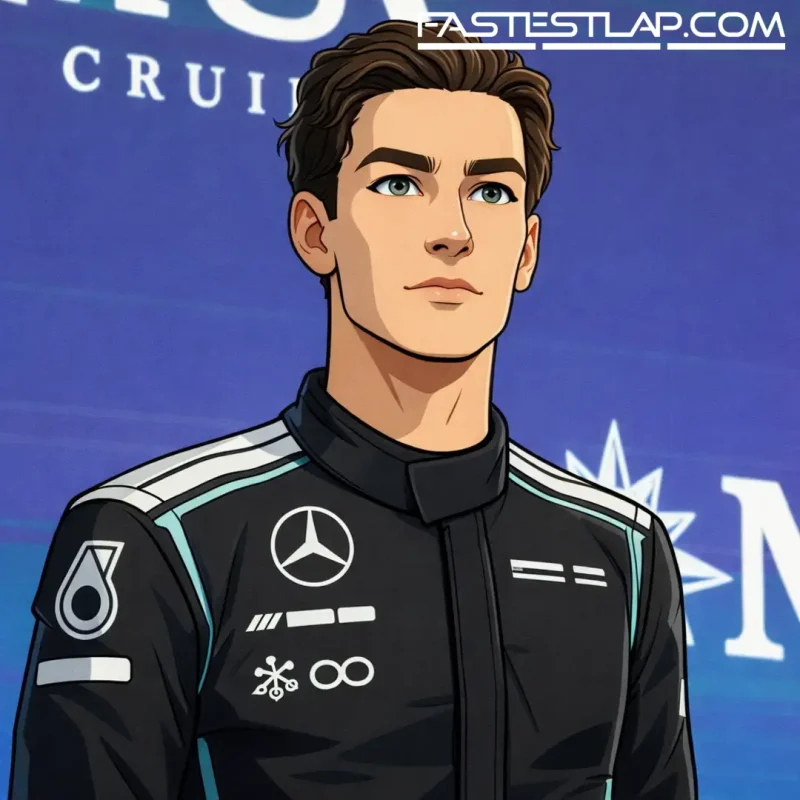
George Russell isn’t pretending everything’s fine at Mercedes right now, but he’s also not in the business of making a crisis out of what he sees as a very modern F1 problem: the car and tyres have changed, the operating window has moved, and his instincts haven’t yet caught up in the way he knows they eventually can.
The frustrating part for Russell is that he’s already seen what “caught up” looks like — it’s happening in the other side of his own garage.
After opening the season in Melbourne with the sort of weekend that made him look like the natural spearhead of a resurgent Mercedes, Russell’s momentum has ebbed since the Canadian Grand Prix. The result is stark: he’s winless since that first race, third in the standings, and now 50 points behind the benchmark in a season that began with him cast as title favourite.
Russell’s read on it is less about one missing piece than a broader, slightly intangible process of adaptation to the 2026 regulation overhaul. In his words, he’s waiting for it to “click” — the kind of feel and rhythm that turns analysis into muscle memory.
“There always needs to be improvements, because when you’re driving with a new car and new tyres, you need to evolve,” Russell said. What he’s describing is not a driver lost for ideas, but a driver who’s almost over-aware of the search for them — and who believes his best performances tend to arrive when he stops trying to force the answer.
Russell offered a telling example from his simulator work a couple of years ago: two consecutive days running in Barcelona, where he felt quick on day one after a full programme, then returned the next day and found himself dramatically faster almost immediately.
“I came in the next day on my second lap I went two times faster, and I thought to myself, ‘How on earth did I just go two times faster on my second lap the day compared to doing 100 laps the day before?’” Russell said.
He wasn’t claiming he’d discovered a magic technique overnight — he was making a point about how drivers learn without realising they’re learning. You bank experience, sleep on it, and the next time the car moves underneath you, the brain quietly files it into the right drawer. It’s not romance; it’s repetition meeting confidence. And Russell’s belief is that if he can get back into that headspace — less searching, more absorbing — the performance will follow.
That’s where Antonelli enters the story, because Russell isn’t talking in a vacuum. He’s watching his team-mate adapt to the new generation of cars with an ease that can’t help but sting, even if Russell is careful to frame it as admiration rather than alarm.
“And, of course, Kimi is doing such an amazing job at the moment,” Russell said. “But his driving style is exactly the same as his driving style of last year, and it’s clicking. So he hasn’t chased it. It’s just clicking for him perfectly well.”
Russell’s subtext is hard to miss. He’s not saying Antonelli is doing anything mystical. He’s saying Antonelli hasn’t been dragged into the same loop of consciously trying to “solve” the car, and that freedom is allowing the speed to surface naturally. For one driver, the new rules have landed as permission; for the other, they’ve arrived as a question.
There’s also an uncomfortable professional truth here: when one side of the garage looks like it understands the car, the other side runs out of places to hide. The team can point to set-up directions, to tyre preparation, to the challenge of extracting lap time in a tight window — but, in the end, Russell is judged against the most relevant reference point he has. Right now, that reference point is making it look easier than Russell insists it is.
Still, Russell isn’t presenting this as a long-term identity crisis. If anything, he sounds oddly energised by the idea that the solution isn’t a dramatic reinvention, but a return to something he recognises — that subconscious, self-correcting adaptation he says has defined his career.
“I want to go back to that place where I’m subconsciously learning how,” he said. “I’m not chasing those answers, because I know I can do it, and I’ve done it my whole career… and that’s what I’m excited about.”
It’s a very Russell way of framing a difficult period: reflective, slightly clinical, but with a competitive edge underneath. Because when he mentions Melbourne — “as it did in Melbourne” — he’s also reminding everyone that the ceiling is still there. The pace hasn’t vanished; it’s just not living with him every weekend.
The championship picture, though, doesn’t pause for anyone’s “click” moment. Fifty points is not an impossible gap in 2026, but it’s big enough that Russell can’t afford many more weekends of waiting for his brain to catch up with the car. And Mercedes, having finally found itself in a position of strength again, won’t want a season defined by one driver’s adaptation curve while the other rides the wave.
For now, Russell is betting on something drivers talk about all the time but rarely say this plainly: at the limit, the difference between fighting the car and flowing with it can be a single thought you stop having. The trouble is that you can’t schedule that realisation for Friday practice. You can only put yourself in position for it to arrive — and hope it turns up before the title fight disappears over the horizon.