Barcelona has a habit of pulling old Mercedes stories out of hiding, and this year it did it with a smirk.
As George Russell and Kimi Antonelli edged towards that familiar line between “hard racing” and “team headache” around the Circuit de Barcelona-Catalunya, the paddock inevitably reached for the last time a Mercedes title fight boiled over here — the 2016 collision between Lewis Hamilton and Nico Rosberg that detonated both cars and helped define an era.
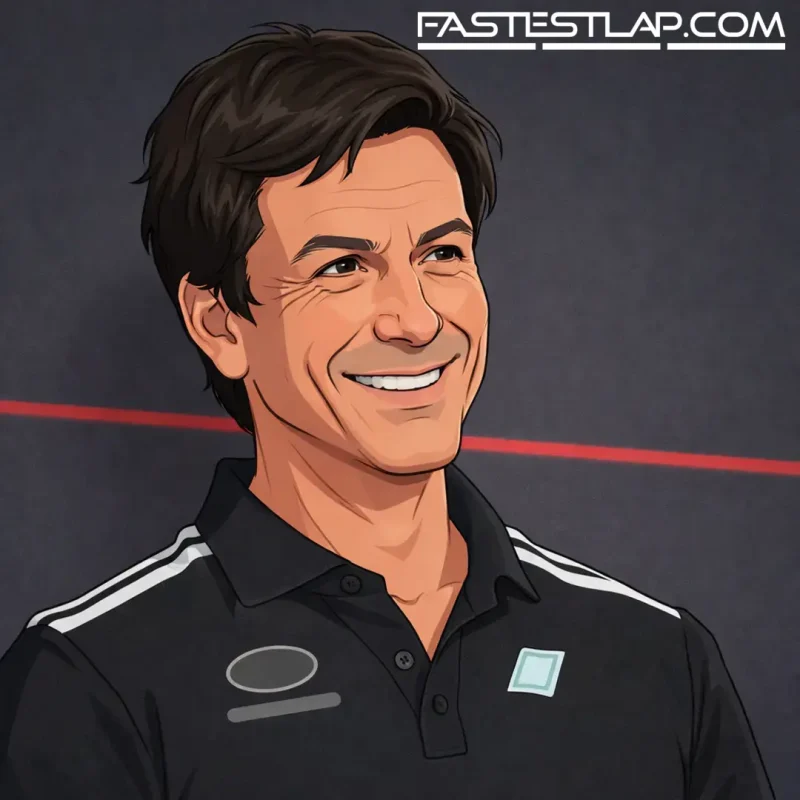
Rosberg, now on TV duties, couldn’t resist poking the bear. On Sky Sports, he revealed that in the aftermath of that crash Toto Wolff produced a very specific deterrent: a contract clause that removed blame from the equation entirely. If the Mercedes drivers hit each other again, the cost would be split 50-50. No stewarding nuance, no internal court case, just a bill landing on both desks.
“A piece of paper on my desk,” Rosberg said, describing it. “And it said, from now on, it doesn’t matter whose fault it is, you’re gonna pay for the damage 50-50. Is that contract still in place? Has Kimi signed it as well?”
Wolff’s answer was immediate — and telling. “No.”
That was the opening Rosberg wanted. “You’ve gone soft! You’ve gone soft!”
Wolff played along, but not without a quiet warning threaded through the banter. Asked why the clause had disappeared, he replied: “You’ve given me a good idea actually.” And then, in case the point hadn’t landed, he added: “Let’s see if there’s another collision, then I’ll probably put that paper in front of them.”
The exchange was light, but the subtext wasn’t. Mercedes’ Barcelona weekend wasn’t derailed by carbon fibre strewn across Turn 4, yet the team still ended up asking itself the kind of question Wolff hates having to answer in public: how much is “letting them race” worth when there’s a third party benefiting from your two cars slowing each other down?
In this case, that third party was Hamilton. The former Mercedes spearhead, now elsewhere, took the win on a day when Russell and Antonelli ran close enough — and spent enough time in each other’s orbit — for Mercedes to quietly wonder what might have been. The intra-team scrap, by Wolff’s own admission afterwards, may have cost them the chance to control the race before a crucial Virtual Safety Car moment swung the rhythm of the grand prix.
Wolff didn’t reach for the contract drawer in the post-race debrief. Instead, he reached for something more modern Mercedes: calibration. “Number one, there is a third party now getting involved in a championship fight – constructor and driver,” he said. “And in that respect we will discuss internally with them with the two drivers how we want to end the situation where we risk holding each other up.
“I think it was not a problem, it is just maybe we need to recalibrate.”
That’s the tightrope Mercedes now walks with Antonelli in the car. Russell is established enough to believe he should be given full latitude. Antonelli is talented enough to demand it. And both are close enough on pace that “recalibrating” quickly becomes a euphemism for drawing lines neither wants drawn.
Rosberg’s story about the 50-50 clause lands because it’s the most Wolff solution imaginable from that era: simple, brutal, and personal. If two drivers know a clash is going to cost them a chunk of their own money, the theory goes, they’ll find a way to give each other half a car-width more.
Rosberg even supplied the punchline that made everyone in the studio wince. He recalled one moment when the policy genuinely bit. “Was definitely pretty scary,” he said, “because once I paid $360,000 so I didn’t crash anymore.” Martin Brundle, doing the mental arithmetic of 2026 repair bills, could only mutter: “Imagine what that would cost now.”
Wolff, never missing a chance to needle his old champion, shot back: “After that, Nico ended up in the money investment world.”
The irony is that Mercedes doesn’t really need a signed piece of paper to understand the cost of a collision in 2026. The cost is points. The cost is momentum. The cost is the feeling, inside a team, that you let an opportunity slip because you were busy proving a point to your team-mate.
Barcelona won’t be the last time Russell and Antonelli find themselves wheel-to-wheel with something tangible on the line. If anything, this weekend was a reminder that Mercedes is heading into a phase where the cars might be separated by tenths, but the consequences are separated by championships.
And if it does go wrong — if carbon fibre does end up littering an escape road and Wolff has to front up again, face tight, voice calm — don’t be surprised if Rosberg’s “piece of paper” suddenly makes a comeback.