Mercedes has quietly stepped away from one of the more awkward bits of post-Monaco fallout, withdrawing the Right of Review request it had lodged over George Russell’s penalties in Monte Carlo.
On paper, it looks like a team deciding it doesn’t fancy a long fight. In reality, it reads more like Mercedes recognising what this episode has become: less a straightforward stewarding dispute and more a timing-system problem that’s now too big, too messy, and too specific to Monaco to be “won” in any clean, satisfying way.
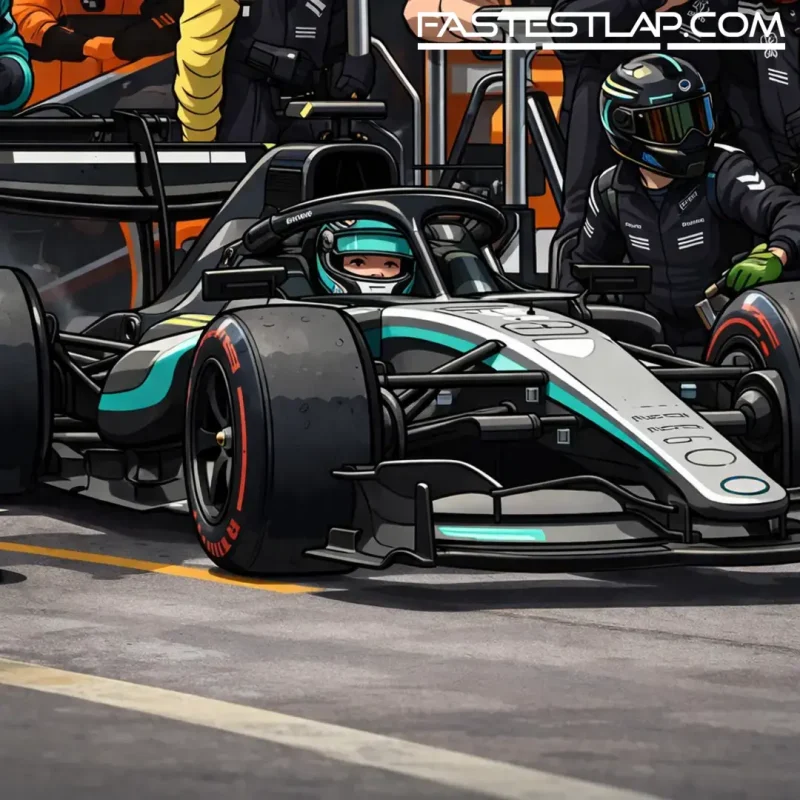
Russell’s race unravelled in two acts. First came the five-second time penalty for pitlane speeding — one of five drivers caught by the system on the day. Then came the more damaging twist: Russell didn’t serve that penalty correctly at his stop, because a communication breakdown between pitwall and crew meant the car was worked on before the five seconds elapsed. That’s an automatic escalation to a drive-through, which Russell served late on, after a Safety Car, and it dropped him out of the points.
The entire situation changed complexion once Alpine forced the FIA to revisit Pierre Gasly’s case. Gasly had finished third on the road but was penalised for pitlane speeding — a penalty he had not served by the chequered flag. Alpine’s Right of Review was admitted and, crucially, succeeded after the stewards’ paperwork outlined a discrepancy in the length of one of the pitlane timing loops. In other words: the measuring tape may have been wrong.
That’s how Monaco has ended up in a place the sport hates to be: with stewards’ documents acknowledging that what looked like a cluster of near-identical speed readings — “almost all a uniform 60.1km/h” — might not have reflected reality. The FIA is described as an end user of the timing systems supplied by Formula One Management, and suddenly the argument isn’t just about a driver lifting fractionally late. It’s about whether the data used to prosecute the offence was sound in the first place.
For Mercedes, the problem was always going to be procedural as much as philosophical. Gasly’s penalty could be removed because it existed as a post-race time addition he hadn’t served, leaving room to argue that new information materially affected the decision.
Russell’s case is different. He didn’t just receive a penalty — he served an even harsher one after the team’s own operational error at the stop. That’s why Mercedes moved quickly in Barcelona to file a Right of Review submission: not necessarily because it was confident of a reversal, but because the clock on these things is brutal and you protect your position first, argue later.
By Thursday after the Spanish Grand Prix, that position had changed. The FIA published confirmation the team had withdrawn the request, and on Friday Mercedes explained why it was stepping back.
“We can confirm that we have withdrawn our Right of Review submission relating to the penalties received and served by George Russell during the Monaco Grand Prix,” Mercedes said.
It admitted the rescinding of Gasly’s penalty made it “important… to explore all available options” given the impact on Russell’s result, and it noted it filed in Barcelona largely to “reserve our position”.
The key line, though, was what came next: Mercedes said discussions with the FIA and Formula One had shown “their determination to review the unique circumstances arising from the Monaco Grand Prix” and to address the causes. With that in motion, Mercedes concluded continuing would “not serve our team or the sport”.
There’s a slightly pointed pragmatism there. If the sport is already committed to investigating the root cause — a timing loop discrepancy is not the sort of thing you solve by winning an appeal — then litigating Russell’s result starts to look like a fight over scraps rather than a push for clarity. Mercedes can read the room as well as anyone: in a situation where the integrity of the measurement is under question, the bigger win is fixing the process before it bites again.
Team principal Toto Wolff also swatted away the suggestion that FOM’s role in the timing architecture created a conflict of interest.
“No, I think there is no point in that; they have been doing this for many years, and there would never be any problems,” Wolff said. “We are all aligned here… there’s no conflict of interest, it’s just we’re in this sport altogether between the FIA, the teams, the drivers, no problem for me.”
The politics now shift elsewhere, because Mercedes isn’t the only outfit that felt burned by Monaco’s chain reaction. Red Bull and McLaren both have appeals lodged against the race result, and unlike Mercedes they’re still pushing.
McLaren has been explicit about why. It says it’s not targeting a competitor, but that removing penalties after some teams “accepted and served” them risks creating a sporting imbalance — essentially penalising those who complied with the system as it was presented at the time. The team has formally notified an appeal to the FIA International Court of Appeal and framed it as a matter of “sporting fairness, regulatory consistency, and the integrity of competition”.
That’s the crux of it: Monaco has exposed a scenario where being tidy and obedient in the moment could leave you worse off once the sport rewinds the tape. That’s corrosive in a championship built on operational discipline.
Mercedes, for its part, has chosen to get out of the legal queue and lean into the fix. Russell won’t get Monaco back, but Brackley clearly believes the next battleground is ensuring the system that created the mess is made robust — and quickly — before another weekend is decided by a number that turns out not to be real.