Formula 1’s new power-unit era was always going to throw up odd little side-effects, and few have been more visible — or more unnerving — than what’s been happening off the line in the opening races of 2026.
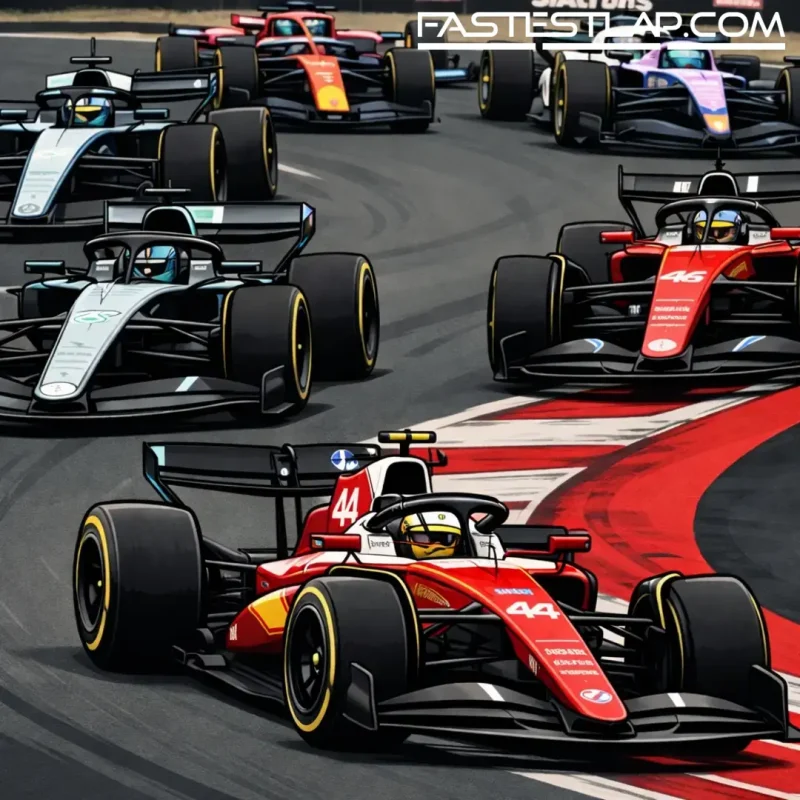
Ferrari emerged from winter testing with a party trick: brutal, clean launches that made everyone else look a beat late. While others were still getting the turbo to play ball, Lewis Hamilton and Charles Leclerc were consistently snapping into motion and immediately turning the first 200 metres into an overtaking zone. It quickly became the one area where Ferrari could put genuine stress on Mercedes, even if the broader pace picture had the silver cars ahead.
You didn’t need a deep dive into data traces to see it. George Russell’s pole in Australia counted for less than he’d have liked when Leclerc was alongside before Turn 1. In China, Hamilton made a similar statement against Kimi Antonelli, turning the start into the lead. Japan brought another strong Ferrari getaway, with Leclerc again getting the better of Antonelli early on — even if he found himself behind Oscar Piastri that time.
Ferrari hasn’t exactly pinned a diagram to the garage wall explaining how it’s doing it. But the paddock chatter has been predictable: anything from clutch maps to turbo sizing. Russell publicly pointed in one particular direction, suggesting Ferrari might be running a smaller turbo — the kind of detail that, in this new world without the MGU-H, could alter how quickly the system responds when the driver drops the clutch.
The problem for F1, though, isn’t that one team has nailed a launch. It’s that others haven’t — and the failures have been messy enough to flirt with something worse.
The most alarming example came in Australia, when Liam Lawson effectively didn’t go anywhere at the lights and Franco Colapinto, behind him, did. Colapinto missed Lawson by millimetres. Had that been contact, the consequences at the start of a grand prix — with the pack concertinaing and drivers committed — don’t bear thinking about.
Colapinto didn’t sugar-coat it afterwards, pointing squarely at the new power-unit characteristics.
“I was really, really lucky,” he said. “These are things that can happen with these new cars, but it was just very dangerous and quite sketchy.”
That, in essence, is why the sport has stepped in. From the Miami Grand Prix, the FIA is rolling out a revised set of start-related controls agreed with Formula One Management, the teams and the engine manufacturers.
The key change is a “low power start detection” system designed to spot cars accelerating abnormally slowly immediately after clutch release. If the system detects that scenario, it will automatically trigger MGU-K deployment to guarantee a minimum level of acceleration — specifically framed as a safety mitigation, not a performance enhancer. There’s also a new visual warning: flashing lights at the rear and sides of an affected car to alert anyone charging up behind. Additionally, the energy counter will now be reset at the start of the formation lap, addressing what the FIA described as a previously identified inconsistency.
On paper, it’s the sort of intervention F1 tends to prefer: minimal, targeted, and justified on safety grounds. In practice, it’s also likely to shuffle the competitive deck in a small but meaningful way — because in 2026, the first few seconds after the lights are one of the few places Ferrari has been consistently landing punches on Mercedes.
Juan Pablo Montoya, never one to miss an angle that matters, thinks Miami could quietly clip Ferrari’s wings. Speaking to AS Colombia, he argued the tweak will disproportionately benefit the Mercedes-powered runners who’ve been more prone to sluggish or uneven launches — and that it will also iron out similar inconsistencies seen at Red Bull.
“Personally, I think the changes at the starts, and how they are going to adjust the energy at the starts, is going to help Mercedes,” Montoya said. “It removes a disadvantage they had.
“And not just Mercedes as a team, but all cars with a Mercedes engine… If you look at the starts of most Mercedes cars, they weren’t strong. And Red Bull’s starts were often not good either, or not bad, but inconsistent. And this takes away a bit of an advantage from Ferrari in the opening phase.”
It’s a pointed read on a season that’s been defined by fine margins and frustrated Saturdays. Ferrari has looked like the clear second-best package overall, but without a win to show for it. Those electric launches have created thrilling first laps and occasionally flipped track position, yet over race distance Mercedes has generally had the answers.
The numbers underline it. Ferrari is already 45 points adrift of Mercedes in the Constructors’ Championship. In the Drivers’ standings, Leclerc sits third, 23 points behind Antonelli.
Miami, then, lands as more than a procedural safety update. If Ferrari’s starts have been the lever that kept it in arm’s reach, any regulation-driven smoothing of that phase risks turning a fight into a chase — especially if Mercedes’ customer cars also find a more reliable baseline.
Of course, Ferrari won’t see it that way. The team will argue — privately, at least — that it has simply done a better job of adapting to the new rules, and that competence shouldn’t be dulled because others are still catching up. But the Lawson-Colapinto near-miss is the sort of incident that makes that argument hard to sell in an FIA meeting.
So the sport heads to Miami with a rare in-season recalibration of the launch phase. It’s being sold as a safety net, and it probably is. But it may also end up being something else: the moment Ferrari’s most visible early-season edge gets regulated into the background.