Charles Leclerc didn’t need a replay to know his Monaco Grand Prix was over. The moment he arrived at Turn 19 after the Safety Car restart, the Ferrari simply didn’t have the stopping power to make the corner, and the home favourite was a passenger into the barrier.
He was incandescent on the radio. “I’m not even going to take the blame,” Leclerc snapped, before pointing the finger squarely at what he called “these f***ing brakes”. In a race where so much is decided by millimetres, Monaco has a brutal way of turning a small technical weakness into an instant, non-negotiable exit.
Leclerc’s frustration wasn’t born in that one moment, either. The warning signs had been there since Friday. Twice in practice he’d found the Mirabeau run-off after lock-ups, and by qualifying — when he’d hoped to be in the mix for a fourth Monaco pole — he was only fourth quickest, describing the brakes as “extremely inconsistent” and admitting he was “struggling massively”.
Even so, he’d played the Sunday perfectly for a long spell, keeping himself in podium contention and running third late on. Then came the turning point: Lance Stroll crashed at Turn 19, triggering the Safety Car and compressing the field at exactly the wrong time for Leclerc.
Ferrari called Lewis Hamilton in from second place, pitting him ahead of Leclerc, and the two lined up behind runaway championship leader Kimi Antonelli as the race prepared to go green again on Lap 66. Whatever the internal logic of Ferrari’s sequencing, the bigger problem was already brewing on Leclerc’s car.
On the way to starting that lap, he arrived at Turn 19 and had nothing like the braking response he’d been managing up to that point. Into the wall he went, his afternoon ended in the least forgiving place on the calendar — and in the most painful race for it to happen.
In the media pen afterwards, Leclerc painted a bleak picture of what he’d been dealing with.
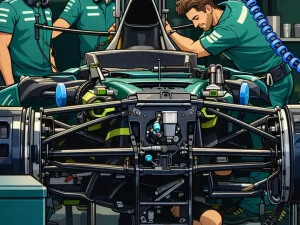
“Out of the four brakes I had three brakes not working,” he said. “The front left was working well, the front right was half working, and the two rear brakes were not working at all.
“And when I say at all, on data there’s no deceleration at all. It’s like… the calipers were not on the car, so it’s a little bit of an issue.”
There had been some paddock chatter that a track-related issue might have played a part, given Stroll had crashed at the same corner. Leclerc wasn’t interested in that line of thinking. He insisted the cause was entirely on his side of the garage — and, crucially, that the Safety Car phase was what turned a manageable problem into an impossible one.
“As long as I was doing consecutive [laps], it was inconsistent, but there was none of those problems, at least to that extent,” he explained. “The problem was with the Safety Car. As soon as I did the Safety Car, the three brakes stopped working. I could never switch them on again. Nothing was working anymore.”
That’s the nasty subtext here: Monaco exposes systems issues because there’s nowhere to hide them, and Safety Car periods can be a worst-case scenario if you’re relying on keeping temperature and consistency in components. Leclerc said he tried multiple in-car actions to bring the brakes back, but nothing worked.
“The only solution I had was to not brake in the last corner, but I will have crashed in Turn One,” he said. “I mean, there’s no way I could have done a lap. There was just no solution.”
Ferrari, he insisted, already understands the origin of the problem — and has a fix lined up. Leclerc said he’ll switch to “Lewis configuration” from the next race, implying Hamilton’s set-up or hardware specification has offered a more robust answer to whatever has been undermining Leclerc’s confidence since Friday.
“The only thing I can say is that we have a solution in-house, and I’ll go to Lewis configuration from next race on,” he said. “Which hopefully will be a step.”
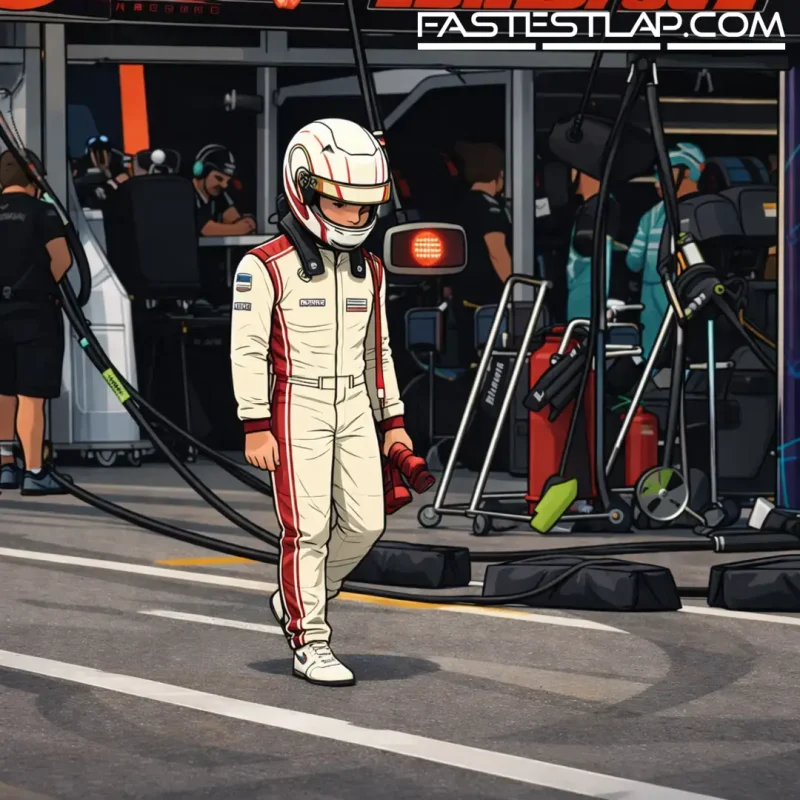
Back in the pitlane, Leclerc was seen in a serious, close conversation with team principal Fred Vasseur and deputy team principal Jérôme d’Ambrosio. Asked if there was any debate inside the team about what had happened, Leclerc was adamant there wasn’t.
“No, no, no, it’s very clear,” he said. “I think Fred and Jérôme then saw the data, and I think it’s very clear for everyone. I don’t think there’s any doubt.”
For Leclerc, the sting is doubled because he’d dragged a compromised car into a position where Monaco could’ve been damage limitation at worst and a podium at best. Instead, he leaves with nothing, the latest chapter in a home-race narrative that refuses to soften.
The championship consequences are immediate too. Leclerc’s DNF drops him to fourth in the Drivers’ standings, while Hamilton’s second place opens up a 15-point cushion over his team-mate. Up front, Antonelli continues to disappear into the distance as the season’s pacesetter — and Monaco, of all places, has ended up widening gaps rather than tightening them.
Ferrari will point to the data, to the fix, to the next race. Leclerc will do the same. But Monaco has a way of lingering, and this one will: a driver with the pace to fight for the podium, taken out not by a mistake he recognises as his own, but by a braking system that — in his words — effectively vanished the moment the Safety Car came into play.