Ferrari and Audi have emerged as the main speed bumps on Formula 1’s latest attempt to reshape the 2027 power unit landscape — not because either is fundamentally against the destination, but because the route there is starting to look uncomfortably improvised.
Over the Monaco Grand Prix weekend, senior figures from the power unit manufacturers will sit down with the FIA to refine what, exactly, “agreement in principle” means after the sport signalled a desire to move away from the current near-50/50 split between internal combustion and electrical output. The direction of travel is clear: a 60/40 split, leaning harder on the ICE. The problem is that the practical and regulatory scaffolding required to do it — quickly, and without rewriting the competitive order by accident — isn’t settled.
That detail matters because the calendar doesn’t care. With 2026 running out, manufacturers need to lock in test-bench programmes, budgets and design decisions for 2027. Chassis departments, too, want to know whether they can realistically carry over elements of their 2026 package or whether the knock-on effects — fuel system packaging being the obvious one — will force deeper changes.
In the paddock, the broad split is now fairly defined. Mercedes, Red Bull Powertrains and Honda are understood to be open to implementing the shift, accepting that it will require modifications as the championship pivots from the near-even balance to a 60/40 ratio. Ferrari and Audi, however, are pushing back on how the change is being executed rather than arguing against the idea outright.
Ferrari’s concerns centre on governance and process — specifically the ADUO framework (Additional Development and Upgrades Opportunities) and how any mid-cycle change interacts with the permitted windows for development. The fear, as it’s been framed, isn’t simply “more work”; it’s the sense that the rulebook is sliding under the designers’ feet after major architectural calls were already made for the 2026 regulations.
One proposed way to square that circle is to separate the ICE from the electrical ancillaries for the purposes of ADUO. Ferrari is said to be resistant to wrapping the combustion side into ADUO permissions, but more comfortable with additional development opportunities on the electrical side instead. In other words: if you’re going to move the goalposts, at least be consistent about which part of the system is being asked to flex — and don’t turn a late directive into an invitation for rivals to spend development capital where Ferrari can’t.
Audi’s position is more about feasibility — and, inevitably, the cost curve. The German manufacturer is believed to be broadly amenable to the 60/40 concept, but would prefer it to be phased in: a smaller adjustment for 2027, then the full move in 2028. That’s been justified on practical grounds, with other sources pointing to cost sensitivity as well. With Audi only just arriving after completing its takeover of Sauber, it’s not hard to see why it would be wary of stacking an additional round of R&D spend on top of a fresh programme aimed at the 2026 baseline.
The Monaco meetings are designed to turn all of this into something the Power Unit Advisory Committee can actually vote on. And that’s the point: the political theatre is secondary to the fact that none of it matters until it is written, tabled and approved.
Even the timing is tight. Despite teams calling for urgency, the next formal PUAC meeting — the one where the critical vote would take place — isn’t expected before, at the earliest, the Spanish Grand Prix on June 14. That’s late in the day for a change that would land for 2027, especially given that a supermajority of manufacturers is required with only six months left in 2026.
It’s also not the first time the FIA has tried to move this conversation along. An earlier meeting around the Canadian Grand Prix is understood to have ended with proposed measures being rejected. The sport briefly looked to have the numbers when the FIA initially floated the idea and received broad agreement, but there are now at least two manufacturers querying just how easily the shift can be executed — and, crucially, how it is policed.
The underlying motivation hasn’t been subtle. The 2026 regulations’ near-50/50 split has brought with it driving and racecraft quirks that F1 is already trying to soften. In Miami, the FIA introduced changes on safety grounds, allowing lower energy recovery limits to reduce the reliance on lift-and-coast and “passive” corner approaches to protect energy targets. The 2027 proposals would go further: a more fundamental rebalance, adding roughly 50kW on the combustion side and removing a corresponding 50kW from the electrical side to reach the 60/40 split.
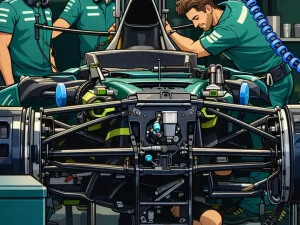
Technically, it’s been presented as achievable without dramatic hardware upheaval on the power unit itself — but “relatively minimal” doesn’t mean consequence-free. The most obvious practical pinch point is fuel. More combustion power implies a higher fuel flow limit, which in turn points to a larger fuel tank to comfortably cover race distance. That’s not just an engine manufacturer problem; it’s a chassis packaging problem, with knock-ons to weight distribution, cooling layout and potentially suspension geometry depending on how aggressive teams have been with packaging for 2026.
And this is where the mood around the debate hardens: teams and manufacturers can live with a rule change if it’s clear, stable and timed sensibly. What they can’t do is commit to expensive development paths while the sport is still negotiating the fine print — or worse, negotiating it in a way that effectively reopens design freedoms for some areas and not others.
There does appear to be a general consensus that the sport wants to get to 60/40. The stumbling block is whether everyone can be brought along under a framework they consider fair, affordable and deliverable inside the remaining development window. Monaco, then, isn’t just another round of talking. It’s a chance to decide whether 2027 becomes an orderly recalibration — or another hurried compromise that leaves half the grid grumbling into their laptops back at the factory.