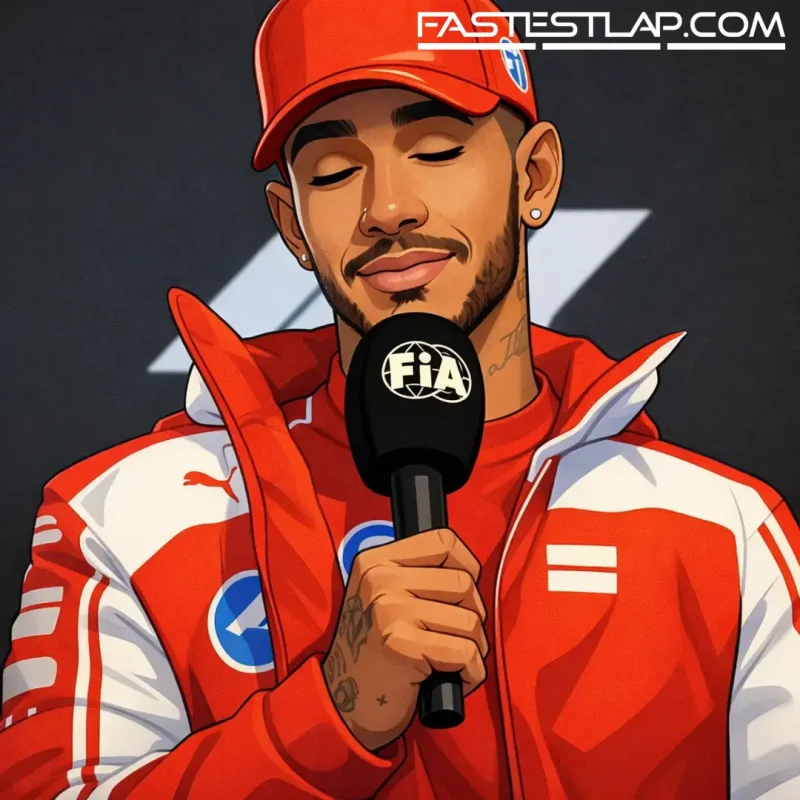
Lewis Hamilton’s relationship with Ferrari’s simulator has become the sort of mid-season talking point that only Formula 1 can conjure: a seven-time world champion, in his first year in red, essentially shrugging off one of the sport’s most relentless preparation tools — and doing it loudly enough that people inside and outside Maranello can’t help but react.
The line from Hamilton is simple: he doesn’t feel he needs the simulator for pre-race preparation in the way the modern paddock expects. Ferrari, according to former race engineer Rob Smedley, has treated that stance with little more than a “shrug of the shoulder”. That’s telling in itself. Ferrari’s not in the business of indulging theatre for theatre’s sake; if they’re not pushing back publicly, it suggests they either agree the trade-off is manageable, or they don’t see value in turning it into a power struggle with the biggest name they’ve signed in a generation.
But Smedley also offered the more useful reality check: Hamilton has only done one grand prix — Canada — without simulator work as part of his build-up. One data point, even a shiny one, is still one data point. Hamilton finished second in Montreal, his best result so far as a Ferrari driver, yet it’s precisely that outcome that has opened the door to the counterfactuals. Otmar Szafnauer has already wondered aloud whether Hamilton might have won the race had he done the usual virtual legwork.
That’s the uncomfortable bit for any driver trying to rewrite a routine: if you bank a podium, people ask what you missed; if you miss a podium, they blame what you skipped. Either way, the microscope is on. And Ferrari’s culture — for all the modern gloss — is still built around process, repetition and exhaustive preparation. If Hamilton’s going to carve out a bespoke approach, it only stays charming while the results stay healthy.
If Hamilton’s week has been about method, Charles Leclerc’s has been about permanence. Ferrari has moved to lock him in for the “coming seasons”, with an understanding he’ll remain in red beyond 2030. In a paddock that chews through driver contracts as if they’re menu items, that’s Ferrari planting a flag: whatever the next technical era throws up, Leclerc is central to it.
Leclerc, now 28, hasn’t won since 2024 despite being an eight-time grand prix winner, but his language around Ferrari has hardened into something more mature than the usual loyalty soundbites. He says he believes in the team “more than ever” and is committed to the shared ambition of delivering a world title. That’s not just romanticism — it’s leverage and clarity. Ferrari, for its part, gets to frame stability at a time when the top of the grid is already thinking in multi-year arcs rather than weekend-to-weekend.
There’s also a subtler subtext: with Hamilton alongside him, Leclerc isn’t being treated as a placeholder or a “project”. Ferrari didn’t need to do this now if they were unsure where the centre of gravity would sit. Extending Leclerc long-term is effectively saying the team sees a future that can accommodate both the superstar import and the homegrown cornerstone — and they’re willing to live with the tension that inevitably creates.
Over at Mercedes, George Russell has injected a different kind of spice into the driver-market chatter by making it clear he wouldn’t shy away from partnering Max Verstappen — either in F1 or even at the Nürburgring. “I’m up for it and would relish the opportunity to always go against the best,” Russell said, which reads less like a polite hypothetical and more like a driver making sure nobody mistakes him for a seat-war passenger.
It’s an interesting note given Verstappen’s name continues to circle around Mercedes. The common assumption in those rumours is that Russell would be the one at risk, not the one welcoming the fight. Yet Russell’s comments flip the dynamic: if Verstappen did arrive, Russell wants it framed as a statement pairing rather than a replacement job.
Still, the reality in Brackley is more complicated. Verstappen has hinted he’d ideally remain with Red Bull into 2027, while Toto Wolff has said he’s content with Russell and Kimi Antonelli as his current line-up. In other words: Russell can be as publicly “up for it” as he likes — the decision tree doesn’t belong to him. But in a sport where perception shapes opportunity, there’s value in telling the world you’re not afraid of the biggest shark in the tank.
While teams argue about sim time and driver pairings, the FIA is trying to steer the conversation much further down the road. President Mohammed Ben Sulayem has doubled down on his promise to bring V8 engines back to Formula 1, targeting 2030 or 2031 at the latest, and insisting they would run on sustainable fuel. The pitch is not subtle: less reliance on battery power than the current formula, lighter and simpler units, more cost-effective — and, crucially, louder.
It’s an easy message to sell to fans, because it hits the emotional muscle memory of what F1 “should” sound like. But it also plants a marker in the political space the sport is about to occupy: 2026 is already a reset year, and talk of another major philosophical shift only a few seasons later is the kind of thing that can either keep manufacturers engaged through a clear long-term roadmap, or spook them if the ground feels like it’s always moving.
All of that is the backdrop as the paddock rolls into Monaco, where Leclerc remains the story even when Ferrari isn’t. The predictions doing the rounds are as ruthless as they are familiar: he either puts it on pole and wins, or he finds a way to complicate his own weekend in qualifying — perhaps both. And with the season still young, there’s already talk that Monaco could matter disproportionately inside Mercedes, where the early intra-team narrative is starting to develop shape.
Monaco has a habit of turning small questions into big ones. If Hamilton nails another big result while sticking to his no-sim experiment, the story becomes one of reinvention. If he doesn’t, the same people currently intrigued will start asking whether Ferrari can really afford to have its newest star operating on instincts rather than inputs. And if Leclerc delivers in front of his home crowd with a fresh long-term deal in his pocket, Ferrari’s future suddenly looks a lot less theoretical — and a lot more like a plan.