Barcelona’s Friday was supposed to be about getting a read on who’s brought what and who’s got their car in the window around a circuit that rarely lies. Instead, the paddock spent most of the day arguing about Monaco — and, more specifically, how a single incorrect measurement has managed to drag half the pit lane into a rules-and-remedies debate.
The headline is clear enough: Pierre Gasly has been restored to the Monaco Grand Prix podium after the stewards accepted Alpine’s appeal and concluded he was hit with two five-second penalties on the back of faulty data. A key measurement used to determine pit-lane speeds was wrong, and once that piece was pulled, the penalties couldn’t stand. Gasly’s result climbs back up accordingly, and Isack Hadjar is the one who loses out.
That’s not just a podium swap, though. It’s the kind of procedural error that instantly raises an awkward question: if the measuring method was compromised, how many other penalties from the same framework are now on shaky ground?
The stewards, in their written reasoning, effectively tried to close the door behind Alpine by noting that other teams can’t appeal the same issue because they missed the relevant deadline. In theory, that should be the end of it. In practice, it rarely is in Formula 1.
In the Barcelona paddock, the mood wasn’t “case closed” so much as “see you in the next meeting”. Red Bull and McLaren are understood to be weighing up appeals of their own after their drivers were also punished under the same pit-lane speeding context. The temptation is obvious: if one team has successfully argued that the underlying measurement was incorrect, anyone else who took a hit will feel they’ve got a sporting and financial responsibility to ask the same questions — even if the rulebook is trying to tell them they’re out of time.
And then there’s Mercedes, who are coming at this from a different angle but with the same destination in mind: can Monaco be reopened at all?
Toto Wolff, sitting in the routine FIA press conference just hours after the Gasly news landed, made it pretty clear Mercedes aren’t planning to shrug and move on. George Russell’s Monaco penalty story was messy — he was handed a drive-through after failing to serve a speeding penalty — and Wolff confirmed he’d already been in touch with the team’s lawyers about possible “remedies”.
“I just left when we were on the phone with our lawyers to look at what can we do,” Wolff said. And while he didn’t pretend the chances were high, he also didn’t sound like a man willing to accept that the matter is purely academic. His point was blunt: a drive-through, if it doesn’t happen at the end, is effectively a 20-second hammer blow, and Mercedes want to know what that meant for Russell’s final classification — and whether there is any mechanism to correct it.
It’s worth underlining the broader problem F1 creates for itself in moments like this. The sport relies on hard lines — deadlines, procedural windows, set processes — because without them you’d be relitigating every grand prix until the next one starts. But when a penalty decision is shown to have been built on incorrect measurement, the “hard lines” start to look less like essential structure and more like convenient insulation.
Barcelona, then, became a strange contrast: a normal Friday on-track, running alongside an abnormal amount of off-track heat.
The first session was heavy on rookies, as teams ticked through their mandatory running and tried to gather clean data on a circuit that rewards proper engineering rather than clever shortcuts. Russell set the pace in FP1, a useful little flex in the middle of all the Monaco legal chatter — even if nobody in the garage will pretend Friday times are anything but a rough sketch.
FP2 swung the spotlight back to the usual suspects at the sharp end, with Lando Norris topping the session. Again, it’s early, but Barcelona tends to show you the truth faster than most venues: if your car is fundamentally good, it will look good here. If it isn’t, you’ll find out quickly and painfully.
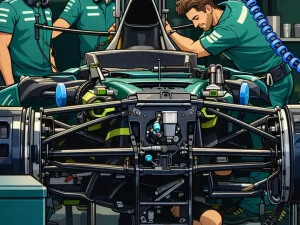
One team clearly intent on changing its story this weekend is Ferrari. When the FIA’s upgrade lists dropped, Ferrari’s entry was the one that made people stop scrolling: eight new components brought to the car in one hit as it looks to close ground at the front. Whether it’s enough to move the needle will only become clear once the fuel loads come down and the qualifying modes go on, but it’s a statement of intent — and a reminder that while everyone’s been busy fighting last weekend’s battles, the championship doesn’t pause.
For now, though, the sport finds itself in a familiar F1 posture: watching the lap times while side-eyeing the rulebook. Gasly’s podium is back. Hadjar’s isn’t. And the rest of the grid is quietly deciding whether this is a one-off correction — or the start of Monaco’s long afterlife.