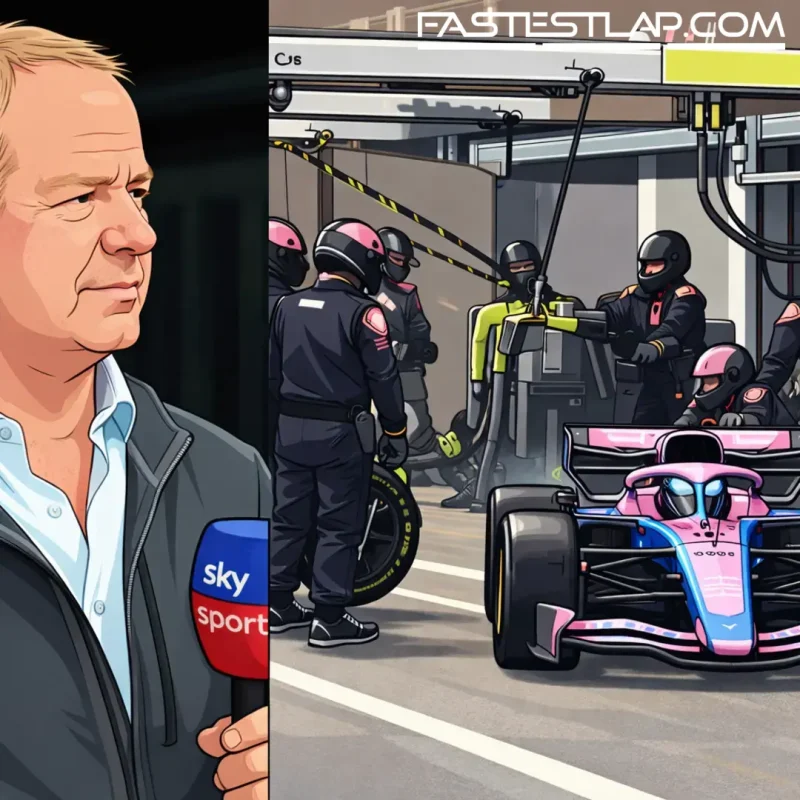
Martin Brundle’s sympathy for the drivers caught out by Monaco’s pit-lane speed trap only goes so far. In his view, the punishments have to be as blunt as they look on paper — because the moment you start carving out “common-sense” wiggle room, you might as well bin the limit altogether.
Monaco’s Grand Prix weekend produced a curious sideshow: six pit-lane speeding penalties shared between five drivers, with margins so slim they barely register on the dash. Lewis Hamilton, George Russell, Oscar Piastri, Franco Colapinto and Pierre Gasly all picked up five-second hits, with Gasly stung twice. One of his offences came at 60.1kph, the other at 60.4kph — in a pit lane capped at 60kph because of Monaco’s cramped confines.
Brundle’s argument is simple, and it’ll resonate with anyone who’s watched F1’s rulebook chew up a good story. If 60.1kph becomes acceptable, then 60.2kph is only a whisper further. The “tolerance” becomes a moving target, teams start gaming it, and before long the only people left arguing about it are the ones with a stopwatch and a lawyer.
“There was a significant sub-story to this whole race… that of speeding in the pit lane,” Brundle noted in his Sky Sports F1 column, pointing out it had already been flagged during practice between the race director and the teams. Even reconnaissance laps to the grid weren’t immune.
What makes Monaco particularly treacherous is that the enforcement is both precise and, for the drivers, awkwardly counter-intuitive. Speed is measured over fixed distances via loops in the track surface, and Brundle highlighted the familiar trick: trying to “cut in” early to shave a metre or two on entry. It’s the sort of marginal gain that’s celebrated everywhere else on a lap. In the pit lane, it can become an unforced error with real consequences.
And Brundle isn’t buying the idea that harshness equals unfairness. He likened it to car weight: come in half a kilo under and you’re out, even if it’s a rounding error in any other walk of life. Motorsport’s lines are hard precisely because everyone lives at the edge of them.
The frustrating part of Monaco 2026 is that the penalties didn’t land evenly in terms of outcome. Hamilton’s five seconds proved largely cosmetic, served under a Safety Car. Piastri and Colapinto also escaped without the sort of lasting damage that changes your Sunday.
Russell didn’t.
Under the Safety Car triggered by Lance Stroll’s crash, Mercedes brought Russell in — but the choreography went wrong. A five-second penalty must be served before any work is carried out, and Brundle explained Mercedes’ jackman immediately lifted the car as mechanics moved to change tyres. That constituted a failure to serve the penalty properly, so the stewards escalated it to a drive-through.
In Monaco, that’s not just a punishment; it’s a guillotine. With the field bunched and the pit lane effectively mandatory while the incident was cleared, Russell’s drive-through became an “effective 20-second” loss in Brundle’s words, dropping him to the back. He ultimately finished 12th, aided only by penalties elsewhere.
Then there was Gasly — a more visceral kind of misery. On the road, he crossed the line third, believing he’d delivered his first podium of the championship. Instead, the two five-second penalties were applied after the flag, and he fell to seventh.
Brundle called it “infuriating and heartbroken” territory: punished twice in the space of 20 minutes for infractions measured in tenths of a kilometre per hour, only for those tiny overshoots to detonate what should’ve been one of the feel-good moments of the season.
Alpine, unsurprisingly, has reached for every lever available. The team has exercised its Right to Review, with mechanics seen measuring distance in the pit lane after the race — searching for anything that might undermine the data or the method. It’s a familiar scene in modern F1: the paddock turning into a forensic lab once the result hurts enough.
Brundle, though, is blunt about Alpine’s prospects. He doesn’t expect the review to change anything.
That’s the rub with Monaco’s pit lane: the limit is low, the margins are microscopic, and the penalty is designed to be a deterrent rather than a proportional response. Drivers will keep pushing because that’s what they’re paid to do; teams will keep searching for loopholes because that’s how lap time is found. But as Brundle sees it, the only way the FIA keeps the pit lane safe — especially at a venue where there’s barely room for two ideas to pass each other — is by making the line absolute, even when the numbers look cruel.
For Russell and Gasly, “necessarily brutal” won’t feel like much comfort. But in a sport built on absolutes — weight, fuel, limits, time — Monaco’s latest batch of penalties might be the purest example of the deal F1 signs every weekend: live on the edge, and accept what happens when you fall off it by a fraction.