
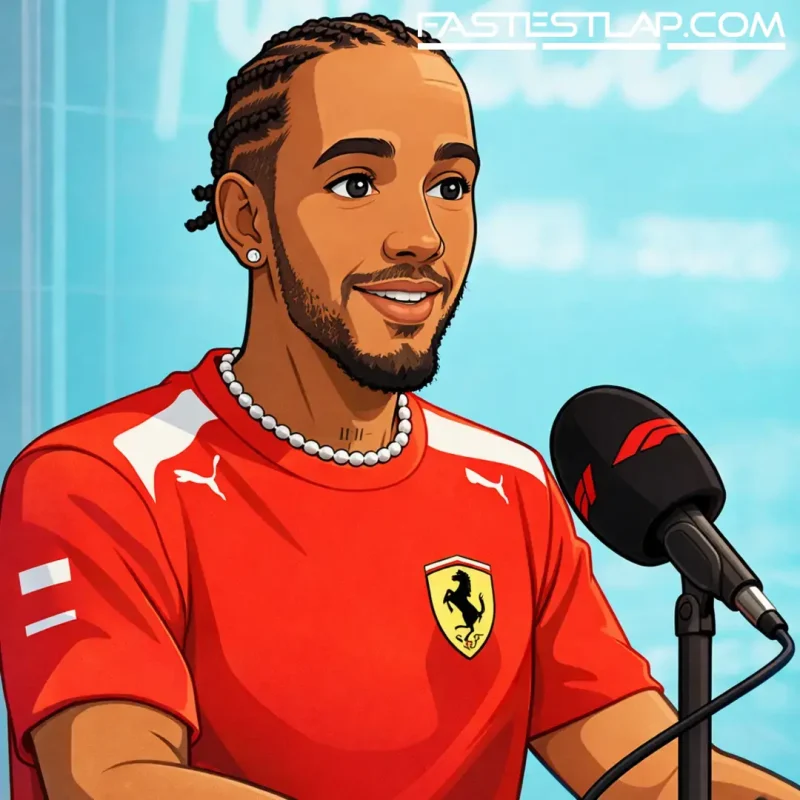
Lewis Hamilton’s Canadian Grand Prix podium didn’t just quieten a few early-season doubts around his Ferrari adaptation — it’s also nudging him towards a pretty telling change in how he wants to work.
Heading into Monaco week, Hamilton admitted he’ll “probably not” be leaning on Ferrari’s simulator in the typical, modern F1 way for race preparation. He’s not swearing it off entirely — he’s been clear he’ll drive it again — but the priority, in his words, is correlation. In other terms: if the numbers and sensations in Maranello don’t line up with what he’s fighting on track, there’s no point burning hours in a virtual cockpit that sends you in the wrong direction.
It’s a revealing stance from a seven-time champion who’s never been shy about trusting feel over theory. It also speaks to a broader truth in 2026: cars are moving targets, and the biggest performance gains are coming from teams that can connect the dots between wind tunnel, sim, and asphalt without kidding themselves. Hamilton’s essentially saying he’d rather do fewer laps in the sim — and have them mean something — than rack up mileage chasing a map that doesn’t match the territory.
Elsewhere in the paddock’s ever-revolving driver-market theatre, Mattia Binotto has offered an intriguing aside on Carlos Sainz’s 2024 decision to join Williams — and, crucially, to not go the Audi route that was widely floated at the time.
Binotto suggested Sainz didn’t simply follow the advice of those closest to him, including his father. Given Carlos Sainz Sr’s long association with Audi, the implication is obvious without being spelled out: there was at least some expectation, perhaps even pressure, that the Audi option made sense on paper. Instead, Sainz “made his own choice”, as Binotto put it — a line that lands as both compliment and quiet acknowledgement that F1 careers are often shaped by family gravity as much as lap time.
There’s a nice irony to it. For all the talk about “projects” and “timelines” in this sport, the drivers who tend to last are the ones who can separate the noise from what they actually want — and then live with the consequences. Sainz picked his path, and Binotto’s comments underline that it wasn’t a decision taken on autopilot.
McLaren, meanwhile, is taking a different sort of long view — one measured in decades rather than contracts. The team will run a special livery across Monaco and Spain as it closes in on its 1000th Formula 1 race, with a tweaked version of the MCL40 design featuring a prominent ‘1000’ and nods to key moments in the journey.
They’re also turning Thursday in Monaco into something of a rolling museum piece: every living McLaren race winner has been invited to a grid celebration, with the current car lined up alongside the M2B — the machine that started McLaren’s F1 story at the 1966 Monaco Grand Prix. In an era when teams can feel increasingly like ultra-efficient tech companies with a racing licence, McLaren is leaning into heritage in a way that’s hard to begrudge — especially at Monaco, where nostalgia is basically part of the track furniture.
Williams had its own forward-looking moment away from the cameras, giving Formula 2 driver Laurens van Hoepen a first private test in older F1 machinery. Team principal James Vowles has also confirmed Williams is “very possibly” considering bringing the Dutchman into its junior set-up.
A TPC run at the Hungaroring might not sound like a headline act, but these are the days where impressions are formed — not just on speed, but on feedback quality, how a driver works with engineers, and whether they understand what matters in an F1 environment. Williams has been deliberate under Vowles about building structure, and that includes treating talent identification like a process rather than a punt.
And then there’s Mercedes, where the internal messaging after Canada has been a study in contrast. Toto Wolff struck a more cautious tone about what the team’s latest upgrades truly deliver, but Kimi Antonelli was far less guarded. The teenager believes there’s more to come once Mercedes unlocks the “full benefit” of what it introduced — a warning that won’t go unnoticed given how Mercedes has begun the 2026 season, and how quickly Antonelli has looked at home in the middle of it.
Drivers can overstate these things, of course. But Antonelli hasn’t sounded like someone guessing. When a rookie talks with that sort of certainty about development potential, it usually means one of two things: either the car’s got a clearer window than outsiders realise, or the team has shown him data that’s hard to ignore. Either way, rivals will have clocked it — because nothing changes the mood in a championship fight faster than the belief that a contender hasn’t even cashed in its upgrade package yet.
Monaco week always amplifies everything — the smallest advantage, the tiniest mistake, the loudest whisper. But the themes emerging right now are more durable than a single weekend: Hamilton prioritising reality over simulation, Sainz steering his own career even when the “obvious” option beckoned, McLaren balancing celebration with performance, Williams quietly shopping for its next prospect, and Mercedes hinting it might still be climbing.
That’s a lot of subtext for a race where overtaking is supposedly impossible. But F1 has never needed on-track passing to keep the politics interesting.









