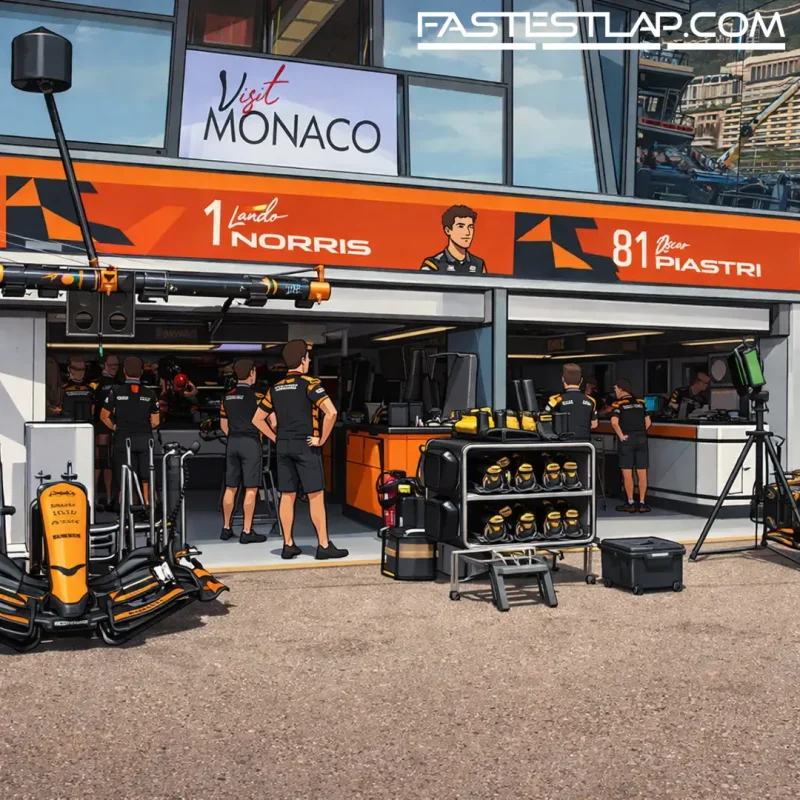
McLaren has turned up in Monaco with the sort of upgrade list that tells you two things at once: it still believes there’s lap time to be grabbed in the tightest corners of the calendar, and it isn’t interested in leaving any low-speed trick unexplored just because the place is an outlier.
Six new parts are logged for the MCL40 this weekend, headlined by a Monaco-specific rear wing concept that’s suddenly become the paddock’s talking point. Mercedes and Red Bull arrived in Monte Carlo with eye-catching rear-wing details built around the activation pod area, and McLaren’s solution sits in the same family: a cascade of extra winglets added around that region to claw back downforce.
The logic is simple enough, and very Monaco. With active aero not in play here, rear wings are effectively locked in a fixed position throughout the weekend. You can’t lean on the usual mechanisms to juggle drag and load corner-by-corner, so teams are going old-school: bolt on more surface area and shape it in ways that keep the car stable through the slow stuff without completely strangling it on the short squirts between the barriers.
McLaren’s winglet cascade is only one piece of the puzzle. Three of its updates are straight performance plays: a larger engine cover intended to lift overall cooling capacity, a revised beam wing, and tweaks to the rear corner. On a circuit where traction, confidence and rear stability decide whether you’re threading the needle or kissing the wall, those rear-end changes aren’t subtle box-ticking — they’re an attempt to reshape how the car puts its power down and holds a platform in yaw.
There’s also a reliability-minded change: a floor stay attached to the diffuser, aimed at improving robustness and controlling deflection. Monaco is brutal on components in a different way to the high-speed venues — kerb strikes, constant steering input, and the kind of minor contacts that don’t make headlines but do bend things just enough to ruin your weekend. Anything that helps keep the floor and diffuser working as designed is worth its weight in lap time here.
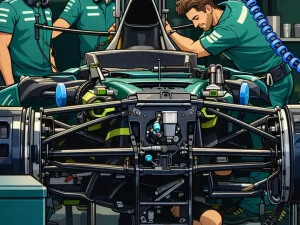
Two items on McLaren’s list are explicitly Monaco-specific: that new front suspension and the rear wing winglet cascade. That’s significant, because it shows McLaren hasn’t treated Monaco as a “survive and move on” weekend. A front suspension change for one event is not the kind of thing you do unless you’re chasing a very particular behaviour — typically mechanical grip, compliance over bumps, and front-end bite at the moment the car transitions from braking to rotation. Around Monaco, those moments are basically the lap.
McLaren isn’t alone in going down this rear-wing rabbit hole. Mercedes has confirmed its own winglet revisions are directly linked to the absence of the SM mechanism, and Red Bull has said the same. The FIA’s upgrade notes underline that while the ideas rhyme, the executions differ: Mercedes has added “small winglets within the rear wing SM fairing volume”, while Red Bull has gone for an extended “SM fairing” alongside a rear wing that includes “a central extension”.
It’s the kind of detail that matters because Monaco is the one place where engineers can afford to be shamelessly circuit-specific. You can carry a drag penalty here and barely notice it. You can load the car up, accept the inefficiency, and bet on the fact that lap time is generated by confidence in the slowest corners and the ability to place the car precisely — not by topping a speed trap.
Red Bull’s Monaco paperwork also lists a new front corner and engine cover, both framed as reliability introductions. Ferrari’s approach looks more like a targeted package: new front suspension, floor body and diffuser, all labelled circuit-specific. That reads like a team chasing a particular aero-mechanical blend through the slow turns — and doing it with the underfloor in mind, which remains where the big performance is.
Further down the pitlane, Williams has turned up with two performance parts focused on the front suspension and the exhaust tailpipe, while Racing Bulls has changed its front suspension and added winglets to the SM pod area — a nod to the same downforce problem everyone’s trying to solve.
In fact, it’s one of those Monaco weeks where “everyone brought something” isn’t an exaggeration. Aston Martin has a new tailpipe and front suspension. Haas has a new front suspension and rear wing. Audi has rolled out a new front and rear wing plus an engine cover. Alpine has also joined the winglet club at the back of the car.
And for Cadillac, Monaco marks a milestone: its debut here comes with a new rear wing and exhaust tailpipe, the sort of pragmatic, circuit-first tweaks you’d expect from a team still building its baseline understanding of how its car responds when the track offers no margin for error.
What’s striking in 2026 is how quickly the grid has converged on the same Monaco conclusion: if you can’t lean on active aero to give you the extra load at low speed, you’ll manufacture it with geometry and add-ons wherever the regulations allow — especially around that rear-wing pod area. The differences are in the details, and the lap time will be too.
Now it’s down to whether these bespoke parts actually deliver confidence. Monaco doesn’t reward theoretical performance; it rewards a car that lets a driver attack the same corner 78 times with the same commitment. If McLaren’s new rear wing and suspension give that, the upgrade list won’t just look busy — it’ll look smart.