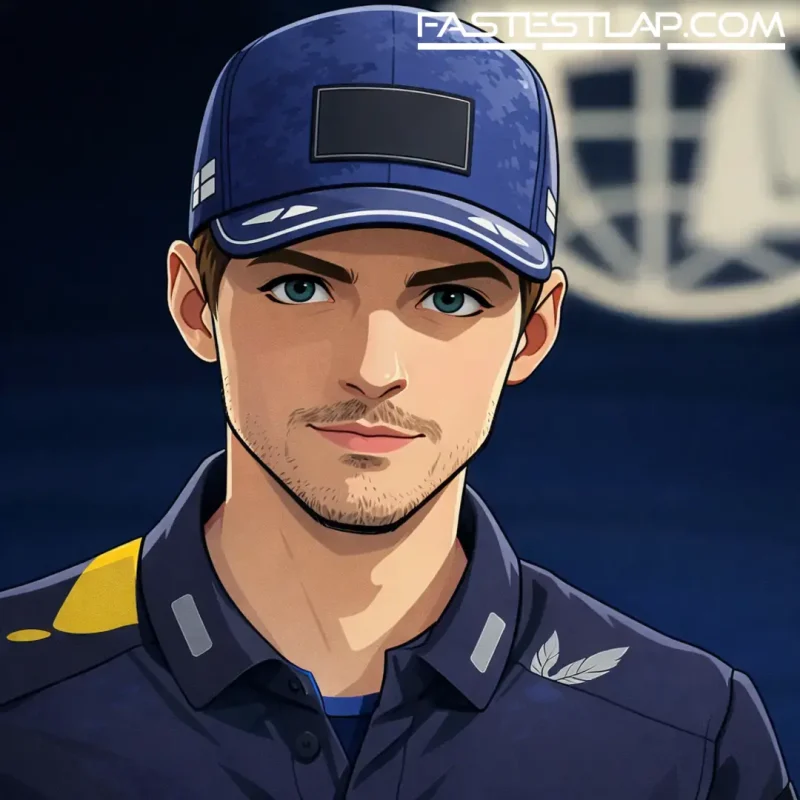
Carlos Sainz has never been shy about a little paddock theatre, but even by his standards this week’s claim landed with a thud of intrigue: Max Verstappen, he says, is essentially contractually insulated from the grind the rest of the grid has come to accept as the price of being a modern Formula 1 driver.
The context was light enough. In a Mundo Deportivo interview, Sainz was asked about the idea of reviving something in the spirit of the old Elf Masters indoor karting event — a once-a-year, no-excuses shootout where F1 names turned up and raced because they wanted to. Sainz, with a grin, suggested he’d back himself to win such a race against today’s field. Then he got to the real point: it couldn’t happen now, not with 24 races and the commercial machine that wraps itself around every free hour.
“I think that in a 24-race championship, with all the marketing and interviews we do, that’s impossible,” Sainz said. “No driver could manage it.
“Well… Max would be the only one, because he’s the only one who doesn’t do marketing or interviews – he has it written into his contracts, he can afford to do so, and Red Bull accepts it.”
It’s an extraordinary thing to say about another driver’s deal, not least because contracts in this sport are treated like state secrets and most drivers are careful not to wander anywhere near them in public. Sainz didn’t offer proof and, to be clear, this is his assertion rather than something confirmed by Red Bull or Verstappen. But the idea resonates because it fits the broader impression F1 has cultivated around Verstappen over the last few years: a driver who doesn’t just want to win grands prix, but wants to control the terms on which he lives the job.
The practical significance isn’t hard to see. Anyone who has spent time around an F1 weekend knows the visible part — sessions, press conferences, the grid — is only the surface. Beneath it is sponsor work, partner appearances, filming days, debriefs that stretch late, and obligations that can turn a “day off” into a sequence of scheduled windows. Even drivers who genuinely enjoy the public-facing side of the sport talk privately about how little mental space is left once the calendar hits full stride.
Sainz’s comment effectively suggests Verstappen has negotiated a different reality: fewer of the time-consuming extras, more room to breathe, and therefore more capacity to chase whatever else he fancies.
And right now, Verstappen fancies GT racing. He’s broadened his programme outside F1 in recent seasons and, notably, made his Nürburgring 24 Hours debut in May. Lance Stroll has also dipped into GT3 during a break in April, but the wider point holds: full-time F1 drivers rarely stack serious competitive mileage elsewhere anymore. Not because they can’t drive — because time and energy are finite, and teams are increasingly protective of both.
So if Verstappen really is operating with fewer commercial tethers than his peers, that doesn’t just make him an outlier. It hints at a deeper shift in where power sits for the very top drivers. The more indispensable you are, the more you can shape the job around performance rather than publicity. Red Bull, in Sainz’s telling, accepts that trade-off.
There’s also a neat sting in the tail. Sainz’s remark wasn’t delivered as a complaint, but it carries an implicit contrast: most of the grid is drowning in the obligations that come with a 24-race sport; Verstappen is the one guy who’s somehow found a way to keep the noise out.
All of this arrives at a time when neither Sainz nor Verstappen are having the sort of 2026 they’d have pencilled in.
Sainz’s Williams move was supposed to be a bet on momentum. The team generated real buzz off a strong 2025 and the sense it had positioned itself smartly ahead of the new regulations. Instead, seven rounds into 2026, Williams has just 11 points — six of them scored by Sainz — and the early narrative has been less about a climb and more about damage limitation.
Team principal James Vowles has insisted both Sainz and Alex Albon remain committed to the project, yet the sport does what it always does when a big-name driver is stuck in the midfield: it starts watching the calendar. Vowles has spoken about 2028 as a target for fighting at the front; Sainz’s response was tellingly candid.
“I think it’s a realistic goal now, but it’s also true that the step backwards we’ve taken this year may well have delayed that goal by a few months or a year,” he said. “I don’t know exactly how much it has delayed it in terms of my own timeline – what I thought this project would take to become a winning team.
“It’s something I’m working on, in my own mind too – how long I’m prepared to wait to win again in Formula 1. I want that time to be as short as possible… I’m going to push the team to make it happen sooner.”
That isn’t a threat, but it is reality. Sainz is a four-time grand prix winner, all from his Ferrari stint, and he’s not at the stage of his career where he’ll quietly accept being told to be patient for two seasons while the sport moves on around him.
Which is why the Verstappen aside matters more than it first appears. In a conversation about a fantasy kart race, Sainz ended up outlining the modern F1 hierarchy: the schedule is brutal, the obligations are relentless, and only the very top can carve out exceptions. Whether Verstappen literally has a “no marketing, no interviews” clause or simply an unusually favourable arrangement, the broader truth is hard to argue with — in today’s Formula 1, freedom is just another performance advantage.