
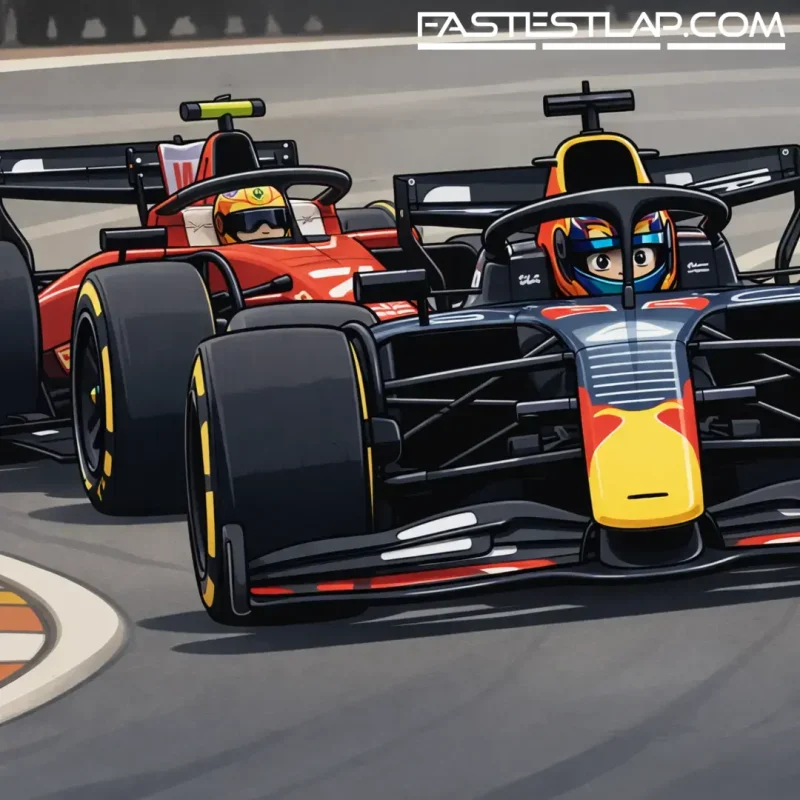
Lewis Hamilton climbed out of the Ferrari in Montreal wearing the kind of grin you don’t often see after a race where you’ve spent the final stint being hunted. Second place behind Kimi Antonelli’s winning Mercedes was a big result on paper; the way it arrived — a properly worked, properly earned scrap with Max Verstappen — was what had Hamilton looking like he’d just been reminded why he still does this.
The Canadian Grand Prix delivered a throwback duel for the podium that never felt like theatre. Verstappen nicked what was then third from Hamilton on lap nine with a decisive move on the inside, Hamilton immediately complaining he’d been caught short on power. That early exchange set the tone: Red Bull could hurt Ferrari on the straights, Ferrari could lean back in through the corners, and both drivers knew exactly what the other was trying to do.
When George Russell later retired, the fight sharpened into a straight shootout for P2. Hamilton spent laps circling, probing — a look through Turns 12/13, another faint at Turn 1 — while Verstappen did what Verstappen does when he’s got a car that’s quick in the right places: place it, defend it, and make you burn time and battery just to get a sniff.
Hamilton admitted afterwards he was “pushing” as he tried to reel Verstappen in, while managing tyre temperatures and the reality of a car that couldn’t simply drive around the Red Bull on the straights. That’s what made the dynamic so compelling: this wasn’t about DRS-drive-bys or a single lunge from too far back. It was the kind of modern F1 problem-solving exercise that still has a human heartbeat — energy deployment, positioning, and a driver deciding when to spend everything.
“You see him in qualifying, we were relatively close,” Hamilton said. “Whilst we’re probably a little bit quicker through the corners, everything you gain in the corner, they gain on the straight, and [it’s] very challenging behind him.”
The key phase, in Hamilton’s telling, was the switch to the medium tyre. Verstappen had been stronger early on, but once Hamilton had the tyre working he could start “the hunt” — and it clearly lit something up in him.
“I love that hunt. My whole life has been about that since a kid… I was just always hunting,” he said. “It was amazing to be back in that position and hunting down a champion up ahead.”
That line mattered, because it spoke to something bigger than one overtake in Montreal: Hamilton isn’t just collecting points in his first season in red, he’s chasing moments that make sense of the move. He called Verstappen “one of the greats” and you could hear the sincerity in it, even after all the years of friction between them.
But the detail Hamilton leaned on wasn’t nostalgia — it was how hard it is to manufacture an overtake when you feel you’re down on power. He described “calculations” on every straight, managing the “battery bar,” timing the spend so he’d have enough at precisely the point the move could be made. This is what fans don’t always see from the onboard: the constant arithmetic, and the fact that you’re making it while the car’s moving around beneath you at 300km/h.
“Even in overtake, they still have more power in the straights,” Hamilton said. “Finding a way… trying to figure out how to maximise the amount of power on my battery bar each straight.”
Eventually, the opportunity came — lap 62, Turn 1, late on the brakes and around the outside. It was a move that didn’t rely on surprise so much as inevitability: Hamilton had shown his hand enough times that Verstappen knew it was coming, but not exactly when he’d commit. When he did, he made it stick.
What followed was almost as good. Hamilton didn’t disappear; Verstappen didn’t fold. The Red Bull stayed in his mirrors and kept applying pressure right to the flag, the sort of close-quarters run that makes even a clean fight look tense because one small mistake would’ve been decisive either way.
Verstappen, for his part, sounded like a driver who’d enjoyed having something straightforward to do for once: race hard, race clean, and see where it lands. He talked about how being within a second at Montreal changes the energy picture, allowing a driver to spend more, and why that matters so much on a circuit where straight-line gain is “very efficient”.
“When you are within a second at this track, we are very energy poor around here,” Verstappen explained. “When you are within a second, you’re allowed to spend a bit more energy… so the last few laps, I tried to get [him] back.”
He also offered a telling little aside: “It’s my first race where I basically had a normal race, nothing crazy happened.” Coming from Verstappen, that landed as both a sigh and a compliment to the afternoon — sometimes “normal” is exactly what you want when the racing is good enough.
For Hamilton, second place in Montreal stands as his best grand prix result so far with Ferrari, and it nudged his season narrative along in a far more convincing way than any quiet points finish could. He leaves Canada fourth in the standings, three points behind team-mate Charles Leclerc, while Verstappen sits seventh on 43 points after five rounds.
None of that, though, was what Hamilton looked happiest about. Montreal gave him an opponent he respects, a car close enough to fight, and a battle that demanded the full toolkit — not just speed, but judgement. In 2026, with the paddock still reshuffling its pecking order week to week, that might be the most valuable confirmation Ferrari could’ve asked for.









