Cadillac insist there’s no mystery left to solve after Sergio Perez’s Canadian Grand Prix retirement — and, more importantly for a team still learning how life feels at the sharp end of F1’s operational demands, they’re adamant it isn’t a warning flare for Monaco.
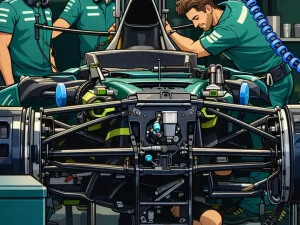
Perez’s race in Montreal ended after 39 laps, but it’s the images that lingered: the front-right suspension letting go in spectacular fashion as he nursed the car back towards the pit lane, and an onboard shot that briefly made it look as if he was steering left on a straight before everything finally came apart. It didn’t help that it instantly stirred memories of Sebastien Buemi’s infamous 2010 failure at Toro Rosso, where a brake application seemed to trigger a dramatic front-end collapse.
Cadillac team principal Graeme Lowdon says the comparison flatters the drama more than the reality.
“We fully understand what happened there,” Lowdon said in Miami, explaining that what people saw flying around on the onboard was “primarily the brakes”, not a sudden, unexplained implosion. The key detail, according to Lowdon, is that the decisive failure didn’t begin at the braking zone at all — it had already started earlier.
“There was already a failure ahead of that,” he said. “Then as soon as the brakes get applied, there’s nothing securing the brakes to the level that they need to be, so you then end up with something that looks quite dramatic at the end of it.”
In other words: the moment the driver gets on the pedal, the forces simply finish off what’s already compromised. It’s a subtle but important distinction for a new entrant trying to project calm. A component failing under load is one thing; a latent fault that manifests later is another — and it’s the latter that can rattle confidence internally if you can’t pinpoint it quickly.
Lowdon’s message was that Cadillac have done exactly that. The “root cause”, he said, has been identified and “already been addressed”, and he pushed back against the idea that the team should be particularly worried heading into the slow-speed, high-commitment torture test of Monaco.
“If the question was ‘are we concerned about Monaco after that’, no,” he said. “I think pretty much every team’s seen something similar in the past, so I don’t think it was anything too out of the ordinary.”
That’s a telling line from a team boss trying to balance two competing jobs at once: being transparent enough to satisfy a paddock that always assumes the worst, while also damping down the kind of narrative that can snowball around a young operation. Mechanical DNFs are one thing; a reputation for fragility is another, and it’s the latter Cadillac can’t afford to let take hold in its first season.
Monaco, of course, has a habit of turning small issues into big ones. The margins are tight, kerbs are unforgiving, and anything even slightly “not quite right” tends to show up brutally. But Cadillac will lean on experience: Perez and Valtteri Bottas are not learning the principality’s rhythms for the first time. Lowdon pointed to that as a “big plus point” for a team approaching only its sixth Grand Prix.
Perez, a Monaco winner in 2022, and Bottas, who has a best finish of third there (2019), give Cadillac a driver pairing that understands the weekend’s peculiar pressures — from threading a car through a qualifying lap that feels like it’s happening in a corridor, to surviving a race where impatience is punished and concentration is everything.
“You’re always optimistic — you have to be optimistic,” Lowdon said. “It’s a very challenging circuit, it’s an outlier in so many ways. I think we’ve got drivers who know their way around the streets of Monaco pretty well… It’ll be our sixth ever grand prix, so we’re going to look forward to it for sure. We ain’t tired of any of this yet, that’s for sure!”
Lowdon’s upbeat tone also lands against a backdrop of noise Cadillac have been trying to stamp out. In Miami, he again rejected speculation that Bottas could be replaced ahead of Monaco after a difficult start to the year, dismissing talk that test driver Colton Herta might be parachuted into the race seat.
Lowdon said there was “no foundation of truth” to the rumours, and went a step further by taking aim at the basic credibility of the claims: Herta, he pointed out, doesn’t yet have the FIA superlicence points required to race in Formula 1.
“In terms of rumours… a few that I’ve read just don’t even seem to take into account some of the absolute basic rules of Formula 1,” Lowdon said. “Some of them suggest they would put Colton in to replace Valtteri in the next few races or whatever. Colton doesn’t have any super license points… and, to some extent, that probably says it all about the quality of some of the rumours.”
For Cadillac, the immediate priority is simpler: arrive in Monaco with a clean bill of health after Montreal, and with the confidence that the Perez failure is filed away as an early-season lesson rather than the start of a pattern. The team can’t control the gossip cycle, but it can control the message it sends with its next weekend: calm execution, two drivers who know exactly what Monaco demands, and a car that stays in one piece.