Max Verstappen’s third place in Montreal didn’t just feel like another salvage job from a slightly scrappy Red Bull weekend. It landed as a small but pointed milestone in the new era: the first podium for the Red Bull Powertrains-Ford project, and Ford’s first visit to the rostrum in Formula 1 since Giancarlo Fisichella’s Jordan-Ford win in Brazil back in 2003.
In 2026, that history lesson matters because Ford hasn’t returned as a sticker-on-the-side sponsor. It’s tied itself to Red Bull’s biggest structural gamble — turning the Milton Keynes operation into a true manufacturer outfit via Red Bull Powertrains, in a landscape where the sport’s direction is being shaped as much in FIA meeting rooms as it is on Sundays.
Ford Performance’s global director Mark Rushbrook was keen to frame Canada as a “landmark moment” for the partnership, and you can see why. Early in a new regulations cycle, when reliability quirks and calibration oddities can chew up weekends without warning, any tangible result that looks like progress becomes a proof point internally. And externally, too.
“Seeing Max secure a first podium of the Red Bull Ford Powertrains era is a landmark moment for our partnership,” Rushbrook said. “It has been fantastic to witness the remarkable effort that has gone into the preparation for the 2026 season, and this result is a well-earned marker of the efforts of both Oracle Red Bull Racing and Ford Racing.”
That’s the corporate line — but it dovetails with what rivals have been muttering in the paddock since the opening flyaways: the RBPT package is properly competitive. Red Bull’s RB22 has been uneven through the first five grands prix, yet the power unit itself has earned a reputation as one of the sharpest tools on the grid, regularly bracketed with Mercedes and, depending on who you ask, possibly the benchmark.
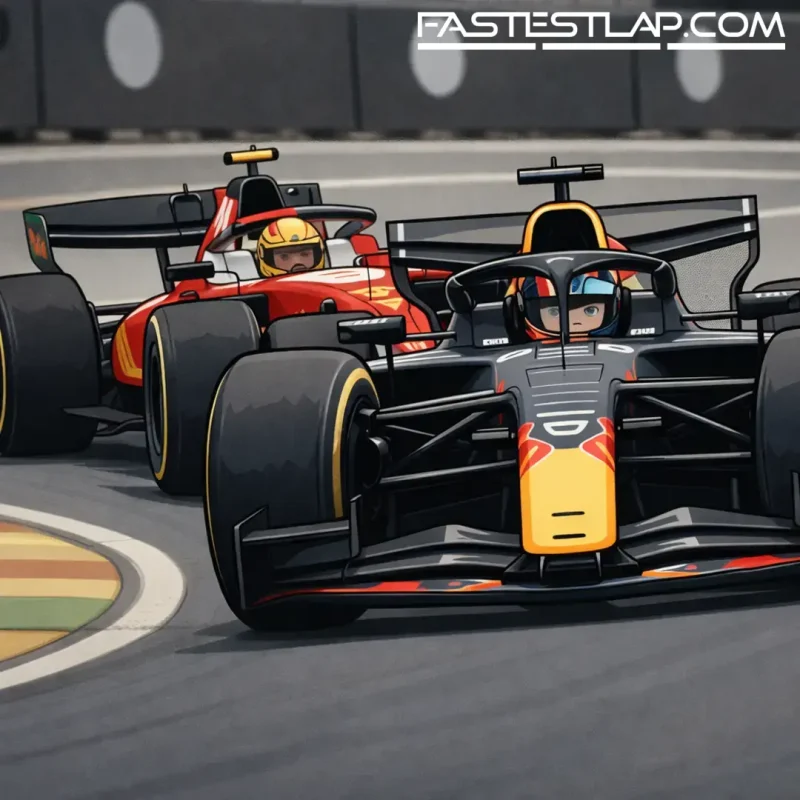
Canada was a good advertisement. Verstappen had to earn it, muscling his way to third after a hard fight with Lewis Hamilton behind race winner Kimi Antonelli. It was classic Verstappen: pragmatic aggression, no wasted motion, and a clear sense of what the car could and couldn’t do. For Ford, it was a clean headline after a return that’s been anything but quiet.
Because if the power unit story is encouraging, the politics around it have been loud. Red Bull has spent the last year not only bedding in a new engine programme, but also absorbing a major leadership reset. Christian Horner, the man who had been the catalyst for the RBPT push under the late Dietrich Mateschitz, is no longer in charge. Laurent Mekies now oversees Red Bull’s racing activities, including the powertrain project, and that reality hangs over everything — including how the Ford partnership is managed day-to-day.
Rushbrook insists the collaboration is in a healthy place, and his comments read like the kind of reassurance you give when you know people are watching closely for cracks.
“We’re very happy with where we are right now,” he said. “Red Bull Racing and Red Bull Powertrains – they’re great partners… The partnership with them has been incredible to develop an all-new power train together with them, based in Milton Keynes, and I’m incredibly proud to have that power unit on track in the Red Bull Racing cars and the Racing Bulls cars as well.”
He also went out of his way to credit the key faces on the Red Bull side: Ben Hodgkinson leading the powertrains business, and Mekies running the wider operation. The subtext is straightforward: Ford wants this to look stable, because stability is performance in a cost-capped, tightly regulated world.
That regulatory world is where the next phase of this story lives. The FIA’s catch-up mechanisms and the so-called ADUO checkpoints are already a talking point, and Montreal was one of those moments where paddock whispers started to sharpen into expectation. Rushbrook laughed off the suggestion he’d predict how the FIA would judge RBPT’s status after Canada, but the implication is obvious: if RBPT is already within the two per cent performance window — or even leading — it may not be eligible for extra upgrade opportunities.
Whatever you think of the rule, it changes the tone of a manufacturer’s first season. It’s one thing to arrive with a to-do list and a development roadmap. It’s another to arrive, find you’re near the front, and realise the rulebook may effectively tell you to hold position while others get a leg-up.
Rushbrook, for his part, sounded broadly supportive of the principle — with the usual competitive caveat.
“There needs to be something like that in place… everybody’s brand is on the line, so to give an opportunity, I think it’s appropriate,” he said, adding that he trusts Mekies and Hodgkinson to handle the politics with the FIA and F1.
Hodgkinson has been more blunt in the past, arguing he’d rather see a “gloves-off fight” without homologation. The irony is that the very tools designed to stop manufacturers lighting money on fire — budget caps, dyno limits — are also the tools that should, in theory, make a freer development war survivable. But that’s not the world 2026 has built. Not yet.
Ford’s return, then, is already balancing three tensions at once: the desire for rapid innovation, the reality of regulation throttles, and the need to present a united front during Red Bull’s internal transition. Montreal delivered a neat, photogenic reward — but it also raised the stakes. If RBPT-Ford really is at the sharp end, it won’t just be judged on podiums. It’ll be judged on whether it can keep moving forward while the rulebook tries to compress the field behind it.
Rushbrook’s closing message was unmistakably long-term: Ford wants this to deepen, not just last.
“Ford wants to be in Formula 1 long-term… we’re very happy to be back, and we want to continue that long-term, and we’re very happy with that Red Bull relationship,” he said. “It’s a partnership… where we feel like we’re able to talk and listen to each other and move forward.”
For now, that first podium is a marker. The next question is whether Red Bull-Ford can turn “top half of the grid” satisfaction into the only currency that matters in this paddock: wins — and, soon enough, a championship fight that doesn’t end with “within two points.”