Rachel Brookes didn’t exactly disappear when she walked away from Sky Sports at the end of June. If anything, Silverstone weekend underlined the more interesting reality: in modern F1, the line between broadcaster, team partner and paddock personality has never been blurrier.
Brookes’ first prominent outing since leaving Sky came not in a rival TV pen, but on Aston Martin turf. She fronted “The Lawn” during the British Grand Prix weekend, the team’s annual VIP and fan hospitality event staged at the AMR Technology Campus a short hop from the circuit. In the middle of a messy sporting weekend for the green cars, the off-track operation ran exactly as you’d expect from a team that’s building an empire as much as a race car.
Her Sky departure was announced ahead of the Austrian Grand Prix, Brookes telling followers she was “moving on to exciting new ventures” while staying “involved” in Formula 1. Sky, for its part, framed it as a straightforward reshuffle as the broadcaster evolves its coverage, praising her contribution and wishing her well.
One thing that’s clear from the paddock chatter is what it wasn’t: this wasn’t some knee-jerk reaction to her recent podcast appearance, where she spoke candidly about the online abuse she received after an interview with Max Verstappen in 2025. Those close to the situation have been adamant there’s no link. Brookes herself hasn’t offered further detail when approached, and given how quickly she’s reappeared in a high-profile F1-facing role, it’s hard to read this as anything other than a deliberate pivot.
Aston Martin, crucially, isn’t a new relationship for her. Brookes has long been one of the most recognisable faces in the team’s outward-facing media, having hosted its car launches in 2022, 2023 and again this year. In other words, this wasn’t a one-off cameo: it looked and felt like the sort of move that’s been quietly lined up for a while. Teams don’t hand major hospitality hosting duties to unfamiliar hands, not when sponsors and partners are in the room and the brand is the product.
“The Lawn” itself was billed as her home for the weekend, and the content did what it always does: humanise the operation, soften the edges, make the technology campus feel like a destination rather than a factory. There was the obligatory pit stop challenge and a set from Razorlight, the kind of programme that keeps the energy up regardless of what’s happening on the timing screens.
And what was happening on the timing screens was, frankly, grim.
Aston Martin arrived at its home race already under pressure and left with more questions than answers. Lance Stroll and Fernando Alonso qualified on the back row for the fourth consecutive weekend, a statistic that lands with a thud given the scale of ambition behind this project. The race did little to lift the mood: Alonso came home 18th, Stroll 19th, with Stroll picking up three five-second penalties within nine laps for separate track limits infringements — the sort of detail that makes a bad Sunday look even longer when you’re trying to manage a season’s narrative.
Brookes, posting a series of images from the event, joked that they “even made Fernando Alonso smile at the end of a tough day”. It was a neat line — and also a reminder of the role people like her play in the F1 ecosystem now. When results are sliding, a team’s ability to control the tone, keep partners engaged and project momentum becomes part of the competitive landscape too. It’s not points, but it’s not nothing.
Aston Martin is, inevitably, selling hope. The team is pinning much of the second half of its 2026 season on a major upgrade package due to land at the Hungarian Grand Prix later this month. Team principal Adrian Newey has already begun to outline the shape of it, talking up the potential for a “large” step forward.
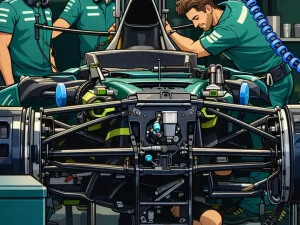
The details matter because they speak to the kind of problems Aston Martin believes it has. Weight is a major target — the plan is to take mass out of the chassis and gearbox architecture — and there are also changes coming to the rear suspension, the nose and the car’s aerodynamic surfaces. It’s not a token tweak; it reads like a proper reset attempt.
There’s more in the pipeline too, with a Honda engine upgrade expected for the Dutch Grand Prix, the first race after the summer break. Put together, it sets a clear internal deadline: Hungary is the chassis/aero push, Zandvoort brings the power unit side, and the team needs both to meaningfully change the trajectory.
In that context, Brookes’ Silverstone appearance lands as more than a feel-good “what’s she doing now?” moment. It’s a small window into how F1 careers increasingly operate — not in straight lines, but in overlapping circles. Broadcast talent becomes team talent; team talent becomes event talent; and the paddock keeps moving, swapping faces between its various stages.
For Brookes, it looked like a smooth first step into whatever her post-Sky portfolio is going to be. For Aston Martin, it was a reminder that even when the car is making life difficult, the show around it still has to run flawlessly — because the next big promise is only ever a couple of races away.