Isack Hadjar’s finest Sunday in Formula 1 might yet be decided in a stewards’ room rather than on the streets of Monte Carlo.
The Red Bull driver was classified third in a Monaco Grand Prix that unravelled in the closing laps, finishing behind Kimi Antonelli and Lewis Hamilton, and inheriting the final podium spot after Charles Leclerc’s late exit. But the FIA is investigating Hadjar and Red Bull for an alleged red-flag infringement, with the podium now hanging on an interpretation of what the team did — and when — during the stoppage.
Monaco’s finish went from tense to chaotic when a late Safety Car period was followed by a race suspension after incidents involving Lance Stroll and then Leclerc at the final corner. Hadjar was initially looked at for a potential Safety Car infringement, only for that to be cleared. The bigger issue is what followed once the red flags came out.
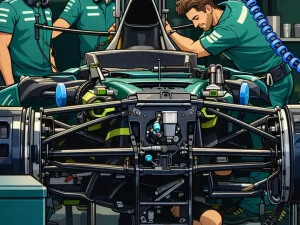
In the stewards’ summary, the FIA noted that Red Bull mechanics were observed working on Hadjar’s car during the suspension in a way that may breach the regulations.
“During the suspension of the Race, mechanics of the Oracle Red Bull Racing Team were working on car number 6, performing operations not permitted by Article B5.14.4.a. at 16:55,” the note read.
“When queried about their works, they stopped working and reverted the car to its previous state without replacing any part.”
That wording matters. Monaco is always a game of inches, but under a red flag the sport becomes painfully binary: either the work was permitted, or it wasn’t. And even if a team claims nothing was changed in the end, the FIA’s reference to “operations not permitted” puts the emphasis on the act itself, not the outcome.
Hadjar’s result is particularly exposed because of how tight the battle was behind him. He took the flag 23.4 seconds behind Antonelli and 16.1 behind Hamilton, but only 0.9s ahead of Oscar Piastri. Liam Lawson, classified fifth, was only a further 2.3s back. Any meaningful sanction could therefore do more than reshuffle the podium — it could drop Hadjar into the pack, depending on what penalty the stewards deem appropriate.
There’s also an uncomfortable irony here: Hadjar earned that podium the hard way. With Max Verstappen sidelined by a start issue, Hadjar ended up as Red Bull’s lone finisher and spent a significant part of the race fighting what he later described as gremlins in his RB22, including a lack of power that made him a sitting duck at times. Monaco doesn’t offer many ways to pass, but it offers plenty of ways to apply pressure, and Piastri did exactly that late on.
Hadjar’s composure stood out all the more given his weekend. He’d crashed in practice and admitted it knocked his confidence — the sort of candour you don’t always hear from drivers trying to project bulletproof certainty. To respond with a podium, holding off a McLaren in a compromised car at Monaco, is the kind of performance that can shift a driver’s internal narrative for a season.
Which is why a post-race procedural penalty would be such a brutal way to lose it.
Hadjar wasn’t the only driver on the stewards’ radar as Monaco’s messy afternoon generated a backlog of paperwork. George Russell received a drive-through after an earlier pit-lane speeding penalty was not served correctly. Pierre Gasly also picked up a time penalty for speeding in the pit lane, while Piastri incurred the same but was able to clear it during his stop.
For Red Bull, though, the stakes here are more pointed than another line in the official document. Teams drill their pit crews relentlessly on red-flag protocols because the margins are microscopic and the consequences can be enormous. If the FIA concludes Red Bull crossed the line — even briefly — it won’t matter that the mechanics stopped when challenged or that the car was reverted. The question becomes whether that moment itself constituted gaining an advantage or breaching a controlled condition designed to keep the playing field level during suspensions.
And for Hadjar personally, the difference between “Monaco podium” and “penalised out of it” will stick to his 2026 story either way — a defining result, or a defining frustration.
The FIA’s decision will determine which version makes it into the record books.