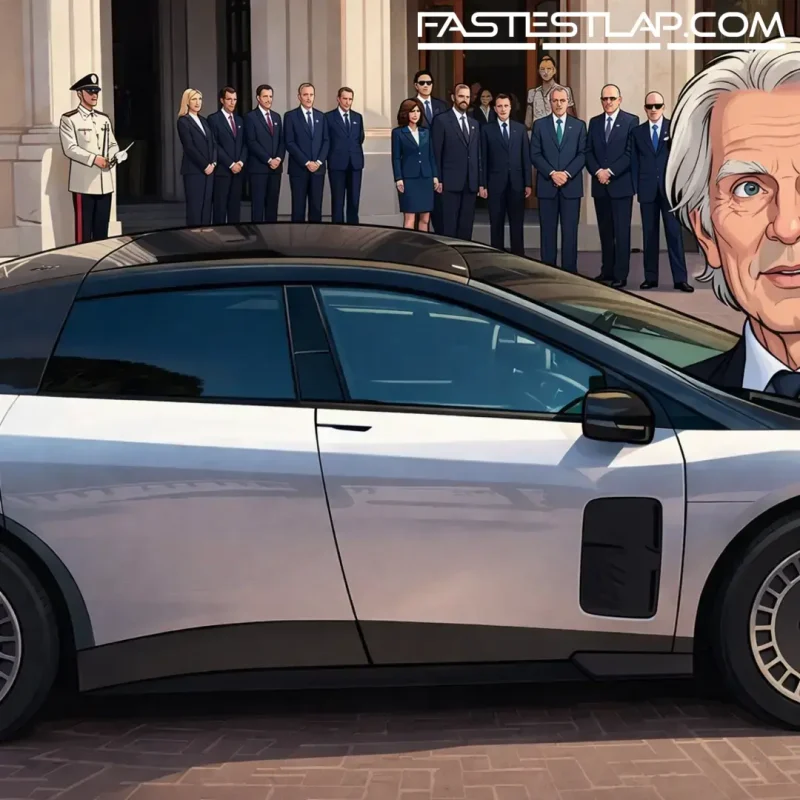
Ferrari knew its first fully electric road car would land with a thud in certain corners of its own fanbase. What it probably didn’t expect was the loudest dissent coming from one of the men most closely associated with the modern myth of Maranello.
Luca di Montezemolo has taken a swing at the newly unveiled Ferrari Luce — the company’s first EV and its first five-seat model — and he didn’t bother dressing it up. At 78, the former Ferrari F1 team boss and ex-chairman is no longer obliged to play the loyal elder statesman, and his verdict reads more like an intervention than a product review.
“If I were to say what I think, I would do Ferrari a disservice,” he’s widely quoted as saying, before immediately doing exactly that. His main point cut straight to the symbolism: he wants Ferrari to remove the Prancing Horse badge from the Luce. In Montezemolo’s telling, this isn’t just a new model line — it’s a reputational gamble with the brand’s hardest-won currency.
“We risk destroying a legend, and I am very sorry about that,” he added, also firing off a sharp aside: “This is certainly a car that at least the Chinese won’t copy.”
It’s a spectacularly undiplomatic broadside, and it matters because Montezemolo isn’t simply another nostalgic voice moaning about batteries. For a generation of tifosi, he embodies Ferrari as a cultural institution: the careful stewardship of an idea as much as a racing team, the insistence that the badge means something beyond performance figures and quarterly results.
That’s what makes the Luce such a lightning rod. On paper, Ferrari has stacked it with the sort of numbers that should stop arguments before they start. The Luce is priced north of $600,000. Ferrari says it produces over 1000 hp, runs 0–62 mph in 2.5 seconds, and targets an estimated 329 miles of range on a full charge, subject to homologation. It has also been designed in partnership with LoveFrom’s Sir Jony Ive and Marc Newson — a statement of intent, as much aesthetic as automotive.
Deliveries are set to begin in the fourth quarter of 2026.
None of that blunted the reaction. The car has proven divisive since its reveal, and the market response underlined just how sensitive this pivot is. Ferrari shares fell by more than eight per cent in Milan and by more than five per cent in New York the day after the Luce broke cover, according to widely reported figures. Investors don’t usually panic over a single product launch unless they think the brand’s pricing power — the very thing Ferrari trades on — might be more fragile than it looks.
What adds spice is the unavoidable Formula 1 subtext, even if the Luce itself is not an F1 story. Ferrari has lived in the electrified era for over a decade thanks to the turbo-hybrid V6 regulations introduced in 2014, and in 2026 electrical energy becomes an even bigger part of the performance picture. In that context, an all-electric Ferrari is less a shock than an inevitability.
And yet inevitability isn’t the same as acceptance — especially when the company’s heritage has been built around the theatre of internal combustion: noise, heat, violence, and the sense that you’re buying into a lineage rather than a drivetrain. The Luce asks customers to transfer that emotion to a different kind of speed. For some, that’s modernity. For others, it’s sacrilege.
Montezemolo’s complaint isn’t really about whether an EV can be fast. It’s about whether it can be Ferrari-fast in a way that feels authentically Ferrari. The badge request is telling: he’s arguing the Luce doesn’t just challenge tradition; it risks cheapening it by stretching the definition of “Ferrari” until it becomes a marketing exercise.
Ferrari’s counterargument — implicit in the Luce’s very existence — is that the legend only survives if it evolves. That the Prancing Horse has never been a museum piece, and that the brand has spent years learning to blend electricity with performance at the sharp end of motorsport. From that perspective, the Luce isn’t an abandonment of the old world but a bid to carry Ferrari’s obsession with speed and design into a future where emissions rules, urban restrictions, and customer expectations are moving whether enthusiasts like it or not.
The tension, then, is less about the car and more about who gets to define the company’s identity in 2026: the guardians of an older Ferrari mystique, or the modern Ferrari that sees luxury, technology and exclusivity as the real constants — with the power source simply the latest variable.
What’s certain is that Ferrari’s EV era won’t be eased in quietly. When one of your most famous former bosses is effectively asking you to de-brand your newest flagship, you’re no longer dealing with a launch-window backlash. You’re in a fight over the meaning of the badge itself — and that’s the kind of argument that tends to linger long after the first deliveries roll out.