Ferrari’s been talking about its rotating rear wing all season as if it’s the sort of cleverness that should pay rent on the SF-26. Now, in the paddock heat of a Hungarian Grand Prix weekend that’s always about downforce and patience, it’s arrived with a version that looks less like a gentle evolution and more like an admission that you can’t keep leaving circuit-specific performance on the table.
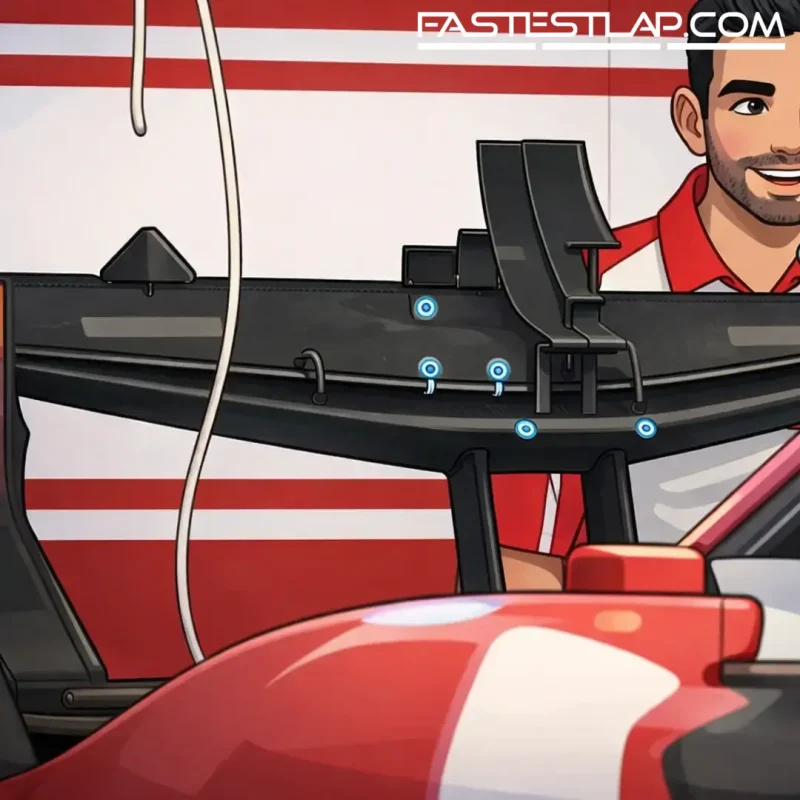
Photos from the pit lane on Thursday showed an extreme take on Ferrari’s much-discussed “Macarena” rear wing concept: three curved mini-winglets stacked vertically, perched like an add-on cascade. It’s a striking piece of hardware, and not just because it’s visually busy. The Hungaroring punishes anyone who turns up under-winged; it’s a place where you can lose a weekend on Friday if your baseline aero choice is timid. Ferrari is clearly trying to ensure that doesn’t happen again.
The timing is telling. Earlier in the year, Lewis Hamilton didn’t hide his surprise at Monaco when Ferrari arrived without the sort of trick high-downforce rear wing solutions others had produced. With active aero effectively taken out of the equation there, several teams leaned into bespoke rear-wing add-ons to claw back load the old-fashioned way. Ferrari didn’t, and Hamilton flagged it publicly.
“I think when we arrived on Thursday we saw other people, those guys with trick additions to their wing, we didn’t have that, which was a little bit of a surprise,” he said at the time.
Budapest is obviously not Monaco, but the demand profile rhymes: low speed, long corner duration, a premium on rear stability and traction, and a lap that’s more about rhythm than heroics. If Monaco exposed a gap in Ferrari’s toolbox, Hungary looks like the first proper attempt to slam it shut.
What makes this more interesting is that Ferrari’s rotating rear wing has already become one of the defining technical stories of 2026. First seen in pre-season testing and then effectively embedded into Ferrari’s identity since Miami, it’s been influential enough that both Red Bull and McLaren have pushed their own versions into the mix. That’s the thing about a concept that’s both visible and apparently valuable: it forces everyone else to either copy it or prove they don’t need it.
But “copy it” in 2026 hasn’t been as straightforward as it sounds. Red Bull’s run with its own take has been turbulent. It encountered trouble with its active aero system, specifically an airflow reattachment issue on the rear wing, which was linked to Max Verstappen’s accidents in Austria and Britain. The team then rolled back to an older-spec rear wing in Belgium while it worked through the problem, with technical director Pierre Waché later confirming the troublesome wing had been fixed and hinting it could return in Hungary.
That subplot matters because if Red Bull does reintroduce its Macarena-style wing this weekend, Budapest becomes less of a pure “Ferrari brings a new toy” story and more of a three-way check on who actually understands the interaction between these rotating elements and the rest of the car. It’s one thing to make the mechanism function; it’s another to keep the airflow behaving when conditions change mid-corner and the car’s riding kerbs, yawing, and living on the rear axle.
McLaren, too, is hovering in the background. It could bring its own rotating rear wing to Budapest after a planned trial was scrapped in Austria when Lando Norris hit a technical snag in FP1. If that part is now resolved, Hungary’s high-downforce requirement is the natural moment to try again — not least because a lot of the benefit of these concepts is believed to be in how teams blend cornering load with straights efficiency. At the Hungaroring, you don’t have many places to hide if the trade-off is wrong.
For Ferrari, the political and competitive context is pretty simple: it can’t afford another weekend where its drivers are asking why rival garages have a solution it hasn’t even unpacked. The SF-26 has had the Macarena wing as a permanent fixture since Miami, which tells you the team believes in the principle. But this new, more extreme assembly suggests Ferrari has accepted that “believing in it” isn’t enough — you need the full range of specifications, from medium-downforce compromises to the sort of aggressive option you only dare to run when the circuit forces everyone’s hand.
There’s also an undercurrent here about development discipline. With regulations still relatively fresh in 2026, teams are learning — sometimes painfully — where the sensitivity is. Red Bull’s recent wobble is an example of what happens when the system’s edge-case behaviour bites back. Ferrari’s Monaco miss was the opposite problem: the system might have been robust, but the hardware menu wasn’t complete.
Budapest is a decent place to find out whether Ferrari’s new add-ons are performance, theatre, or a bit of both. If it works, it won’t just be about lap time; it’ll be a signal that Ferrari’s listening to its drivers and closing the loop faster. If it doesn’t, then the sport’s “outstanding innovation” of 2026 starts to look a little more like a high-wire act — and one that can just as easily throw you off as carry you forward.