
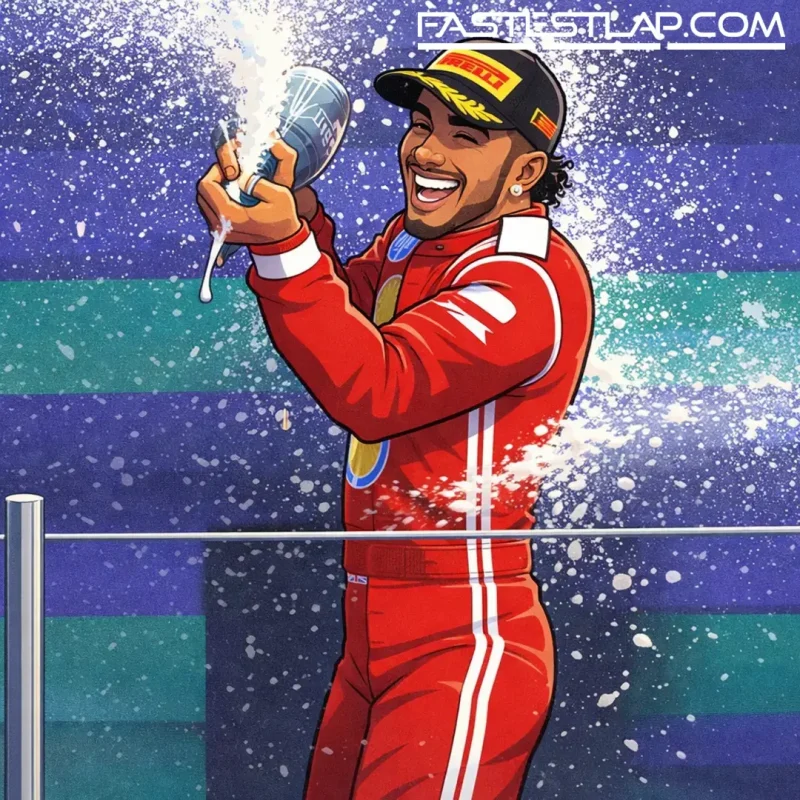
George Russell didn’t need telling twice what he’d just watched in Barcelona.
Mercedes looked comfortable in the Spain heat until Ferrari rolled the dice on strategy — and Lewis Hamilton, of all people, was the one cashing in. Russell, second on the day behind his former team-mate, was quick to applaud the result. He was also candid about what it means for the weeks ahead: a rival Mercedes thought it had left behind is suddenly back in the thick of it.
“It was a big, bold move to join Ferrari,” Russell said after the race. “And to see it now paying off for him is very special to see given the magnitude of the decision. And, yeah, he’s going to be a real threat… Hopefully it doesn’t continue for too long.”
That last line landed with a grin, but the underlying point wasn’t playful. For the first phase of 2026, Mercedes had the look of a team ready to turn the new regulations into a procession — both titles, both cars, a clear pecking order. Now, after three straight Hamilton podiums that built from runner-up finishes in Monaco and Canada into a win in Spain, there’s a different rhythm to the season.
It’s not just a single Sunday, either. Ferrari’s latest upgrades have clearly shifted its baseline. Hamilton has spoken openly about feeling more at home in this new generation of cars after four bruising seasons in the ground-effect era, and the timing matters: when a driver with Hamilton’s instincts starts talking like he trusts what’s underneath him again, the paddock takes note.
He’s also framing it as something he pushed towards. Hamilton said he spent much of last season lobbying for changes that have now been made — and that he finally feels he has “the right team” and “the right car” around him to “start doing what I do best.” The sentiment is classic Hamilton: equal parts motivation and message, a reminder that he didn’t go to Ferrari for a farewell tour.
Barcelona also shuffled the internal British mini-battle behind Mercedes’ Kimi Antonelli. Hamilton’s Monaco result nudged him ahead of Russell in the standings, and the Spanish Grand Prix has extended that advantage to nine points. Russell, who’d been Hamilton’s nearest reference point at Mercedes, is now looking at his old team-mate as the closer title threat — at least on paper.
The bigger picture is that both are still staring up at Antonelli. The Italian leads on 156 points and holds a 41-point cushion over Hamilton, a healthy margin even in a season where upgrades are arriving like weather fronts and the competitive order can swing quickly. Russell has already said the title is Antonelli’s to lose, and he wasn’t about to rewrite that after one Ferrari masterstroke.
“Well, at the moment Lewis is obviously ahead of me in the championship,” Russell said. “We need to see across the course of a couple of races. They did bring a big upgrade and I think the development slope is so steep at the moment for all of the teams.
“Whoever is going to be bringing those upgrades earliest is going to be taking a step forward.
“We saw it with McLaren in Miami, having a really strong weekend, and then ourselves and Ferrari have taken a step forward thereafter.”
That’s the heart of it. This doesn’t feel like a championship that will be settled by one team “figuring it out” and disappearing. It feels like one where timing is everything: when your update works, when your rivals miss, when your strategy department finds an opening. In Barcelona, Ferrari found the opening and Mercedes didn’t cover it. Those are the sorts of small, unglamorous moments that decide titles long before the dramatic ones do.
For Russell personally, the message was straightforward: no reinvention required, just cleaner execution. “Honestly, the approach doesn’t change for me,” he insisted. “I’m just looking to maximise my weekends. It hasn’t been the case recently and see where it takes us.”
There’s a telling subtext in that, too. Russell’s pace has rarely been the question, but in a year where the margins are being yanked around by upgrades and strategy calls, “maximising” is code for not leaving points on the table. With Hamilton now converting Ferrari’s momentum into real results, and Antonelli out front with a buffer, Russell can’t afford many more weekends that end with a sense of what might have been.
As for Mercedes, Hamilton’s resurgence is the sort of problem you can’t simply wish away. You can beat a fast driver with a slower car over a season; you can’t relax when the fast driver suddenly has a car that can win — and a team willing to gamble to make it happen.
Russell summed it up neatly. It was special to see, he said. He just doesn’t want to see it too often.









