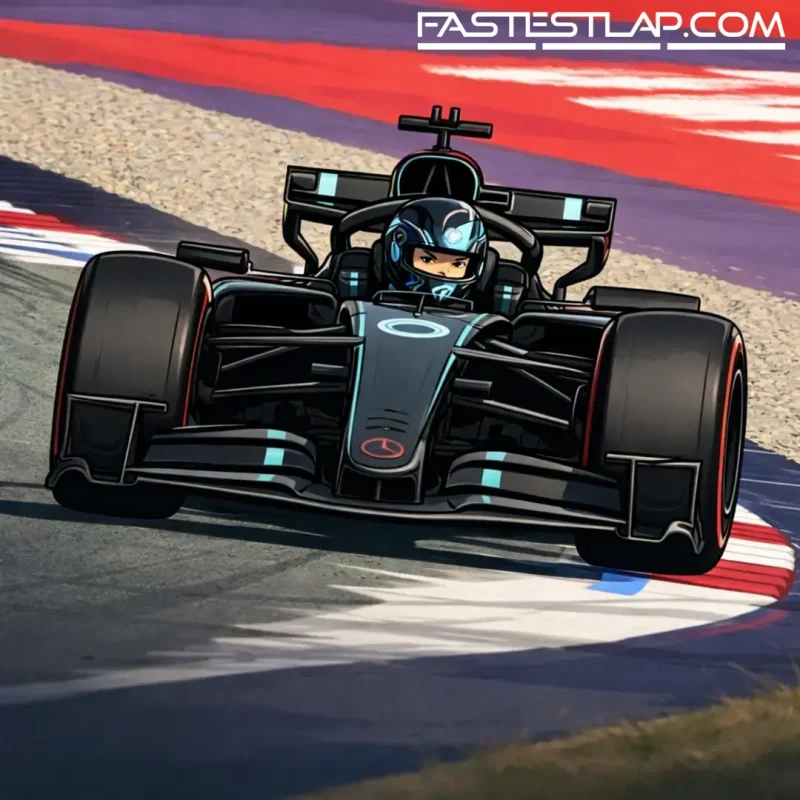
George Russell didn’t just take pole at the Red Bull Ring — he took control of a situation that, for a few tense seconds, had the potential to turn qualifying into a refereeing exercise.
The decisive moment arrived in the grey area every driver hates and every veteran learns to exploit: the gap between a single waved yellow and the escalation to double yellows that effectively kills a lap. Max Verstappen’s Turn 9 crash brought out the caution, and the field reacted in two very different ways. Russell processed it, managed it, and still found enough lap time to put Mercedes on top. Kimi Antonelli, hearing “Yellow, yellow” in his ear and searching for clarity from the marshals, defaulted to the conservative call — and paid for it.
Russell’s own post-session candour hinted at a driver who knows he’s been living on the limit recently. Toto Wolff’s radio message was simple: enjoy it. The response was a pole lap that left both Ferraris behind and even had Antonelli admitting Russell’s time was out of reach. Whatever fog sat over Russell’s form earlier in the season, it’s lifting — and Austria felt like the sort of day that can reset a campaign, not just a weekend.
The yellow-flag debate will linger, because it always does when the fastest lap of the session is completed under any kind of caution. Russell’s defence was that he complied: he lifted, he assessed, he saw no immediate danger, and he didn’t abort. The crucial detail is that he didn’t need to abort under a single yellow — but he did need to demonstrate a reaction. His lift through Turn 9, measured at a fraction of a tenth, was enough to tick the box without detonating the lap.
That’s where Antonelli becomes the uncomfortable counterpoint. The rookie did what race directors and safety advocates say they want drivers to do: err on the side of caution. Yet he was penalised competitively for it, slipping behind the two Ferraris and handing Russell breathing room at the front. It was also, by Antonelli’s account, a rare case of cognitive overload: his engineer’s call, his own glance toward the marshal post, and an interpretation that it was double yellows. He backed out of it.
You can commend him for that and still recognise the problem it exposes. If the sport creates conditions where backing off properly is punished and “just enough” lifting is rewarded, drivers will learn the wrong lesson — not because they’re reckless, but because they’re professional racers chasing hundredths. Antonelli suggested afterwards the situation deserved review and that double yellows might have been the clearer, safer call. He won’t be the last to say it this year.
Behind that controversy, Ferrari quietly had its most convincing qualifying day in a while. Friday sounded grim inside the garage, yet Saturday ended with Charles Leclerc and Lewis Hamilton lining up second and third — an outcome that looked entirely plausible on merit even before Antonelli’s aborted lap reshuffled the order. Leclerc shaded Hamilton for the better grid spot, and he suggested there was still time left on the table, though not enough to reach Russell.
Ferrari’s comments framed this as momentum: the car “feeling good”, the team pushing hard, and updates continuing to arrive. Leclerc referenced chassis changes alongside an ADUO-updated power unit homologation, and the bigger picture was clear: Ferrari is increasingly planting itself as the second-quickest package. In a season where the pecking order can swing with each upgrade cycle, the Scuderia’s trend line matters.
Hamilton, for his part, did what experienced drivers do on a day when perfection matters: made an early mistake, then salvaged the session with one clean attempt when it counted. He also sounded realistic about Sunday. Ferrari has pulled some lap time back, but he felt Mercedes still held a meaningful advantage at this circuit — and pointed to the long run to Turn 3 as the obvious place to apply pressure, especially with both red cars together.
Verstappen’s afternoon ended abruptly and strangely. The Red Bull snapped at Turn 9 with a violence that didn’t look like a typical “too much kerb” moment, and it left the four-time champion with little to catch. Team boss Laurent Mekies took responsibility, describing a loss of rear aero performance that gave Verstappen “no chance to survive”. The one saving grace: Verstappen appeared genuinely in the pole fight before it went wrong, having just produced a purple second sector.
That will draw attention to the wider technical conversation Red Bull — and Ferrari — have been living with: how aggressively teams are operating their straight-line mode active aerodynamics and the margin for reattaching downforce before turn-in. Nobody in the paddock needs a conspiracy to be interested in that after a crash with that kind of signature.
Elsewhere, Aston Martin found a rare reason to smile despite being nowhere near the sharp end. Fernando Alonso was upbeat about progress in drivability — gearbox behaviour, shift quality, and, crucially, energy deployment consistency. He described it as the first qualifying this year where the deployment felt the same on all three runs. In a regulation set where energy management defines straight-line performance, that sort of “boring” consistency can be a genuine step.
Lance Stroll, qualifying behind Alonso, was notably less animated, offering little beyond the familiar “keep pushing” mantra. It had the feel of two drivers processing the same reality in different ways: one extracting motivation from marginal gains, the other simply wanting the stopwatch to back the story up.
Williams, meanwhile, endured one of those Saturdays that exposes the limits of optimism. A double Q1 exit for Carlos Sainz and Alex Albon came with visible sliding and blunt post-session verdicts. Sainz called it a “really, really bad” weekend and pointed to upgrades expected at Silverstone as the hope. Albon felt he’d done a decent job with what he had but admitted the car was living “on the edge” balance-wise. With Williams one of the few teams arriving in Austria without new parts, the gap looked exactly like you’d expect.
One of the cleaner feel-good stories belonged to Liam Lawson. A week spent batting away fresh noise about his future ended with another sharp qualifying, another reminder that he’s operating with a different level of certainty this season. Racing Bulls put both cars into the top 10 with Arvid Lindblad alongside him, even if the rookie didn’t sound thrilled with his own execution. With Alpine lurking just behind — Pierre Gasly 11th — that midfield knife fight looks set to resume on Sunday.
But the headline remains that narrow strip of asphalt at Turn 9 and the judgement call it demanded. Russell made it pay, Antonelli made it hurt, and the sport is left with an awkward question: when the rules allow a “technically correct” pole under a yellow, what behaviour are they really rewarding?