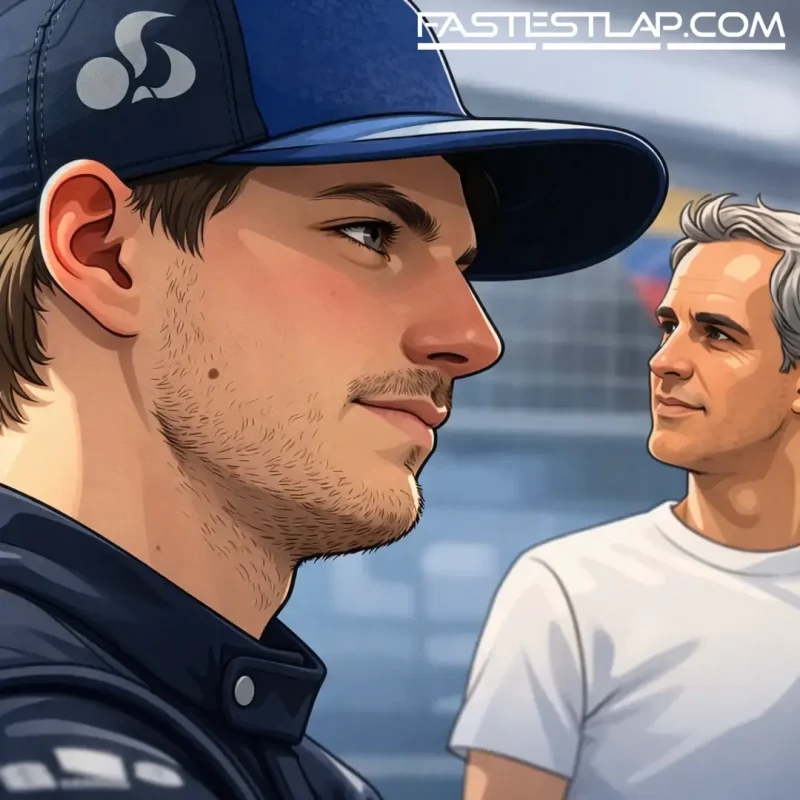
Max Verstappen doesn’t usually bother dignifying paddock noise with a reply, but Juan Pablo Montoya managed to hit a nerve — and the Dutchman responded in kind.
The flashpoint is, inevitably, 2026’s new technical framework and the increasingly public split between those who believe F1 needed a reset and those who think it’s strayed toward something closer to a spec-game than a grand prix formula. Verstappen has been firmly in the second camp for months, branding the rules “anti-racing” and likening the direction of travel to “Mario Kart”. He’s even hinted he could walk away after the 2026 season if the sport keeps heading down a path he doesn’t recognise.
Montoya, never one to let a microphone pass without grabbing it, went the other way. On the BBC’s Chequered Flag podcast, the seven-time grand prix winner argued Formula 1 should effectively “park” Verstappen for criticising the regulations — and floated the idea of handing out Super Licence penalty points to any driver who speaks out against them. It was a classic Montoya grenade: part provocation, part nostalgia for an era when drivers were told to get on with it.
Verstappen’s response, given in an interview with De Telegraaf, was about as subtle as a qualifying lap on fresh softs.
“I can’t really be bothered with someone who talks so much rubbish,” he said, before questioning why F1 “associates itself” with Montoya at all. Verstappen’s point wasn’t simply that he disagreed — it was the implication that Montoya’s occasional work with Formula 1 management gives his comments a different weight.
“I just don’t understand why people like that are paid by Formula 1 management, because he sometimes works for them,” Verstappen continued. “Surely you don’t want someone like that in the paddock, spouting so much nonsense?
“I think it’s a case of: ‘I’ll say something different from everyone else, then I’ll be relevant.’”
That’s a sharper edge than we’re used to hearing from Verstappen when it comes to ex-drivers. He’ll be dismissive, sure, but the “why are you even here?” tone is a step beyond the usual. It also speaks to a broader irritation that’s been building since the regulation debate began: Verstappen doesn’t just dislike the rules — he seems to resent the idea that criticism itself should be policed.
And that’s where Montoya’s suggestion misread the room. Drivers are already living in a world of coached radio messages, sponsor-friendly media lines and increasingly managed personalities. The idea that rule criticism should be punishable doesn’t just sound heavy-handed; it runs counter to the sport’s current appetite for “authenticity” — the very thing F1 sells in its modern, content-driven era.
Montoya, for his part, didn’t exactly back away when the conversation followed him to Montreal. During Sky F1’s Canadian Grand Prix grid walk, Martin Brundle told Montoya he had upset “the Verstappens”. Montoya’s answer was a shrug in sentence form: “Anything new there?”
It was the perfect response for this particular spat: slightly amused, slightly combative, and completely uninterested in smoothing anything over.
What makes the whole exchange more than just a squabble between a current superstar and a former one is the timing. Verstappen arrived in Canada carrying the weight of his ongoing dissatisfaction with the regulations — and left with something tangible on track: his first podium of this new era, finishing third behind race winner Kimi Antonelli and Lewis Hamilton.
In other words, the same weekend he was effectively telling the sport he doesn’t like what it’s becoming, he delivered a result that underlined why it still needs him. F1 can survive any one driver, but it’s plainly better with Verstappen fully engaged — competitively and emotionally — rather than treating it like a job he might quit if the technical direction doesn’t bend his way.
There is a compromise being talked about, too. Verstappen has spoken positively about the agreed proposal to shift the electrical versus internal combustion power ratio for 2027, potentially swinging the split to 60 per cent in favour of internal combustion. Whether that change can actually be implemented is still unclear, but it hints at a sport that knows it may have overcorrected and is already looking for a course adjustment.
Montoya’s line — that criticism should be punished — lands awkwardly against that backdrop. If F1 is genuinely willing to tweak the formula, then outspoken feedback from drivers is part of the ecosystem, not something to stamp out. Even when the feedback is uncomfortable, or delivered with Verstappen’s now-familiar bluntness.
And, perhaps most tellingly, Verstappen didn’t just reject Montoya’s proposal; he rejected the legitimacy of the platform Montoya appears to have in the paddock. That’s a warning shot to F1 itself: if you want drivers to buy into the project, don’t elevate voices calling for them to be silenced.
For now, the war of words will probably cool — at least until the next microphone is switched on. But the underlying tension isn’t going anywhere. The 2026 regulations were meant to define a new chapter. Instead, they’ve become the backdrop to a bigger fight: who gets to shape the sport’s direction, and who gets told to shut up and drive.