
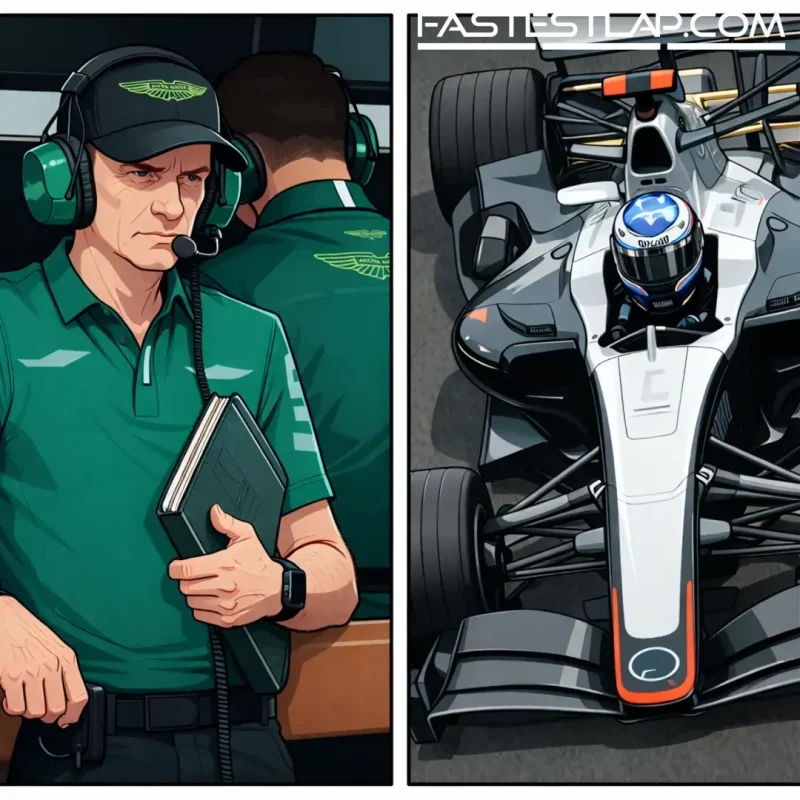
Aston Martin’s 2026 season has been so bleak on the timing screens that it’s easy to miss what’s happening behind the garage doors: this is a team trying to rewire itself in real time, and doing it under the most public pressure cooker in sport.
The curious part isn’t that Adrian Newey has resisted the usual drip-feed of visible upgrades. It’s that the team has largely bought into the pain that comes with that choice. The AMR26 has been a difficult car since it first turned a wheel in Barcelona, and Aston Martin has spent much of the opening half of the year scrapping at the back while it worked with Honda to establish a baseline of reliability before chasing performance. The results are stark — a solitary point to show for it — but the point inside the camp is that this was always the trade.
The next phase is close. Aston Martin is a few weeks away from unveiling a significant upgrade package scheduled for the Hungarian Grand Prix, with further encouragement coming from an ADUO-granted Honda power unit expected to arrive over the coming weekends. In the paddock, “big package” gets thrown around so casually it barely means anything anymore, but the way Aston Martin has framed this one is different: less lipstick, more surgery.
Pedro de la Rosa, now one of the public faces of the project, insists there hasn’t been some sudden morale flip or manufactured “vibe change” as the team waits for the parts to land. If anything, he argues, the mood has been steady precisely because the pain has been explained, internally and repeatedly, with Newey’s stamp all over that bluntness.
“I wouldn’t say there’s a vibe change. It has been the same since the beginning of the season,” De la Rosa said ahead of the British Grand Prix. “We obviously realised we were far away from where we wanted to be and, since then, the team put a plan together. We just have been working towards it, knowing that, as we’re going through a period of not introducing upgrades in the car that is painful, but I think that the vibe is still the same.
“We are still united, we’re working well, and we’re working towards a plan… everyone has been informed of what we were doing and when we were doing it.”
That sounds like corporate comms until you consider the context. F1 teams don’t fall apart when they’re slow; they fall apart when the people inside the machine don’t believe the people steering it. Aston Martin’s first half of 2026 has been exactly the sort of stretch that can splinter a factory — blame games, parallel development directions, “quiet” resignations that aren’t quiet at all. De la Rosa’s point is that transparency has acted like a roll cage around the organisation.
What makes his view worth listening to is that he’s lived through Newey’s highs and the occasional very-public low. In the mid-2000s, De la Rosa was McLaren’s test driver, in the thick of the programme as Newey’s designs evolved — including the stillborn MP4-18, the MP4-19’s troubled early form and its improved B-spec, and then the MP4-20: spectacularly quick, far less spectacularly dependable.
De la Rosa says Newey hasn’t changed “one bit” in two decades, and that’s not meant as nostalgia. It’s a comment about how Newey operates day-to-day — direct, inquisitive, impatient with vagueness — and why that matters when a team is trying to dig itself out of a hole.
“He’s just super good, because that’s Adrian,” De la Rosa said. “With no filters, that’s how he is within the factory… and I think that’s why he’s such a good leader, because the key in our current situation is that everyone has been informed of the plan we were following.”
There’s also the more old-school Newey trait that modern F1 sometimes pretends it hasn’t deprioritised: listening to drivers in a way that goes beyond politely logging comments and returning to the spreadsheets. De la Rosa describes an engineer who doesn’t just ask for feedback — he interrogates it, chases the “why”, and then links it to a design action.
He reached back to a moment from the 2005 Australian Grand Prix, when teams could run a third car in first practice and McLaren sent De la Rosa out in the spare MP4-20. Newey, he recalled, asked him which corner felt worst. The answer was Turn 1 — not because it was slow, but because De la Rosa felt he’d reached the limit of what the car would give him.
That’s where the conversation got revealing. Newey wanted specifics: why he couldn’t carry more speed, why more steering lock didn’t help, what the steering felt like. De la Rosa described a point where adding lock made the wheel go “very light”, with the front simply not biting. Newey asked him to show the steering angle, wrote it down, and then delivered the line that has stuck with De la Rosa ever since: above six degrees, the team had no wind tunnel data. The car was essentially “designed” up to that threshold.
A couple of races later, De la Rosa says, Newey introduced a front-wing modification to address that unexplored operating window. It’s a neat story, but it’s also a very Newey story — not magic, not mystique, just an ability to identify what the model isn’t covering and then correct it quickly.
“That’s the story of the MP4-20,” De la Rosa said. “We were the fastest car in 2005. We didn’t win the championship because mainly we were unreliable, but we were the fastest. It was a beast.”
It’s not difficult to see why Aston Martin people cling to examples like that, especially when the current car has offered so little to celebrate. But the more interesting part is De la Rosa’s explanation of the “blind faith” Newey tends to generate even among those who haven’t worked with him before. It isn’t the CV, he argues — it’s the clarity. When Newey tells you what’s wrong and where it’s wrong, the problem suddenly becomes finite, and in F1 that’s half the battle.
“He has this character, this attitude of knowing what he’s doing and what is wrong, that gives you this blind faith that you will come on top,” De la Rosa said. “He is extremely strong in identifying what is wrong with the car, what part, and why. It is very important because it just saves so much time, and there’s no time available in Formula 1.”
That’s the gamble Aston Martin has made with Hungary in mind. Not that one upgrade package will turn a season on its head — nothing is that clean — but that a more fundamental reset, delivered with conviction and internal alignment, can stop the wasting of weeks on the wrong fixes.
The stopwatch will decide how much of this optimism is earned. For now, Aston Martin’s story isn’t really about a single point or a single update. It’s about whether Newey can do what De la Rosa swears he’s seen before: take a troubled concept, find the missing piece in the thinking, and drag a group of people with him while the outside world laughs at the lap time.









