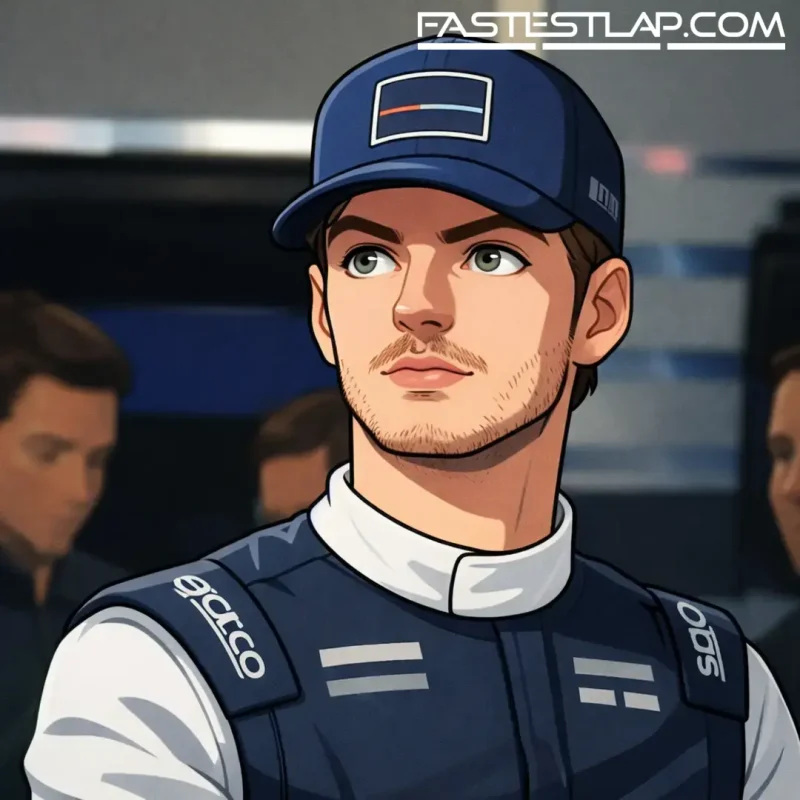
Max Verstappen walked out of Barcelona with another points haul and, on paper, a solid fourth place. It still felt like a quiet kind of bruising weekend for Red Bull — the sort that doesn’t produce a disaster headline, but does underline a more awkward truth about where they are in 2026.
Verstappen wasn’t in the trenches of a scrap, wasn’t flashing into view on alternate strategy, wasn’t ever really in the frame for the win. He spent most of the Spanish Grand Prix in a no-man’s land that’s become uncomfortably familiar this season: not quick enough to go and take the fight to the three cars ahead, but secure enough that the pack behind never properly threatened to drag him into a mess.
Afterwards, he didn’t dress it up.
“It’s clear that we’re still behind Ferrari, Mercedes, and McLaren,” Verstappen said. “Because I basically finished behind each one of them.”
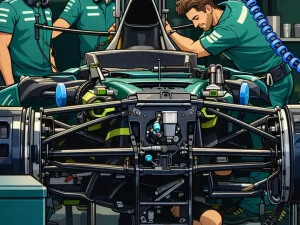
That line cut through the usual post-race fog. Barcelona is a circuit teams still use as a reference point because it asks awkward questions in every direction — a long straight that tells you whether your efficiency is real, plus a sequence of mid-speed and high-speed corners that exposes whether the car has the platform and balance to lean on the tyres. Red Bull arrived with two front-wing updates to the RB22, but in a weekend where rivals rolled out more substantial packages, it was the kind of change that can tidy the car up without shifting the competitive order.
The result, even before the late-race attrition, had a certain inevitability to it. Verstappen ended up fourth, but only moved into that position thanks to the retirements of Kimi Antonelli and Charles Leclerc. That’s not a slight on Verstappen’s drive — it’s the point. He didn’t claw his way there through raw pace. The race came to him.
It also leaves a stark-looking season summary at the front end of June: Verstappen still without a win in 2026 and with only one podium, a third place in Canada. His qualifying record includes two second places and that’s telling in itself — there have been flashes, but not enough weekends where Red Bull has the full lap stitched together to reliably take the front row, let alone control a Sunday.
Even within the team there was no attempt to spin Barcelona as an “almost”. New team principal Laurent Mekies called it a “reality check”, and it sounded like one.
“I think we were expecting that reality check in Barcelona,” Mekies said. “First track with a long straight, the mid-speed, high-speed corners. It’s probably the first time after China, Japan, where we come back to this sort of track.
“So we are expecting certainly a different performance compared to Monaco, where we could suddenly fight for pole.”
That contrast is doing a lot of work here. Monaco can be a mirage: a place where a car with sharp rotation and strong low-speed response can punch above its weight, and where qualifying position is practically half the race. Barcelona doesn’t let you hide. If you’re down on overall performance — and especially if your weaknesses span multiple areas — it shows.
Mekies didn’t point at a single culprit, and that’s arguably the most significant takeaway. Red Bull’s gap isn’t a simple “fix this and you’re back” problem.
“What we are talking about is three or four tenths from pole, or three or four tenths from what you need to do to fight for the win,” he said. “There is still a gap, no doubt, PU side, chassis side… It’s not about one single thing anymore, it’s about finding a little bit of performance in a mid-speed corner, in high speed corner, on the straight line.”
In other words: a bit everywhere.
Verstappen’s own view landed on the same basic conclusion, even if he put it in the blunt terms you’d expect from a driver who’s used to being the reference point rather than the chaser. Red Bull, he said, is effectively fourth right now — maybe a touch better on certain weekends — and the only route out is the slow grind of upgrades and correlation.
“So we’re still, I think, P4 as a team, maybe a little bit better, but it’s still not where, of course, we want to be. It’s a work in progress. I hope very soon that we can pick up a little bit more in performance,” he said.
“In general it’s just bringing more upgrades and better performance which is what we are working on.
“Whoever brings upgrades will make a jump. It just depends who is bringing always the biggest one.”
That last line will resonate up and down the paddock because it captures the new rhythm of this season: the front order is not a single fixed hierarchy, it’s a moving target shaped by development swings. Barcelona, though, suggested Red Bull is having to play catch-up rather than trade blows. When you’re relying on rivals’ misfortune to turn a “fifth-ish” weekend into a fourth, you’re not in control of your own narrative.
And that’s why Verstappen’s anonymity on Sunday mattered more than the final classification. A Verstappen race where nothing really happens isn’t usually a compliment to the field — it’s often a sign he’s driven off into the distance. In Barcelona, it meant something else entirely.
Red Bull leaves Spain with points, but also with confirmation that Monaco was the exception, not the baseline. The next step isn’t one magic upgrade or one perfect setup call. It’s closing three or four tenths across an entire lap — and across every type of corner — while Ferrari, Mercedes and McLaren keep moving too.