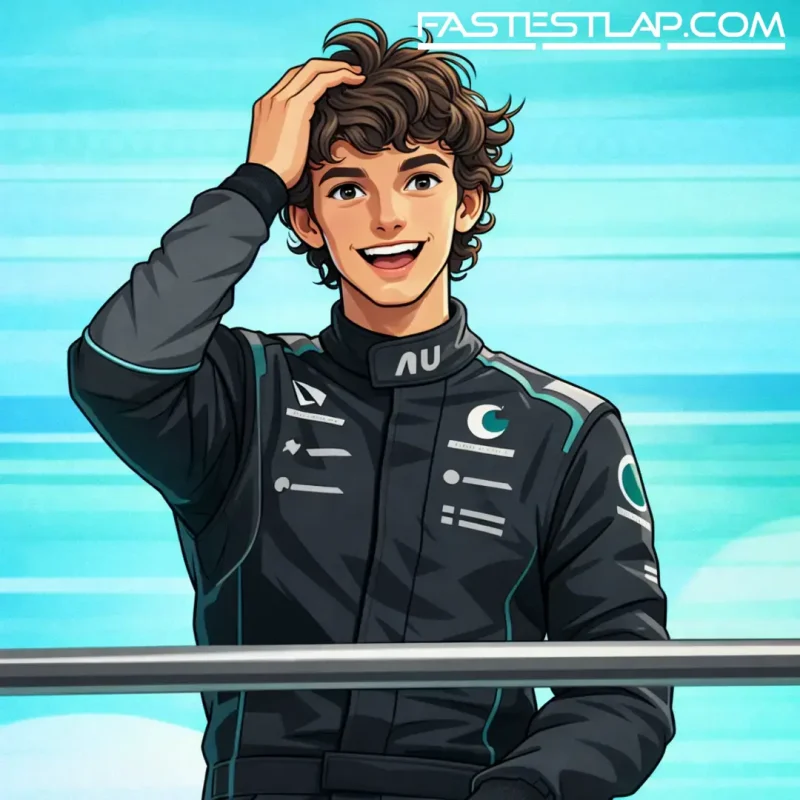
Kimi Antonelli looks like the last person in the Mercedes garage willing to turn the first three rounds of 2026 into a coronation.
He arrives in the paddock as the championship leader — 72 points on the board, nine clear of George Russell — and yet the 19-year-old keeps dragging the conversation back to basics: keep improving, keep the head down, expect the field to tighten. It’s a very un-viral stance for the sport’s newest headline act, but it also tells you a lot about how Mercedes wants this season handled.
Antonelli’s start to the year has been a study in how quickly the narrative can flip. In Australia, his weekend began with a thumping FP3 crash, losing it on the kerbs during a qualifying simulation. For most rookies — or second-year drivers still finding their feet — that’s the kind of moment that triggers a long reset. Instead, he rebounded immediately and finished second behind Russell.
Then came Shanghai, where the “he’s quick” chatter turned into something sharper. Antonelli became Formula 1’s youngest pole-sitter, made a sluggish start, and still fought his way back to win the Chinese Grand Prix. Japan followed with another victory, and with it the points lead. Three weekends in, he’s also become the youngest driver ever to lead the world championship: 19 years, seven months, and four days.
If you’re Toto Wolff, it’s the sort of opening that makes you look both prophetic and slightly surprised. And Wolff, to his credit, has admitted the latter.
“When we decided to give him the seat one and a half years ago, we hoped for this trajectory,” Wolff said, reflecting on the decision to put Antonelli in the car. “With the ups and downs that you expect from a young driver aged 18 in the first year. Eventually, second year, the success would materialise, and I think this is happening.
“Now, could we have predicted two wins out of three races for Kimi? No.”
That’s the key detail. Mercedes expected growth. It didn’t expect to be managing a title lead this early, especially not after a pre-season where the conversation centred on Russell as the favourite — the established hand, in the team since 2022, the obvious reference point after last year’s internal pecking order.
Because last season matters here. In 2025, Russell had Antonelli covered: two grand prix wins and double his points. That’s not a small gap, and it framed Antonelli’s promotion as a longer-term investment rather than an instant power shift. What’s changed in 2026, by Antonelli’s own telling, is less about some magic new trait and more about being less overwhelmed by the job.
“Big step. Experience does a lot,” Antonelli said when asked about the leap. “Obviously, last year I’ve gone through a lot, and it taught me massively more than what I anticipated, and for sure it’s helping so far this year.
“Of course, there’s still a lot of work to do, but I definitely feel much more in control of the situation.”
That line — “more in control” — is doing heavy lifting. It’s also why the paddock is starting to take him seriously as more than a short-term phenomenon. Nico Rosberg, who knows exactly what it looks like when a Mercedes garage becomes a pressure cooker, called Antonelli “the ultimate underdog” while marvelling at the scale of the story.
“What an amazing story we have,” Rosberg said. “19-year-old Kimi Antonelli, the ultimate underdog, is leading this world championship three races in.
“That’s wonderful.”
Rosberg also pointed to the speed with which the fanbase has latched on — a reminder that Mercedes hasn’t just found a fast driver, it’s found an identity hook for the post-Hamilton era. That’s useful, but it’s also dangerous if it starts to write cheques the team can’t cash internally.
Eddie Irvine, never one to tiptoe around the uncomfortable bit, went straight to the collision course. Antonelli, he reckons, is “a real title contender”, even if it’s too early for predictions. And when asked whether the Mercedes drivers will trip over each other as the year goes on, Irvine’s answer was blunt: “I’m 100 per cent sure of it.”
His logic is familiar to anyone who remembers the worst of Rosberg-Hamilton. When the stakes rise and the cars are close, managing a pair of title-calibre drivers becomes less about motivational quotes and more about physics and ego. Irvine’s point was that Wolff can’t simply lean on team orders if the performance is genuinely matched — and Wolff has already lived through the consequences when it goes wrong.
Antonelli, though, is refusing to play to that script. He’s been careful to frame Russell as the benchmark that will inevitably come back at him.
“I’m not thinking too much about the championship,” he insisted. “Of course it’s great, but it’s still a long way to go and need to keep raising the bar because, you know, George is very quick and for sure he’s going to be back at his usual level, and also competitors eventually they will get closer.
“I think we need to keep our head down and keep raising the bar.”
There are two ways to read that. One is the obvious one: the kid is trying to stay calm, and he’s right to do it after three races. The other is more telling for Mercedes: Antonelli is already speaking like someone who understands that the first rival he has to manage isn’t a Red car or a papaya one — it’s the other silver car.
Wolff, meanwhile, offered a neatly Mercedes-style explanation for the Japan win: speed when it mattered, a little luck, and momentum. “In Japan, he was quick when it mattered, the luck was on his side,” Wolff said, adding that those ingredients helped deliver a consecutive victory.
That’s not an attempt to diminish Antonelli; it’s a reminder that seasons don’t get won in March. But it also hints at something else: Mercedes knows it’s early, knows the competitive picture can shift, and knows that if this becomes a two-driver title fight, the hardest part won’t be building a quick car — it’ll be keeping its own situation from turning “wonderful” into combustible.
For now, Antonelli is doing his part. He’s winning races, absorbing the noise, and refusing to sound like a teenager who’s just discovered he can lead an F1 championship. That might end up being the most impressive thing about his start: not the points lead, not the records, but the sense that he’s already driving — and talking — like someone who expects the real fight to start when everyone else catches up.