Ayao Komatsu isn’t buying the early-season panic around Formula 1’s 2026 rules. Three grands prix into a brand-new technical era, the Haas team principal is urging the paddock to take a breath and let the evidence build before anyone reaches for the regulation spanners.
The conversation, though, is already well underway. Drivers have been vocal about the overall feel of the cars, while team bosses have pinpointed areas like the ability to go flat-out in qualifying as a potential pressure point. With a near 50-50 split between electrical power and the internal combustion engine now shaping everything from deployment to racecraft, the sport has started to ask an uncomfortable but inevitable question: are the rules delivering what F1 wanted?
Initial discussions between the FIA, FOM and the teams took place on 9 April, described by the governing body as “constructive dialogue on difficult topics”. Two further rounds of talks are scheduled for later in April, before the championship resumes in Miami, and it’s no secret that “small” tweaks are on the table.
Komatsu’s position is that the sport would be foolish to act as if three events provide anything like a full picture — especially when the calendar has already thrown wildly different demands at the new power units.
So far, the dataset is messy by design. Bahrain’s pre-season running is one thing; racing is another. Melbourne and Suzuka have leaned heavily into energy sensitivity, while Shanghai — in Komatsu’s view — offered a glimpse of what the 2026 concept can look like when the circuits allow the systems to breathe.
“Three different races, we saw again, three very different spectacles,” he said, and that line does a lot of work. It’s the crux of the argument against a quick-fix mindset: the variation isn’t necessarily a bug, it might be a feature — but only if the sport understands which levers it’s pulling.
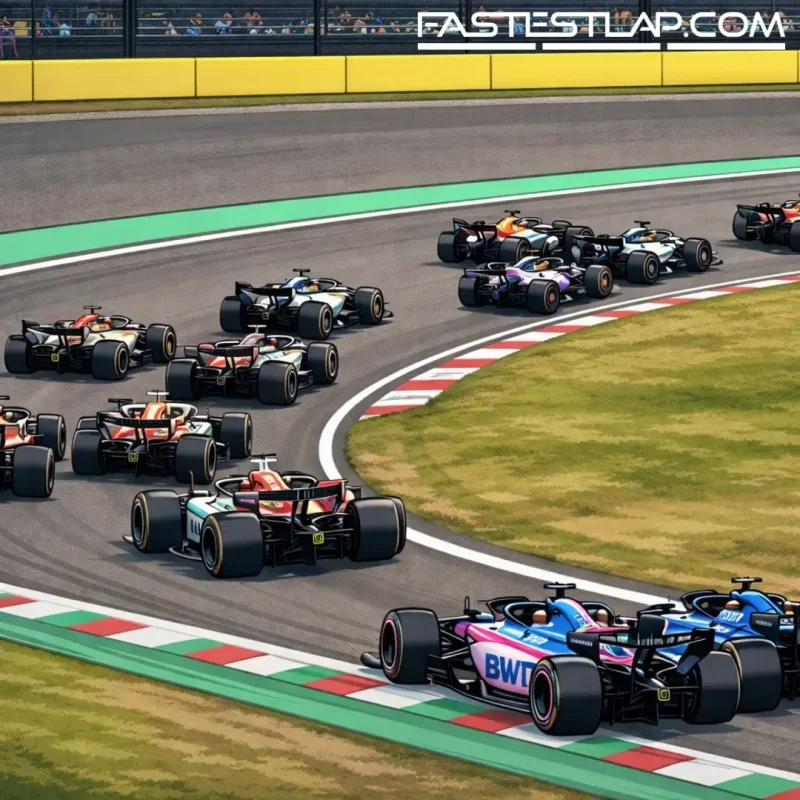
Komatsu singled out Melbourne as a race where overtaking felt too easy, China as “very, very good”, and Suzuka as a weekend where passing became “quite difficult”. That spread matters. It suggests F1 isn’t dealing with a single obvious failure mode — it’s dealing with sensitivity. And in regulations this complex, sensitivity is exactly where unintended consequences breed.
This is where the political tone of the debate becomes almost as important as the technical one. F1 has lived through too many eras where one kneejerk change leads to another, then another, until the rules are patched into something no one originally intended. Komatsu is effectively arguing for discipline: test the small changes, measure the outcome, and only then decide whether anything more aggressive is needed.
“Those small adjustments can actually make a big impact in terms of safety as well as the sporting spectacle,” he said, underlining that this isn’t just about whether the cars look good on TV. If energy management is pushing drivers into awkward behaviour — lifting in unexpected places, defending differently, committing to overtakes with less margin — it’s easy to see why the FIA is listening closely.
But Komatsu is also pushing back against the idea that the product is already broken. His read is that the Shanghai race, at least, showed the rules can produce exactly the kind of grand prix F1 wants in this new era. The danger, as he sees it, is reacting to a single “bad” weekend, then discovering five races later that the adjustment has bent the racing in a different and equally undesirable direction.
“The last thing we want is to do some kneejerk reaction based on one data sample,” Komatsu warned, pointing to the risk of triggering a cycle of constant corrections.
That’s a familiar fear inside team factories too. Even minor regulatory trims can cause major resource shifts — and 2026 is already a high-cost, high-complexity landscape with teams still discovering the edges of the new power and aero package. If the sport starts moving goalposts too early, it won’t just change the on-track show; it’ll change development priorities, the competitive order, and the rate at which some teams can recover.
Komatsu also made a pointed observation about the mood in the room: he doesn’t sense teams pushing for tweaks purely for competitive gain. In a paddock that rarely misses a chance to dress self-interest in the language of “the sport”, it’s an interesting claim — and perhaps a sign that everyone recognises how exposed they all are right now. Nobody wants to spend half a season engineering towards one interpretation of the rules only for the fundamentals to be shifted underneath them.
His broader timeline is telling, too. If there is going to be a bigger decision, Komatsu expects clarity closer to mid-season, when F1 has seen the cars across a wider range of circuits and the trendlines stop jumping around. Until then, he’s advocating incrementalism: make a few minor adjustments, study the sensitivity, then decide what — if anything — needs to be more substantial for next year.
For now, Haas’ boss is essentially asking the paddock to remember the obvious: F1 chose a radical reset for 2026, and radical resets take time to stabilise. The sport can’t pretend three races are enough to declare success — or failure. The smarter move is to keep the debate open, the changes measured, and the panic in check.