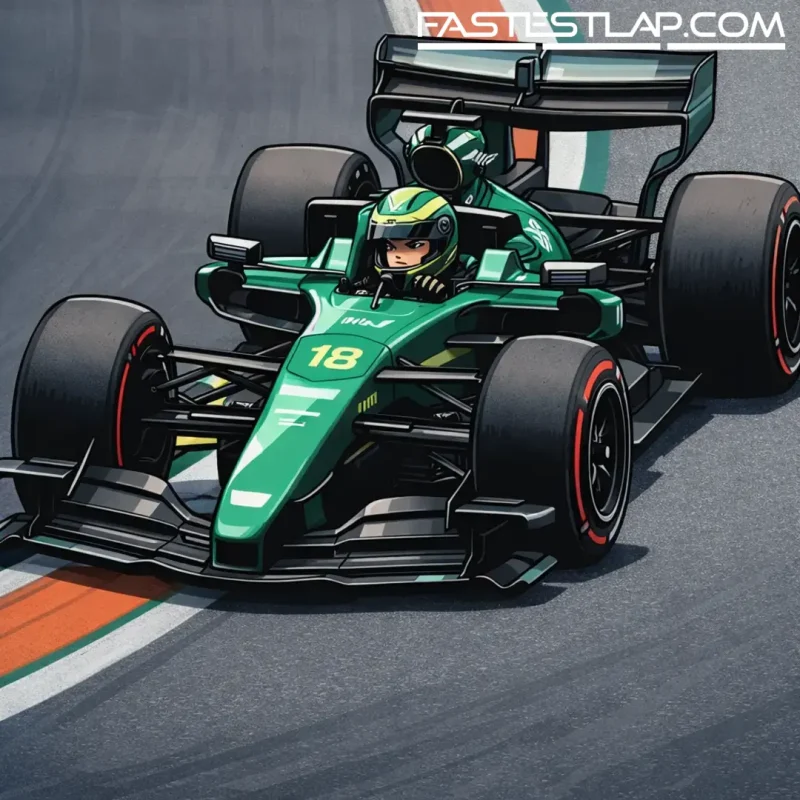
Fernando Alonso’s Canadian Grand Prix didn’t end with carbon fibre scattered across the Wall of Champions or a dramatic power unit failure. It ended with something far more mundane — and, for Aston Martin, far more damning: a seat that became unliveable.
Alonso stopped on lap 23 in Montreal, climbing out after reporting increasing discomfort from a pressure point that the team hasn’t been able to properly eliminate. It’s the kind of issue F1 teams prefer to keep quiet because it doesn’t sound like “elite motorsport”, but it’s also exactly the sort of detail that separates slick operations from organisations that are still tripping over themselves.
“Yeah, we had this seat issue where I feel more and more uncomfortable with the laps, the position doesn’t feel the right one,” Alonso said afterwards. With the AMR26 already drifting away from points contention and the race settling into a straightforward rhythm — “no threat of rain anymore,” as he put it — the decision was made to park it rather than grind through pain for nothing.
“We decided to stop the pain,” Alonso added. “We tried to modify a few things last night, didn’t work, so we’ll try to make a new one for Monaco.”
That line alone tells you how far this has dragged on. Seat comfort is never completely trivial in modern F1 — packaging is so extreme, the driving position so reclined and low that millimetres matter — but retirements because a driver can’t physically stay in the cockpit should be a once-in-a-career freak occurrence. For Alonso, it’s become a storyline.
Aston Martin’s chief trackside officer Mike Krack didn’t try to dress it up as bad luck. He admitted Alonso has been “uncomfortable for a while”, even if it hadn’t crossed the threshold into a full-blown “showstopper” until Canada.
“It’s like a pressure point, where you feel it gets worse and worse,” Krack explained. And his comments cut to a broader truth about the current generation of cars: teams have been pushing drivers further into that laid-back, feet-up posture for aerodynamic and packaging reasons, chasing the lowest possible placement within the chassis.
“You try, with these cars, to be as low as you can,” Krack said, before conceding Aston Martin may have chased that trend too aggressively. “We need to check whether we have done a step too far.”
Krack doesn’t expect Alonso needs a complete re-fit, but the language was telling — not about printing a fresh insert and moving on, but about rethinking fundamentals. “Maybe a little bit, going back to how we have been in the past,” he said.
The awkward part for Aston Martin is that the seat saga was only one strand in a weekend that exposed too many small, avoidable errors for a team that talks — publicly and privately — about becoming a front-line force.
In the other car, Lance Stroll finished 15th, second-last among the classified runners, four laps down after spending the race wrestling with tyre temperature and balance. But the more glaring moment came in qualifying, when the team sent him out with wheel covers still attached. The outer trim came off in the pitlane, and then the inner cover worked loose on the outlap.
It earned a €7,500 FIA fine — on top of an earlier €5,000 penalty for an unsafe release that put Alonso into the path of Alpine’s Franco Colapinto. None of it is catastrophic on its own. Together, it adds up to a weekend where Aston Martin looked like a team trying to run before it can walk.
Krack didn’t hide from that assessment either. Asked about the mood heading into the debrief, he was blunt: “Not so nice, as you can imagine.”
Then came the line that will sting inside the factory because it’s hard to argue with: Aston Martin needs to “get its act together” on basics. “We have done better in the past, and we will do better in the future, but we had a few glitches this weekend that we need to get better at,” Krack said, referencing not only the wheel cover mistake but also the need to start from the pit lane in the Sprint.
What makes the operational wobble more frustrating is that, by Krack’s reckoning, the team has finally started to put early-season reliability headaches behind it. The vibrations that have nagged since pre-season have eased, and Honda’s side of the project — at least in Canada — didn’t throw up a single red flag.
“On the PU side, there was not a single issue, not a single fault,” Krack said. “We have come a long way, but the performance is not where it should be.”
That performance reality was on show even in Alonso’s brief moment of optimism. Aston Martin rolled the dice by starting him on the soft tyre, and Alonso did what Alonso does: found space where others didn’t, placed the car smartly through the opening corners, and briefly ran as high as 10th.
It looked flattering, and Krack acknowledged as much. “At the beginning of the race, with a couple of good calls, you find yourself in positions where you then start to hope,” he said — before adding the cold-water reminder that in a normal race, “you normally end where you belong”.
In Canada, Aston Martin belonged in the lower midfield at best. Alonso was within a few tenths of a Haas and a Williams in Q1, and the team could at least take solace in appearing to have a small cushion over Cadillac at the back. But those are modest benchmarks for a project that wants to fight far higher up the order.
The bigger worry is that when the car isn’t quick enough to mask shortcomings, everything else becomes louder. A slightly off seat fit becomes a retirement. A procedural slip becomes an FIA fine and a headline. And a weekend that should’ve been about inching towards competitiveness turns into a post-mortem on basics.
Aston Martin can reasonably argue it’s been firefighting — first vibrations, then reliability, now performance — and that not every problem has the same root. Krack made that distinction himself. But Formula 1 doesn’t grade on a curve, and the paddock doesn’t care how many separate boxes you’re ticking if you keep dropping the toolkit on the floor.
Alonso will, as ever, move on quickly. He always does. Aston Martin can’t afford to be as casual. When your driver is climbing out mid-race because the seat hurts, you’re no longer losing time only on track — you’re losing credibility in the margins where serious teams live.