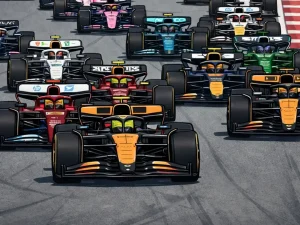
McLaren’s first proper upgrade swing of 2026 has ended up being defined by the one part it initially couldn’t make work.
The new front wing that arrived in Montreal was meant to be the keystone: a piece designed to tidy up flow conditioning across a wider operating window and, by extension, unlock the potential of everything downstream. Instead, it quickly became a red flag. With Lando Norris the best-placed McLaren but still almost 1.4s off the pace, the team did the sensible thing and parked it, reverting to the older specification.
In Barcelona, that same wing returned — but not as an act of stubbornness. It came back after a quiet round of behind-the-scenes refinement, including revised end plates, and this time it delivered. Norris converted it into McLaren’s first podium since Miami with third place, while Oscar Piastri added fifth to make it a strong double points haul that looked far more like the intended trajectory of the MCL40’s development curve.
What’s interesting isn’t simply that McLaren fixed the wing. It’s what the episode says about the state of the 2026 grid and how quickly even the sharper outfits can get tripped up by the new regulations’ sensitivity.
Andrea Stella was candid about the learning process in Spain, describing the front wing as a “project” that needed time to understand not just what it generated in pure aerodynamic terms, but how to deploy it.
“The front wing is a project that took a couple of races to understand exactly how to use it, what it was delivering,” Stella said. “We took a couple of modifications since the first time we introduced it, and these modifications were effective.
“We are happy now with the performance and the correlation of the data compared to the development tools. We used it on both cars, and we think that this has handed lap time.”
The choice of wording matters. Correlation is the tell; it’s the line teams use when they’re admitting the real fight wasn’t only on track, but in making the numbers in the tunnel, the simulations and the real world agree. When they don’t, the part becomes a lottery ticket — and nobody races a lottery ticket when points and momentum are on the line.
McLaren’s approach to its first significant upgrade package this season was always a little more staggered than some rivals. The team split the rollout across Miami and Montreal: Miami brought new front and rear corner structures, modified bodywork and sidepod inlets, extra cooling louvers, a new floor, bargeboards and a rear wing. Montreal then added the new front wing, intended to tie the package together by setting up the airflow for much of the rest of the car.
That’s precisely why it was so hard to ignore when it didn’t behave. A front wing isn’t a “nice-to-have” bolt-on; it defines what the car is allowed to be. If it shifts the balance, changes the way the tyre works, or compromises the platform the floor wants, the whole upgrade can feel like it’s moving in two directions at once.
Stella also suggested the Montreal problem wasn’t purely aerodynamic. There were “some other, from a mechanical point of view” aspects that needed evolution — which, in plain paddock terms, usually means the aero wasn’t wrong in isolation, but the car couldn’t consistently sit in the right window to exploit it. That’s the brutal part of these early-cycle regulations: the margins are thin, and the interaction between pieces is still being mapped.
McLaren’s recovery also came down to operational speed. Stella pointed to the responsiveness of the factory once the team realised changes were required — first for Monaco, then further tweaks in time for Spain.
“I would like to praise the effort of the team, who have been extremely responsive,” he said. “Once we saw that there were a few things that needed to be made and needed to be designed and produced, and we did it for Monaco, and then there were a few more, and we did them for Spain.
“So I would say this completes the first round of upgrades of the car.”
That framing — “first round” — is another clue. McLaren doesn’t see Barcelona as the end of a package, but as the point where the baseline becomes trustworthy enough to build on. Stella made it clear the next steps won’t necessarily arrive as big headline bundles; he expects “continuous development in the various areas of the car”.
And he isn’t pretending McLaren’s alone in this. His wider point was that, across the grid, the 2026 designs are still “immature”, with teams exploring multiple directions rather than following a converged solution. He referenced Ferrari’s pattern of bringing upgrades in Miami and again in Spain, and suggested the field is still searching — even in obvious visual areas like the floor ahead of the rear tyres, where concepts haven’t yet aligned.
In that context, McLaren’s Montreal misstep looks less like a stumble and more like an early-season reality: push development hard enough under new rules and you’re going to find edges that cut back.
The bigger question is what it means for McLaren’s year. After seven race weekends the team sits third in the constructors’ championship on 141 points, 121 behind Mercedes and 49 behind Ferrari. Norris, the reigning world champion, has 73 points and is staring at a hefty deficit to championship leader Kimi Antonelli on 156. Piastri is five points behind Norris, keeping the intra-team picture tight even as both chase a more distant target up the road.
Barcelona won’t suddenly rewrite that arithmetic. But it does restore something McLaren badly needed after Montreal: confidence that the development path is pointing forward, and that when a major part doesn’t work on Friday, it doesn’t have to be written off as a philosophical dead end by Sunday.
In 2026, that ability to retreat, refine and re-attack might be as valuable as outright pace. Convergence will come — Stella thinks it may take another year — but until it does, the teams that adapt quickest will keep stealing results while everyone else is still working out what their own upgrades are really trying to say.