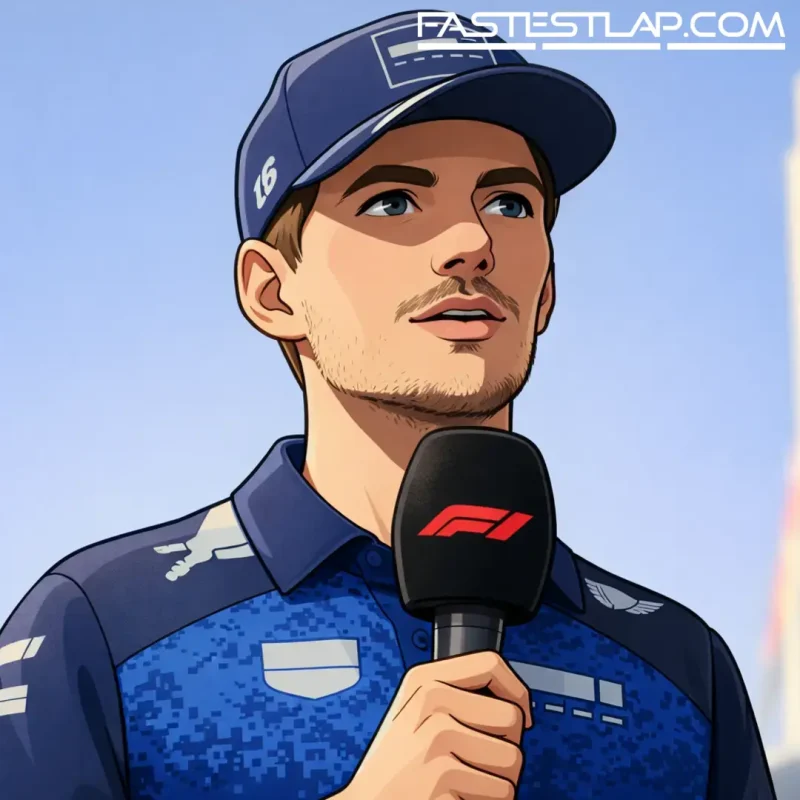
Max Verstappen has never been particularly interested in playing the role of diplomatic statesman for Formula 1, and he isn’t about to start now just because the sport has entered a regulation cycle that’s already proved politically combustible.
Asked about Juan Pablo Montoya’s recent suggestion that F1 should consider “parking” him — even floating the idea of Super Licence penalty points — Verstappen responded with the sort of bluntness you only really get from drivers who know exactly how much leverage they have.
“I don’t know what his problem is,” Verstappen said. “I can’t really be bothered with someone who talks so much rubbish.
“I just don’t understand why people like that are paid by Formula 1 management, because he sometimes works for them. Surely you don’t want someone like that in the paddock, spouting so much nonsense?
“I think it’s a case of: ‘I’ll say something different from everyone else, then I’ll be relevant’. I don’t really care; it’s his problem. I live my life and don’t let it affect me.”
It’s a striking escalation because Verstappen doesn’t merely dismiss Montoya’s opinion — he questions why F1 would give him any kind of platform. That’s the part that lands, because it drags what could’ve been a standard driver-versus-pundit spat into the more sensitive territory of who the series chooses to amplify while it tries to sell a new era.
Montoya, a seven-time grand prix winner and a regular voice around the sport, had taken issue with Verstappen’s earlier public criticism of the 2026 regulations. Speaking on the BBC’s Chequered Flag podcast, Montoya argued that while it’s fine for a driver not to like a set of rules, the way Verstappen aired his displeasure should carry consequences.
“You’ve got to respect the sport,” Montoya said. “I’m okay you not liking the regulations, but the way you were speaking about what you’re living off and your own sport, there should be consequences for that.”
Verstappen’s frustration with the 2026 direction has never been subtle. He’d labelled the racing “anti-racing” and compared it to “Mario Kart” during the earlier debate, and at one stage even suggested he was considering stepping away at the end of the season. Those comments landed at a time when F1’s stakeholders were already sensitive to how the new formula was being perceived — not just by fans, but by the drivers who will ultimately have to sell it with their credibility.
What’s changed now is the shape of Verstappen’s argument. He’s spoken positively about an agreed proposal to adjust the engine direction for 2027, specifically a shift back towards greater internal combustion engine contribution. In other words: he’s not just lobbing grenades from the outside; he’s signalling conditional buy-in — support, provided the sport follows through.
And that’s where his latest warning is more important than the insult-trading with Montoya. Verstappen has suggested that if the agreed 2027 shift doesn’t actually happen, the situation would be “mentally not doable” for him. For a driver of his stature, those aren’t throwaway words. They’re a reminder that, in a paddock where everyone is meant to align behind a long-term vision, the sport’s biggest names still expect to be heard — and they’ll measure the leadership by whether it delivers on the compromises it floats.
Montoya’s call for a suspension was always likely to irritate Verstappen, because it frames the dispute as a behavioural problem rather than a sporting one: as if the issue isn’t whether the regulations are right, but whether a driver is sufficiently loyal in public. Verstappen clearly sees it differently. In his mind, he’s doing what top drivers have always done — pushing hard on what they believe makes racing better — and he has little patience for anyone policing tone from the sidelines.
His final comment on the matter hinted at how personally he files these things away.
“Sometimes I can read people quite easily,” Verstappen said. “And someone gives you a certain feeling, good or bad.
“When I’m done with someone, I’m really done with them.”
The wider context, inevitably, is Verstappen’s own future. He is under contract with Red Bull until the end of 2028, though the existence of a performance-related exit clause has fuelled the usual paddock murmur whenever his long-term happiness becomes a talking point. For now, Verstappen “seemingly” remains set to stay — but his public line has sharpened into something more pointed than mere dissatisfaction. It’s about trust: trust that the sport will enact the changes it has discussed, and trust that it won’t try to muzzle the drivers who are honest enough to say when the product isn’t good enough.
Montoya wanted consequences for Verstappen’s words. Verstappen’s counter is simpler: if Formula 1 wants respect, it should probably start by respecting what its biggest star is actually telling it.