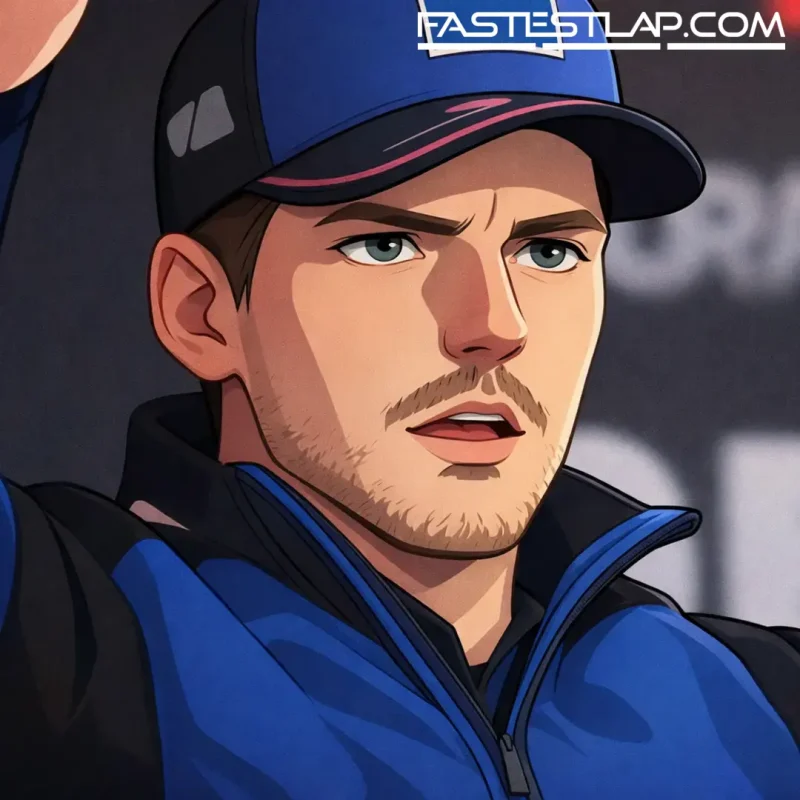
Max Verstappen’s Sunday at the Nürburgring was shaping up like one of those not-so-subtle reminders that, yes, he really can turn up anywhere and immediately look like the quickest person in the room. And then motorsport did what it always does when you start getting comfortable: it bit back.
Sharing the #3 Mercedes-AMG GT3 with Lucas Auer in the four-hour race, Verstappen had hauled the car into contention from a starting spot of fifth — Auer having delivered the kind of Top Qualifying lap that makes you wonder what he had for breakfast. Within the opening corners Verstappen was already up to fourth, and before the first half hour had elapsed he’d prised his way to the front.
The early fight was properly elbows-out. Dennis Marschall’s #45 Ferrari led initially, with Christopher Haase’s Audi R8 in the thick of it, and the front group swapping positions rather than settling into a rhythm. Verstappen moved past Thomas Preining for third, then went by Marschall for second, and spent the next phase of the stint glued to Haase’s rear wing — close enough that every minor correction looked like it might be the one that finally invited contact.
He got the lead just before the half-hour mark, but it wasn’t a clean getaway. A couple of small errors — the kind you’d barely register on an F1 timing screen but that matter when you’re trying to break a tow — kept Haase in the mirrors. Verstappen refuelled around the 50-minute mark, briefly surrendering track position, only to cycle back to the front when Haase pitted and handed over to Alexander Sims.
At that point, the race had that familiar Verstappen feel: controlled pace, clean traffic management, and the gap stretching into something approaching impolite. By the time the stint approached the planned driver change just past the 90-minute mark, he’d built a lead of 32 seconds.
Then the whole thing unravelled in the pitlane.
The Mercedes was pushed into the garage rather than turned around for Auer to rejoin, with mechanics immediately focused on the car’s nose. The team later described it as a front splitter defect, and the visuals matched the diagnosis: there was a gaping hole at the front end, the sort of damage that doesn’t just cost you lap time — it turns the car into an aerodynamic question mark.
In endurance racing, you can survive plenty if you keep moving. What you can’t survive is standing still. Ten minutes went. Then 20. Auer eventually left the pits after 28 minutes, at which point the #3 entry was effectively out of the race, down in 87th.
To Auer’s credit, he didn’t treat it like a Sunday drive to the finish. He started picking off cars as the remaining hours ticked down, dragging the Mercedes back through the order: into the 80s, then the 70s, then 50s. With an hour left he’d reached 49th, and he was running 45th with 15 minutes to go. The final classified position was 39th, 6:49.280 behind the winners.
Those winners were the Audi R8 trio of Ben Green, Haase and Sims, who converted their pace into a victory by 28.024 seconds over the Red Bull Lamborghini driven by Patric Niederhauser, Luca Engstler and Mirko Bortolotti.
The weekend, though, carried a heavier undertone than the stopwatch suggested. Sunday’s race began with a minute’s silence for Juha Miettinen, who died after a seven-car crash in Saturday’s Race 1. Verstappen, typically measured in moments like this, posted a brief message of condolence afterwards.
“Shocked by what happened today…” he wrote. “Motorsport is something we all love, but in times like this it is a reminder of how dangerous it can be. Sending my heartfelt condolences to Juha’s family and loved ones.”
For Verstappen, the Nürburgring story ends as a “what if”: a stint that looked like it belonged at the sharp end, undone by damage and a long repair. For everyone else watching, it was also a snapshot of why these races still demand respect — not just because the field is deep and the margins are cruel, but because the sport can turn in an instant from entertainment to tragedy, and back again, without asking anyone’s permission.