Red Bull has quietly rolled back one of its more eye-catching aero ideas for Spa, switching to an earlier-spec rear wing for the Belgian Grand Prix after two bruising weekends in which Max Verstappen’s RB22 repeatedly bit back.
The change follows a significant rear-wing update introduced at the team’s home race in Austria, a package that was meant to be part performance step, part adaptation to 2026’s active aero demands. Instead, it’s been at the centre of a messy run of incidents — and, crucially, a growing sense inside the paddock that Red Bull can’t afford any more “we’ll understand it by next Friday” moments with a safety-critical component.
At Spielberg, Verstappen’s weekend unravelled in dramatic fashion late in qualifying when he suffered a heavy crash. Red Bull later acknowledged that the loss of control was triggered by a rear-wing problem. Two rounds later at Silverstone, there was an ugly sense of déjà vu: Verstappen spun out of the British Grand Prix in an incident again linked to the rear wing, with the root cause described as aerodynamic disruption during the switch from straight mode to cornering mode under the new active aero system.
That transition — the moment the car sheds its low-drag configuration and asks the wing to become a downforce device again — is proving to be one of 2026’s more treacherous grey areas. When it’s clean, it’s invisible. When it’s not, drivers get a sudden, inexplicable car balance shift at exactly the point they’re committing to a corner.
Verstappen didn’t dress it up after Silverstone, calling the situation “super dangerous” as he vented frustration at suffering his second rear-wing fault in as many weekends.
“Like Austria, a different fault but the same outcome,” he said. “So again, while turning into the corner, the rear wing is not fully attaching and you lose a lot of downforce for that.
“At that point, it’s super dangerous because you can really hurt yourself two times. I was lucky in Austria, I was lucky here, but that’s why you get really fed up with it.”
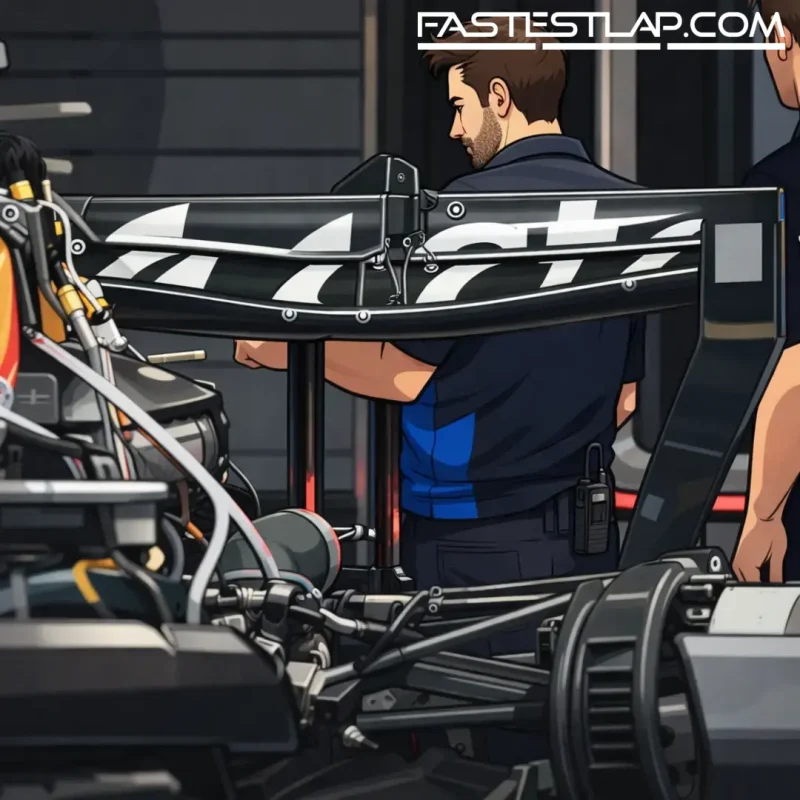
For Spa, Red Bull’s solution is as blunt as it is telling: go back. Images from the pit lane on Thursday showed the team running a previous-specification rear wing design, understood to be without the so-called ‘Macarena’ effect Red Bull has used since Miami in early May. Whether that’s a short-term confidence rebuild, a specific response to Spa’s layout, or the first sign of a deeper rethink about its active aero philosophy, the optics are clear. Red Bull has decided that the quickest way to stop the bleeding is to remove variables.
Spa is also a particularly awkward place to be conducting live development therapy. The FIA has defined five straight-mode zones for this weekend — the most since the season opener in Australia — and they’re positioned in a way that forces cars through repeated cycles of straight mode and cornering mode across one lap.
The first zone sits on the start/finish straight. The second runs down the hill from La Source towards Eau Rouge, with straight mode unavailable through Eau Rouge/Radillon itself. Drivers can then reopen the front and rear wings on the Kemmel straight towards Les Combes. A fourth zone appears on the exit of Stavelot, but straight mode must be switched off on the approach to Blanchimont. The final zone runs from the exit of Blanchimont to the Bus Stop.
In other words: plenty of opportunities for a system to prove it’s robust — and plenty of opportunities for it to bite if it’s not. One of the zones being placed on the approach to Eau Rouge only sharpens the point. Even with straight mode not active through Eau Rouge/Radillon, the lead-in is no place for uncertainty about what the rear end is doing.
From a competitive standpoint, reverting to an older wing doesn’t automatically mean Red Bull is taking a performance hit. Sometimes the “upgrade” is only an upgrade when it works in a narrow operating window, and Spa tends to punish anything that’s on the edge with its long, loaded corners and the need for a stable platform through high-speed direction changes.
But it does underline something that’s been simmering since active aero arrived: the lap time is one thing, the behaviour is another. A car that’s theoretically faster but intermittently unpredictable isn’t just a points liability — it’s the sort of problem that forces a team to stop thinking about optimisation and start thinking about risk management.
For Verstappen, it’s also about trust. Drivers can live with understeer, they can even live with a lack of straight-line efficiency if they know what they’re dealing with. What they can’t live with is a rear wing that occasionally doesn’t “fully attach” as they turn in, because there’s no driving around a sudden absence of rear downforce at the wrong moment. If Red Bull wants its lead driver to attack Spa the way Spa demands, this is the kind of back-to-basics call that makes sense — even if it’s a little embarrassing to admit the latest idea isn’t ready for prime time.
Now the question is whether this is a one-weekend retreat, or the first step in a longer recalibration of Red Bull’s 2026 aero concept. Spa will provide plenty of data either way. It will also provide the one thing Verstappen has been asking for since Silverstone: a rear wing he doesn’t have to think about.