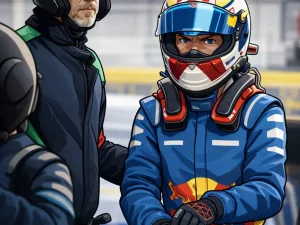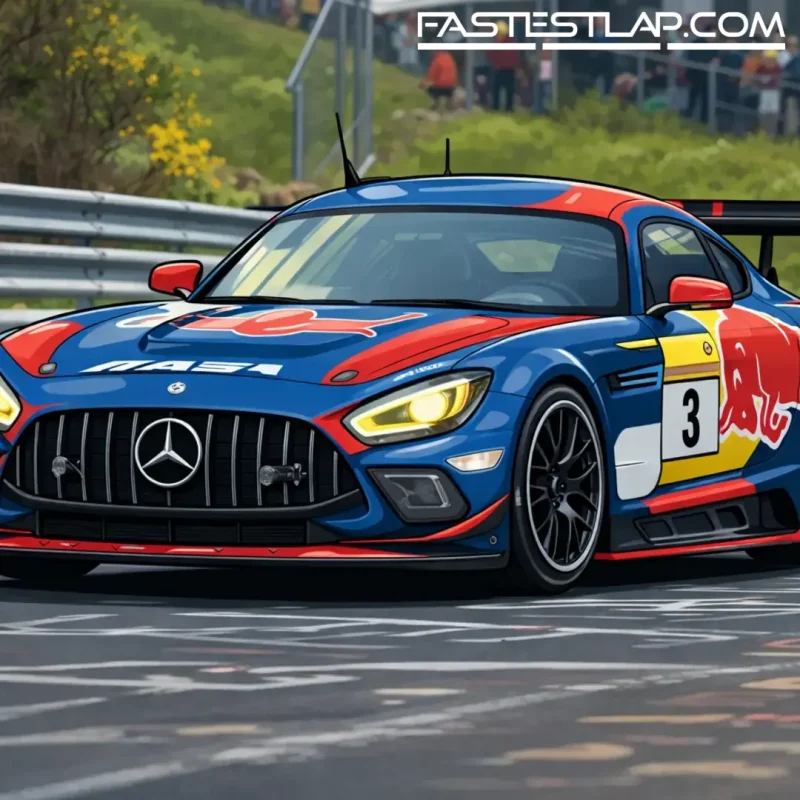
Verstappen Racing had the Nürburgring 24 Hours in its hands — and then the car started talking back.
With just over three hours left on the clock, the #3 Mercedes-AMG GT3 had built a position of control, the sort endurance teams crave late in the race: clean air, pace in hand, and a driver rotation that looked set to bring it home. Max Verstappen had done his part by stretching the lead before handing the car to Daniel Juncadella. From there, it should’ve been about managing risk.
Instead, within a couple of laps, Juncadella reported the kind of warning signs that make even seasoned 24-hour operators go quiet on the radio. First came an ABS warning. It wasn’t immediately catastrophic — the sort of thing you can sometimes nurse if the balance is stable and the grip’s predictable — and Juncadella felt he could manage it.
But then came the noises and vibrations. The bad kind. The kind that tells you something mechanical is no longer simply “not quite right” but actively failing.
Mercedes-AMG’s head of customer racing Stefan Wendel confirmed the sequence afterwards: the ABS warning appeared first, then the car’s behaviour deteriorated rapidly enough that Juncadella had no choice but to peel off for an unscheduled stop after just two laps. When the #3 rolled into the pitlane, it was already clear this wasn’t going to be a quick reset and release.
The car was pushed back into the garage, the rear-right wheel came off, and the crew began the sort of frantic-but-methodical stripdown that endurance racing forces teams to rehearse. Juncadella initially stayed strapped in — that familiar limbo where everyone still wants to believe it’ll be five minutes, maybe ten, and the race can be salvaged on sheer pace. As the minutes dragged and the order tumbled away, the reality set in. He eventually climbed out.
What Mercedes found explains why the situation escalated so quickly. Wendel said the culprit was drive shaft damage — a failure that doesn’t just rob you of propulsion but can trigger secondary problems as it lets vibration and load spike through surrounding components.
“We’d received an ABS warning, but Daniel Juncadella said he could manage it,” Wendel explained. “However, noises and vibrations then started, so he had to make an unscheduled pit stop after two laps.
“We then discovered damage to the drive shaft, which had caused further damage. We’re now repairing it and definitely want to get back out on track.”
In other words: the initial symptom didn’t point cleanly to the underlying issue, and by the time the car was effectively shouting, it was already too late to limit the fallout to one part.
The broader sting is how neatly it undercuts the narrative Verstappen Racing had been writing across the day. The Nordschleife has a habit of humiliating teams in precisely this way: you can do the hard stuff — the traffic management, the stint discipline, the pace control — and still get flattened by a single component that decides it’s had enough. That’s endurance racing’s cruelty, but also its credibility. There are no alibis over 24 hours; if something can break, the Nürburgring will eventually find it.
The immediate beneficiary was close to home. With the #3 delayed and dropping out of contention, the lead transferred to the #80 Mercedes, turning what looked like a likely Verstappen Racing victory into a Mercedes-internal reshuffle at the sharp end.
For Verstappen and his crew, the fix-and-return mindset is the only one that makes sense in the moment — get the car running, get laps on the board, and salvage whatever can be salvaged. But the bigger frustration will be the timing. When you’re leading with three hours to go, you’re not fighting probability anymore. You’re fighting only the clock and your own machinery.
And on this occasion, the machinery blinked first.