Adrian Newey doesn’t do subtle when he’s curious.
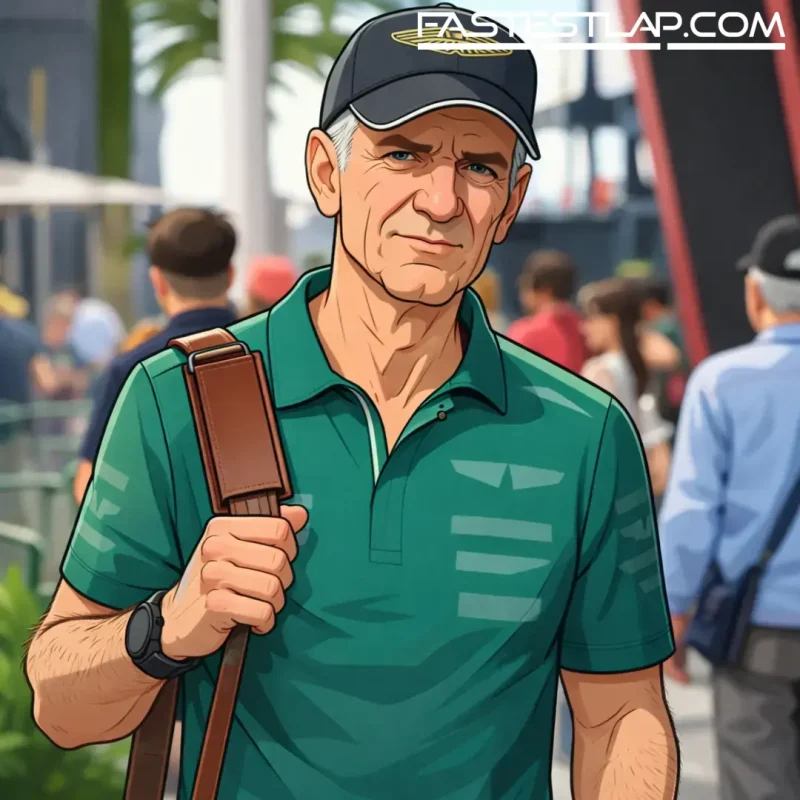
Monaco’s grid walk offered a familiar sight: Aston Martin’s team principal drifting a little wider than the usual glad-handing route, eyes fixed not on the cameras or the VIPs, but on the cars. A quick look at McLaren in the morning became a longer linger by Pierre Gasly’s Alpine A526 ahead of lights out — the sort of unhurried inspection that’s made Newey a paddock character for decades. If you’re in the business of finding performance, you don’t waste a chance to stand a metre away from someone else’s answers.
It was also Newey’s first proper trackside stint since the season-opener in Australia, and the timing was hard to miss. Aston Martin finally opened its 2026 points account in Monte Carlo, Fernando Alonso classified 10th after Sergio Perez’s Cadillac was penalised post-race. One point won’t change anyone’s season, but for a team that’s started a new technical partnership with Honda, it was at least a small validation that the basics are moving in the right direction.
Newey has never been the type to watch his own car circulate and call it a day. When he’s on-site, he uses the paddock like a moving laboratory — especially in the era of increasingly convergent concepts, where the differences are often in the details you can’t appreciate on TV. Grid time is uniquely valuable: cars are unhurried, bodywork is close, teams are less able to shield every angle, and you can pick out execution quality as much as design philosophy.
That’s why the sight of Newey studying the Alpine mattered, even if it was hardly a clandestine operation. He’d already been seen giving McLaren’s pair — Lando Norris and Oscar Piastri — the once-over on the grid. Alpine became the next stop.
And Alpine, right now, are the sort of team you’d pay attention to.
Gasly’s Monaco was dramatic even by principality standards. He climbed from ninth on the grid to third on the road at the chequered flag, only to be dragged back by two separate five-second penalties for pit-lane speeding — a brutal kind of punishment around a circuit where track position is currency and any time loss is disproportionately expensive. He ended up seventh in the final classification.
The penalties weren’t an Alpine-only story, either. Monaco produced an unusually high number of pit-lane speed infringements, and Alpine responded by filing a Right of Review request with the FIA after the race.
The bigger picture, though, is that the A526 has become a consistently point-scoring tool — and that’s the part that will set rival minds turning far more than one messy Sunday in Monte Carlo.
After finishing last in the constructors’ standings in 2025, Alpine’s reset over the winter has been stark. The switch from Renault power to Mercedes engines has underpinned a much cleaner start to 2026, and the car itself — the first of this cycle penned under former Ferrari and McLaren technical boss David Sanchez — has delivered points at every round so far. Gasly and Franco Colapinto have both shown it has range, with a best result of sixth: Gasly achieving that in China, Colapinto matching it in Canada.
That kind of week-in, week-out competence is exactly what draws the attention of the sport’s great engineers. Monaco can exaggerate strengths and hide weaknesses, but you don’t score at every race by accident — not in modern F1, where the midfield is decided by tiny margins and operational sharpness is as important as raw downforce.
Alpine’s also been adding to its technical firepower. Jason Somerville has joined as deputy technical director, returning to Enstone after a career that’s included stints at Williams, Formula One Management and most recently the FIA. That’s not a headline-grabbing hire in the way a superstar designer is, but those are the sorts of moves that tend to show up six months later in the quality of correlation and the speed of development decisions.
So yes, Newey peering at an Alpine on the grid might look like paddock theatre. But it’s rarely just that. Aston Martin’s early-season struggles have made 2026 a year for hard truths — about what’s working, what isn’t, and where the competitive reference points really are under the new Honda partnership. If you’re Newey, you’re not only assessing what Alpine are doing; you’re calibrating your own team’s trajectory against a squad that’s gone from last to reliably in the mix.
And perhaps that’s the real subtext of the Monaco scenes. Newey didn’t come back trackside to admire the scenery. He came back because there’s work to do — and because, as ever in Formula 1, the quickest way to learn is to look over the fence, then go back to your own garage and figure out how to do it better.