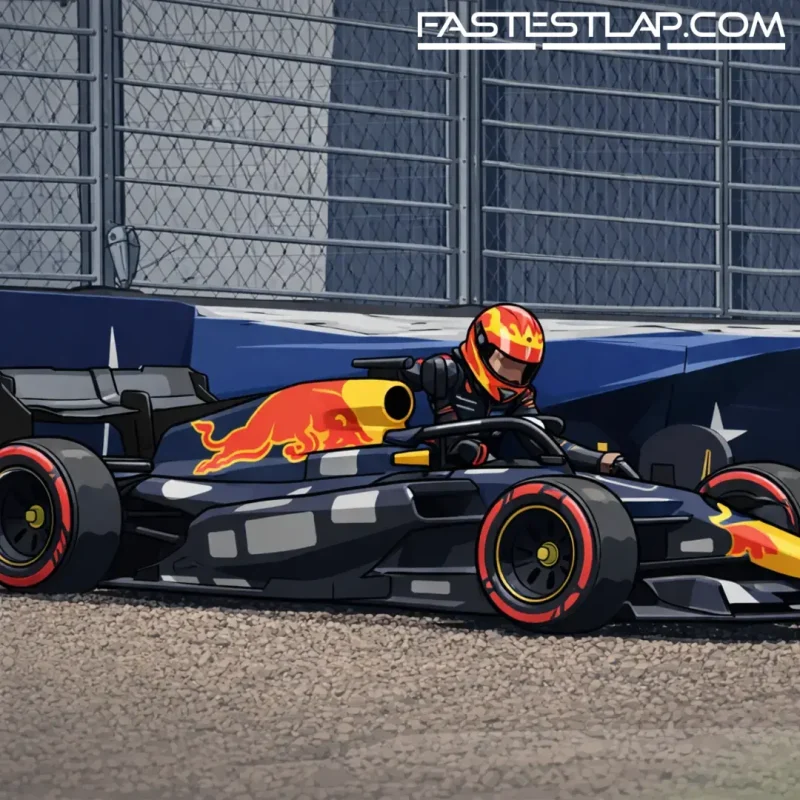
Max Verstappen’s late qualifying crash in Austria didn’t just leave Red Bull licking its wounds — it reopened one of F1’s most awkward grey areas: what, exactly, is a yellow flag supposed to mean in practice when the clock is ticking and everyone’s on the ragged edge.
Kimi Antonelli was the driver caught most visibly in the crossfire. The Mercedes rookie backed out of his final Q3 lap after seeing yellow flags approaching Turn 9, a decision that effectively locked him into fourth while team-mate George Russell pressed on, lifted, and still found enough time to snatch pole ahead of the Ferraris.
Antonelli’s frustration wasn’t aimed at Russell so much as the system that left two Mercedes drivers making two totally different calls in the same moment — and both of them arguably doing what they believed was “right”.
“Probably, I don’t know, I saw wrong, and I just saw two flags instead of one, and I aborted,” Antonelli admitted, sounding more deflated than furious. The detail that mattered was his explanation of how easily the situation can become unreadable at speed: low sun, a glimpse of a marshal post, and a split-second interpretation that changes the entire lap.
“It was hard to see because there was the sun in the face,” he said. “I looked at the marshal… and of course you don’t know if it’s a single or double, so I looked at the marshal, and it was hard to see, and I just saw double yellow instead of one, and I just aborted completely.”
That last line is the heart of the problem. The regulations can be clear on paper — single yellow: lift, be prepared to change direction; double yellow: slow down significantly, be prepared to stop; and in qualifying, that usually means “lap’s done” — but the cockpit reality is messy. Drivers aren’t choosing between two neatly labelled options; they’re reacting to shapes, colours and radio calls with a car bouncing over kerbs at qualifying speed.
In Antonelli’s view, Verstappen’s incident was exactly the kind that should trigger a more conservative response. Verstappen had hit the wall in a fast corner. Even if the car ended up well off the racing line, Antonelli argued the risk profile in that first moment demanded more than a single yellow.
“There was a car in the wall in a fast corner,” he said. “So I think, in this situation, I don’t know why it didn’t go double yellow straight away because it’s a super-quick corner, and if you go off at the same time, it can end up very badly.”
He stopped short of insisting on a red flag — and, crucially, didn’t frame it as sour grapes over Russell’s pole — but he did say the call should be reviewed, especially for high-speed sections where a driver arriving at a compromised corner has the least margin for a surprise.
“I think double yellows would have been enough, because you just need to abort the lap,” Antonelli said. “But for sure it is something that needs to be reviewed. Especially when it happens in a high-speed corner. If it’s a slow speed, still single yellow can be okay, but fast corner, it should be double yellow straightaway.”
Russell, for his part, was always going to defend his lap — and he had a straightforward argument: the flag was single yellow, he lifted early, stayed in control, and the track went green again quickly. The FIA stewards considered the situation and ultimately allowed the lap to stand.
“I got that yellow flag in the single yellow in the last sector, but I did a 100-metre lift, lost a huge amount of time, and still… I don’t have the answer for sure,” Russell said, calling the lap “unbelievable” and conceding he was still trying to understand where the performance came from.
His read of the incident was also telling. He maintained he treated it like a proper caution zone, but because it was single yellow — and because visibility into Turn 9 is relatively good — he felt there was no immediate danger requiring an aborted lap.
“It is a corner where you can see quite a lot, and I did a huge lift,” he said. “As soon as I turned into the corner, I already saw the green up ahead… I didn’t see the car whatsoever, and it was only when I saw the replay afterwards, I saw it was well off into the wall.”
Pressed on whether a single yellow really was enough in retrospect — a question made sharper by Russell’s involvement in the drivers’ safety push through the GPDA — he backed the call.
“It was correct, because a double yellow is immediate danger,” Russell said. “Verstappen, the only reason he was in the wall that far away is because he attacked and lost the car. So, I think the single yellow was correct.”
So where does that leave the sport? With a decision that may be defensible in isolation, but still exposes an uncomfortable truth: qualifying yellow flags can end up as a competitive lottery if two drivers see two different things.
Antonelli insists he heard “yellow, yellow” on the radio and saw enough to convince himself it was double yellow. Russell saw a single yellow, lifted, and kept going. Both approaches are plausible. Only one gets pole.
This is why the conversation doesn’t really end with whether Russell’s lap should’ve been deleted — the stewards have ruled, and the lap stands. The bigger issue is whether the signalling and escalation process is consistent enough to remove ambiguity in the one session where drivers are most incentivised to interpret the minimum requirement.
Because the next time a car hits the wall at the end of a qualifying session, the debate won’t be about a tenth here or there. It’ll be about whether the drivers behind had the clearest possible warning before they arrived at the scene — and whether F1 is comfortable leaving that to a judgement call made at 300km/h, squinting into the sun.