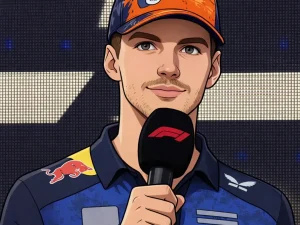
Max Verstappen doesn’t need to prove he can drive quickly. What he’s doing at the Nürburgring right now is more interesting than that: he’s deliberately trying to make himself uncomfortable.
The four-time Formula 1 world champion has been building towards a start in May’s Nürburgring 24 Hours, and he’s using the Nürburgring Langstrecken-Serie (NLS) as his classroom. In Japan recently, Verstappen made it clear the point of these GT3 outings isn’t novelty or a vanity project — it’s to get to the stage where he feels “comfortable and confident to attack” in the messiest part of endurance racing: traffic, tyre management and the procedural grind that F1 simply doesn’t replicate.
That matters because, while Verstappen’s simmering frustration with F1’s 2026 direction has been a running subplot, his actions in Germany look less like a protest and more like a plan. The Nürburgring isn’t a place you “try out” on a whim. It’s a place you prepare for properly, or it swallows you whole.
Last month, Verstappen took a significant step in that preparation by heading to the Nordschleife for an NLS round, sharing a Mercedes-AMG GT3 with Daniel Juncadella and Jules Gounon. The headline was dominant: pole position converted into a win by close to a minute. The asterisk came afterwards, when the trio were disqualified for using seven sets of tyres across qualifying and the race — one more than the permitted six.
The disqualification changes nothing about the bigger takeaway. If anything, it underlines that Verstappen’s learning curve isn’t limited to braking points and bumpier-than-expected kerbs; it’s the ecosystem of endurance racing too, where tyre allocation, stint planning and the fine print can undo an afternoon’s work.
Verstappen confirmed he’ll be back at the Nürburgring later this month for the 24-hour qualifiers — originally set to clash with the Saudi Arabian Grand Prix, before that race was cancelled. It’s another chance to stack miles, procedures and muscle memory before the main event.
When Verstappen talks about why he’s doing it, the details are telling. He’s not obsessing over lap time in isolation, but “getting the car in the right window”, choosing compounds, and being able to attack not just on a clean lap but while navigating other cars. In other words, he’s chasing repeatable performance — the kind you can deploy at 3am with fading tyres and someone else’s fight unfolding in front of you.
And then there’s the part that made him laugh at himself: pit stops.
“Doing pit stops, I felt like a rookie,” Verstappen admitted. Not because he doesn’t understand pit lane choreography — he’s lived it his whole career — but because endurance stops are social in a way F1 isn’t. You jump out, you help strap your team-mate in, you’re part driver and part crew for a minute. In a category that’s built around shared responsibility, the smallest clumsy moment can cost you time or confidence.
It’s also where Verstappen’s approach starts to look like more than a one-off cameo. He’s been driving “different kind of GT cars” over recent months, he said, and wants to get “dialled in” with the procedures and the team. That’s not a driver turning up for a photo opportunity. That’s someone laying groundwork.
What’s caught the eye inside the endurance world is how quickly he’s translating his F1 instincts into a GT3 context — not just the raw speed, but the way he deals with airflow and proximity. Christopher Haase, a long-time Audi endurance driver, came away from the NLS weekend openly impressed by Verstappen’s “precision in the dirty air”, saying he’d rarely seen anyone “tuck in and stay pinned in the wake of another car” like that.
In GT racing — especially around the Nordschleife — sitting that close isn’t just brave, it’s usually inefficient. You cook tyres, you compromise your entry, you flirt with understeer at exactly the wrong moments. Yet Verstappen was doing it anyway, and doing it with enough control that experienced eyes noticed.
Juncadella, who knows a thing or two about both simulation work and endurance reality, went further. He said Verstappen’s first proper experience of racing a GT3 in traffic on that track produced something “quite special” — a “nice trick” he’d never have considered himself. Juncadella wouldn’t reveal it, understandably, but the fact he felt it was worth keeping to himself says plenty. Endurance racing is full of small, private advantages: how you set up a pass two corners in advance, how you position the car to keep temperatures alive, how you manage your own aero loss without surrendering the line. The best drivers collect those tricks; Verstappen seems to invent them.
“It’s not so much about his driving style,” Juncadella said. “It’s the sheer confidence that he has to jump into a car you barely know, on a track that demands absolute self-confidence.”
That’s the connective tissue between Verstappen-the-F1-machine and Verstappen-the-endurance-student. The confidence has always been there. The difference now is where he’s choosing to spend it.
The Nürburgring 24 Hours won’t be won on one hero lap, and Verstappen knows that. What he’s chasing is the ability to be fast when the variables stack up: traffic, tyres, changing conditions, and the relentless repetition of doing the right thing for hour after hour. If he can add that to a skill set that already includes essentially every trick in the single-seater book, the question stops being whether he can “do” endurance racing.
It becomes whether endurance racing can keep him.