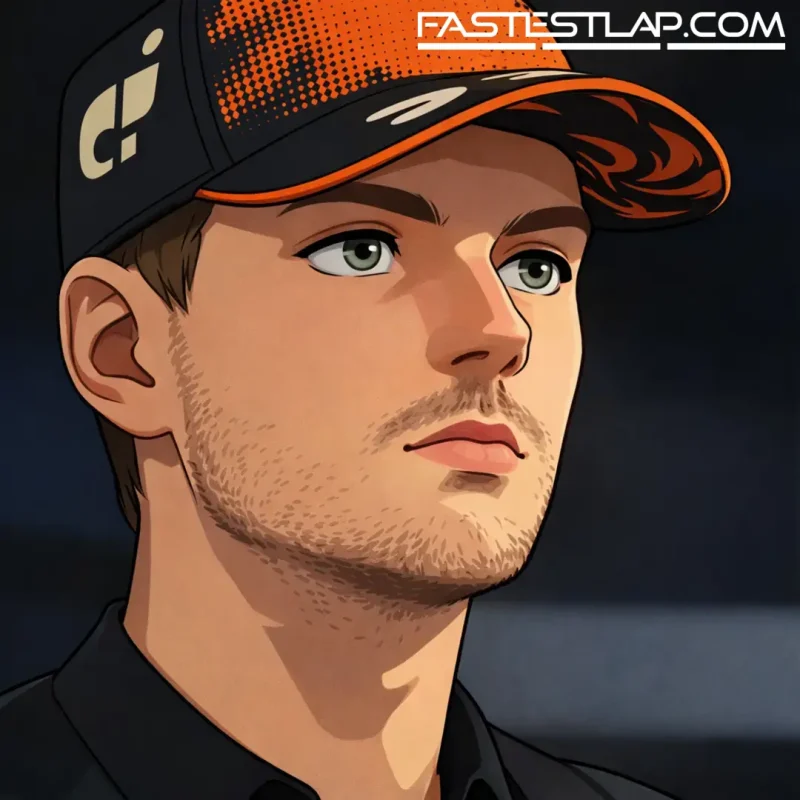
Max Verstappen didn’t need long to find something he didn’t like at Spielberg – and, more pointedly, something he wanted Red Bull’s new power unit group to look at.
Red Bull’s Friday at its home race had the familiar shape of a team still learning how to live with a first-year engine programme. Verstappen ended FP2 fourth, over half a second away from Kimi Antonelli’s pace-setting Mercedes, but the lap time was almost secondary to the way it was achieved: with the RBPT package again feeling inconsistent on the way the power arrives.
On the radio after a moment at the Turn 3 hairpin, Verstappen flagged a drop in revs that he said wasn’t just a one-off on a scruffy lap.
“Look what happened there on the apex of Turn 3 with the engine,” he told the team. “That’s what happens on the push lap as well. The drop in RPM, it’s clear.”
Turn 3 is the sort of corner that exposes any hesitation in drivability. You’re slow, you’re rotated, and you need the car to pick up cleanly and predictably. If it doesn’t, you pay twice: once in wheelspin or a delay that costs lap time, and again because the driver starts protecting against it – changing lines, being cautious with throttle, losing the crispness that makes the Red Bull work around here.
Isack Hadjar, in the other Red Bull, sounded even less diplomatic when he hit the same issue at the same spot. After catching a slide at Turn 3, his frustration came through immediately.
“You see? This is the story of Turn 3. Like, what was that? Again?” Hadjar said, before later adding: “I need the car to **** give me power, man. Because otherwise I’m going to get overtaken and then we’re in the ****.”
This is the complication for Red Bull in 2026: the RBPT-Ford project has earned plenty of paddock admiration for outright potential, and the internal combustion engine has recently topped the FIA’s ADUO (Additional Development and Upgrade Opportunities) rankings. But the season has also been littered with the kind of “small” issues that don’t always dominate headlines yet steadily erode performance – the hesitant launches, the awkward low-speed pick-up, the weekends where the driver never quite trusts the throttle map.
Verstappen’s own day started messily, with the car going into anti-stall twice early in FP1, enough for Red Bull to bring him back to the garage. Those sorts of moments are particularly telling at the Red Bull Ring, where starts and traction zones matter and where the margins are small because the lap is short. Give away a tenth in a couple of places and you’re suddenly staring at a deficit that looks ugly on paper.
And it wasn’t only the power delivery. Verstappen also complained about his seat early in FP2 and noted that the car was shaking in FP1 – another distraction on a day when Red Bull needed clean running to dial in its baseline.
All of this is unfolding against a background that, fairly or not, amplifies every on-track wobble. There are rumours that long-serving chief engineer Paul Monaghan could be on the move, with Cadillac mentioned as a potential destination and sources suggesting he could take a senior role there. If that comes to pass, it would be another significant departure in a two-year period that has already seen Adrian Newey, Jonathan Wheatley and Christian Horner leave the organisation.
Verstappen’s side of the garage also faces change further down the road, with race engineer Gianpiero Lambiase set to leave for McLaren no later than 2028. That’s not an immediate problem for this weekend, but it’s part of the broader sense that Red Bull is having to fight on more fronts than just lap time.
For now, the immediate fight is simpler: make the car predictable when the driver asks for power, especially out of slow corners where the stopwatch bleeds. The encouraging bit for Red Bull is that these are, in theory, solvable problems – calibration, control systems, integration work. The worrying bit is that the same themes keep resurfacing across the first seven race weekends, and Spielberg is exactly the kind of circuit where you can’t hide them.
Saturday will tell us whether Friday was an annoying but manageable start to the weekend, or another sign that Red Bull’s raw engine promise is still being held hostage by the details. At a track that’s supposed to feel like home turf, Verstappen already sounded like someone still waiting for his car to speak the same language as his right foot.